
Ecommerce experience examples
 Verified & Reviewed


 Copy Link
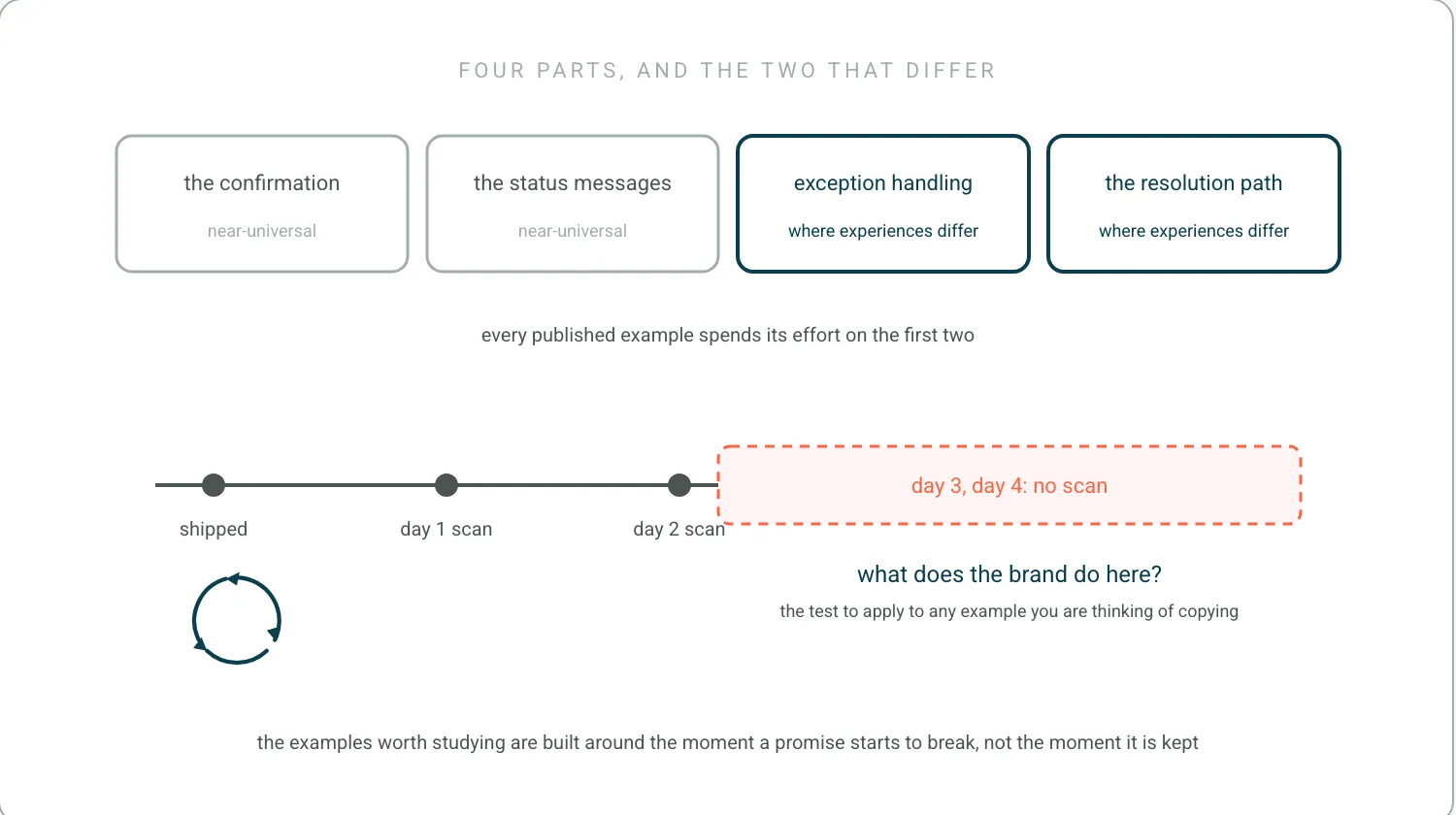
A post-purchase experience is the sequence a customer moves through between paying and being satisfied, and it is made of four things: the confirmation, the status messages, the exception handling, and the resolution path. Examples worth studying are the ones that show all four rather than only the first two, because the first two are near-universal and the last two are where experiences differ. The whole sequence sits inside the post-purchase customer journey, and the software category that packages it is a post-purchase experience platform. The test that separates a good example from a well-designed one is what it does when the order goes wrong.
Judge a tracking page on what it does when the shipment stalls
A tracking page is worth studying on four properties. Whether it is hosted on the brand's own domain, since a link to a carrier site ends the brand experience at the point of highest anxiety. Whether it states an expected delivery date rather than only the last scan, because a carrier feed reports scans rather than promises, as the USPS Track and Confirm API shows, and a scan without a date leaves the customer to interpret it. The pages that own this mechanic are order tracking software and customer order tracking. Whether it offers an action, such as changing the delivery, contacting support in context, or starting a return once delivered. And whether it stays useful when the shipment stalls, which is the property most pages fail, since a page showing a scan from four days ago with no acknowledgement that this is unusual reads as broken rather than as informative. What good looks like against a stated standard is on-time delivery.
Name what happened, say what is known, give a date, offer an action
The exception messages worth modelling share a structure. They name what happened specifically rather than apologizing generally, state what is known and what is not yet known, give a revised expectation with a date attached, and offer an action where one exists. The categories that need their own template are a carrier delay, a failed delivery attempt, a split shipment, an out-of-stock line, and a return not received. Worked versions of the first live on how to inform a customer about a delivery delay and shipping notifications, with the tooling on delivery notification software. The timing rule that governs all of them is that the message is only proactive if it arrives before the customer notices, which for a delay means the message is triggered by the expected date passing rather than by a carrier event, since a stalled parcel generates no event at all.
Every published example in this category shows the happy path, and the experience a customer actually judges you on starts when the parcel stops moving. That is the test to apply to any example you are thinking of copying: not how good the delivered-notification looks, but what the brand does on day four of a shipment that has not scanned. Every order is a promise, and the examples worth studying are the ones built around the moment a promise starts to break rather than the moment it is kept. That is the whole of proactive customer service, and I have made the same argument on Give it a Nudge. Watching the parcel closely enough to catch it is parcel software.
Keep talking after the label is issued
A returns experience worth copying resolves the common case in a few steps and without an agent, and it does two things beyond that. It presents the exchange before the refund, since an exchange retains the revenue and is often what the customer wanted, and it can only do so honestly if the replacement is reserved against live stock at that moment. The refund leg has a legal clock as well as a commercial one, set out in 16 CFR Part 435. And it keeps the customer informed after the label is issued, through the carrier scan, the receipt at the warehouse, and the refund, because the period between sending an item back and seeing the money is where the contacts concentrate. Portals that end their communication at label issue generate the enquiry they were built to remove. The capability set is self-service options and the process is returns management.
Returns deserve the attention this section gives them, and the reason is quantitative rather than aesthetic. After order-status questions, returns are the single highest-volume category of post-purchase pain in the 786 pain points we mined from 270 customer call transcripts between May 2025 and May 2026, running to 5,000 of 21,000 annual tickets at the worst-hit brands, with one brand taking 400 'how do I return this' tickets a month while a returns portal was live. That ordering is worth holding onto when choosing what to copy, because most published experience examples spend their effort on the tracking page, which is the first category, and treat returns as a policy page. The first category itself is WISMO.
Extract the mechanism, not the screenshot
Building the internal case from an example means extracting the mechanism rather than the screenshot. The useful form names the trigger, the data the trigger needs, the system that holds that data, and the contact type it removes, which turns an admired example into a scoped piece of work. The measurable claim attached to it should be the operator's own contact rate for that reason code rather than a figure from the example, since the published number belongs to a different order profile and a different carrier mix. Building that baseline is ecommerce benchmark and the measure definitions are ecommerce KPIs. A case built this way survives the question every such proposal receives, which is whether the result would transfer.
Read the sequence, not the message
Reading a message set analytically means looking at the sequence rather than at the individual message. The properties to compare are how many messages one order generates, what each one is triggered by, whether the subject line carries the state so the message is useful unopened, whether the channel matches the urgency, and what the message asks the customer to do. Two patterns recur in the sets that work. They front-load certainty, giving a date early rather than a status only, and they suppress the promotional layer while an order is in an exception state. That second one is a legal boundary as well as an editorial one, since adding an offer to a shipping update changes how the FTC's CAN-SPAM guidance treats it, and the argument in full is post-purchase marketing. Which channel each message uses is communication preferences. The most common defect in the sets that do not work is volume, where enough routine messages are sent that the exception message is the one the customer has learned to ignore. Reading a sequence as a customer rather than as a spec is the method Baymard Institute uses, and it is the only way to catch this one. The operating model behind all of it is post-purchase operations.
Frequently Asked Questions
What is an ecommerce experience?
In the sense this page uses, the sequence a customer moves through between paying and being satisfied, made of four things: the confirmation, the status messages, the exception handling, and the resolution path. Examples worth studying show all four, because the first two are near-universal and the last two are where experiences actually differ.
Can you give me some examples of ecommerce experience?
The ones that repay study are specific rather than whole brands: a tracking page that stays useful when a shipment stalls, an exception message that names what happened and gives a revised date, a returns flow that presents the exchange before the refund, and a message set that suppresses promotion while an order is in trouble. Each is worked through above.
References
- United States Postal Service. USPS Track and Confirm API. A carrier feed reporting scans, not promises.
- US Electronic Code of Federal Regulations. 16 CFR Part 435. The refund clock behind the exchange-before-refund pattern.
- US Federal Trade Commission. FTC's CAN-SPAM guidance. Why adding an offer to a shipping update changes the message.
- Baymard Institute. Baymard Institute. Reading a message sequence as a customer rather than as a spec.
Ready to Stop Reacting?
The fastest way to see how Keeyu prevents complaints is to see it in action.
In one call, we’ll map your current operations, show how our AI Agent fits in, and walk through real examples of issues fixed before customers notice.
Most teams go live within 48 hours. We never share your data.

