
WISMO: the ticket that tells you a promise broke
 Verified & Reviewed


 Copy Link
WISMO stands for "Where Is My Order?", the single most common inquiry in e-commerce support and, at most brands, 40-60% of the inbox. Here's my take after thirty years running orders: WISMO is not a support problem to answer faster. For decades teams have relied on the WISMO query as the starting point to resolve operations issues reactively, and that approach has to change - every ticket is evidence that a promise broke silently somewhere between the buy button and the doorbell. Prevention beats resolution every time, and the best brands are eliminating "Where is my order?" before it's ever asked. This topic is personal. At the start of COVID, when I was CEO at P.E. Nation, an online warehouse sale outran the sync between our storefront and the warehouse, and we took a thousand orders for stock that was gone. Tracy, my co-founder, had to double the size of her team just to call customers, run refunds, and cancel orders - and every call was the same question. Where is my order?
What WISMO actually is
Formally: the class of tickets where a customer chases the status of an order, exchange, or return (the reverse-leg sibling is WISMR, "Where Is My Return?"). My read: it's the most mislabeled line item in e-commerce, because it gets filed under "support workload" when it's really an operations defect count. I've run this at every altitude - I built Nike's Hurley brand in South Africa with my own capital, ran SurfStitch at $80 million with CX reporting directly to me as CEO, then P.E. Nation, then Papinelle. At Papinelle I walked into 110% complaint tickets to order volume - more complaints than orders - and essentially every complaint was about an order: where it was, why it hadn't shipped, why nobody had said anything. Support wasn't the problem. Unless customer service and e-commerce operations teams have the tools to predict and prevent issues between order placed, payment, fulfillment, dispatch and delivery, "where is my order" complaints are an ongoing cycle.
The automation tools that cut WISMO
The market gives you three tiers of tooling, and they do different jobs: tracking pages and notifications answer the question faster. Detection removes the reason to ask. Most brands buy the first two and wonder why the tickets keep coming.
Branded tracking pages
A tracking page on your own domain, replacing the generic carrier link. It deflects the easy half of WISMO - customers who just wanted visibility - and keeps the anxious moment inside your brand. Worth having, and Shopify's built-ins get you started. Just know what it is: a better window onto the parcel, not a hand on the parcel. A beautiful tracking page showing "in transit" for six days still generates the ticket.
Proactive notifications
Automated SMS and email that reach the customer before they ask: shipped, out for delivery, delayed with a new date. The superior version notifies about the fix, not just the status. The way we built it at Keeyu: when a warehouse falls behind, a CX team sends 100 customized emails in one click. When a style oversells, bulk-cancel, refund, and notify in one move. If we'd had that during the P.E. Nation sale, Tracy's team wouldn't have spent weeks on the phone.
Detection and resolution
The layer above both: watch every order against the promise made at checkout, catch the stuck and breaking ones, and automate the resolution - replacement shipment, proactive email, carrier claim. This is what Keeyu's platform does, and it's the only tier that shrinks the event count instead of the response time.
Inside Keeyu that layer is the whole job: you're focused on your post-purchase ops, everything from order placement to delivery. And when a customer does ask, our global search finds the order by order number, ID, tracking number, customer name, or email, and shows the status instantly, like 'awaiting collection'. The answer takes seconds instead of a tab-hopping hunt across systems.
The mechanism underneath is a traffic light on every order. Blue means it is moving to plan, amber means it is about to breach the promise you made at checkout, red means it already has, and amber is where the work belongs because that is the last moment a fix still beats the ticket. I explained the model on Add To Cart.
What WISMO costs, and how to cut it
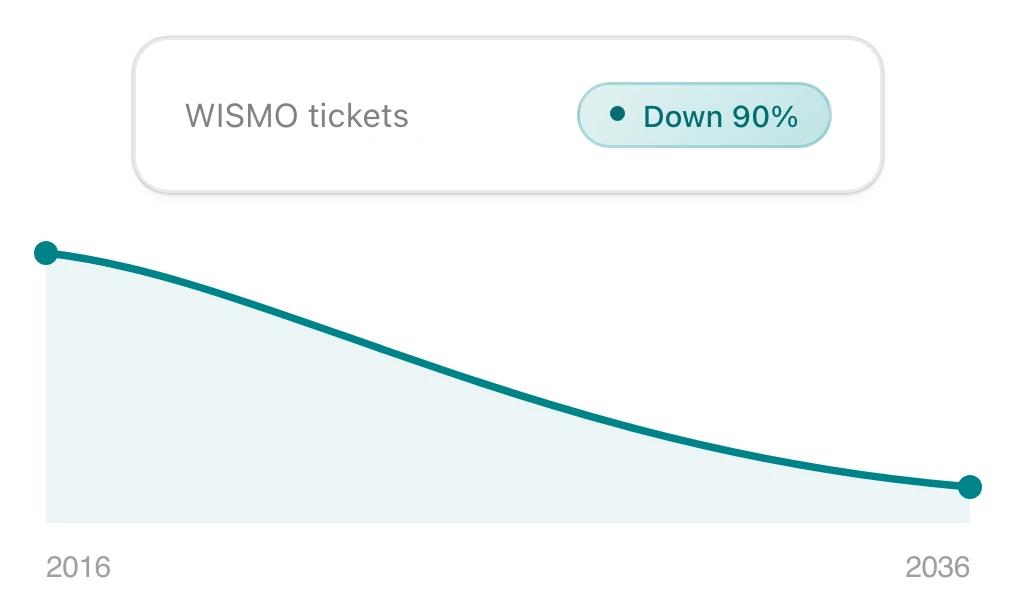
The cost formula is three numbers you already have: monthly tickets x WISMO share (40-60% for most brands) x cost per ticket (Salesforce puts it at $5-15 in agent time and overhead). A brand doing 5,000 tickets a month at a 50% share and $8 a ticket is paying $20,000 a month to answer a question its own operations created. The real diagnostic for me is WISMO percentage. If it is above 30%, there is margin hiding in those tickets, and you get it back where the order broke, not in the inbox. I watched the manual version of this up close: when I met Tracy she was working 16-hour days searching multiple systems by hand to spot and fix breaking orders. Unsustainable - so Tahir, our third co-founder, built an internal system to do the watching, and it delivered a $155k benefit. That tool is Keeyu's ancestor. Automated resolution now runs at about $1 per issue against $8-10 per handled ticket. Across our customers that compounds to up to 90% fewer WISMO tickets and 50% lower support costs. One mechanism makes it concrete: our FIFO view showed one brand 113 orders placed yesterday still unshipped, with only 11 gone out and eight partially fulfilled. That is breaking customer promise levels in plain view, and you could expect 150 inbound customer queries from it. Volume math on the pricing page.
Turn the wait into retention
The post-purchase wait is where loyalty gets decided. When we analyzed more than 100 Australian e-commerce brands, the pattern was brutal: 79% of customers will not shop again after one bad post-purchase experience. Not two strikes. One. And 60% of the reasons customers don't return happen after checkout. The outside numbers point the same way: Salesforce reports that 43% of consumers say a poor customer experience deters them from shopping with the brand again. The take I've carried for years: customer service should be a profit center, not an apology queue. That idea comes from Tracy at P.E. Nation - her goal was to make her department generate more revenue than it cost, and it sounds impossible while the team is drowning in WISMO. It becomes obvious the moment they're not: a proactive "we caught it, here's what we did" turns your worst moment into your most convincing one, and the freed team works the conversations that create revenue - exchanges instead of refunds, reorders, reviews. The brands doing this are in customer stories.
The counter worth running is not first response time. As soon as we detect an order breaking, we attach that shopper's lifetime value to it, so the team watches three numbers instead of one: lifetime value at risk, shown as a ticking amount until the issue is resolved; complaints prevented (I say complaints, not tickets, because the fix is proactive); and the lifetime value saved or protected once it is fixed. I walked through those counters on The Ecommerce Edge. Support metrics score how well you apologized. These score how much revenue never left.
Choosing the solution stack
Practical guidance: run all three tiers, but in the right order of expectation - platform built-ins for baseline visibility, a post-purchase app if you want branded tracking and notifications, and the proactive operations layer to remove the events themselves. Only the last one changes the defect count. That layer is what Keeyu is - proactive e-commerce operations, working every order backwards from the checkout promise. The proof point I always come back to: after one Black Friday I asked EHP Labs how it went, and the answer was "everything that went wrong" - peak sync failures had them flying blind with hundreds of unshipped orders, my P.E. Nation story with a different logo. They signed on the spot, and they've since cut WISMO 90% and halved manual work. Every order is a promise, and a kept promise never files a ticket. See your own broken promises live: book a demo, or start with the white paper.
Weigh the stack against the time it is really costing. By our own numbers, one in five shoppers did not get what they wanted on time in a single year and had to raise it. That was 123 million hours wasted on customer service calls, a figure I shared on Add To Cart. That's a lot of pain. To see the vendors side by side, we scored the main WISMO tools, Keeyu among them, on six published criteria in our ranking of the best WISMO reduction tools.
Related reading
- Shopify order tracking: the blind spot before the tracking number
- Proactive vs reactive customer service: the real difference
- Returns management, and the returns that were never really returns
- Package tracking app: visibility is not resolution
References
- The Ecommerce Edge E637: proactive post-purchase ops and CX (podcast)
- Salesforce: WISMO and its cost to commerce brands
- Jevon on the 123 million hours WISMO wastes (YouTube)
- The Breakout CEO #86, The Pivot This Founder Made After an Investor Called It Impossible - one in five US shoppers not getting orders on time, and the ticket ratios behind it.
- Marketing for SMEs, Jevon Le Roux on the E-Commerce Mistake Costing Millions - the orchestration layer, and the 55% ticket cut at EHP Labs.
- Add To Cart #599, How to Prevent "Where is my Order?" Complaints Before Customers Ask - preventing "where is my order" before the customer asks.
Frequently Asked Questions
What is a normal WISMO rate?
Under 20% of your inbox means unusually clean operations. Most brands sit at 40-60%. The worst I've personally walked into was Papinelle at 110% complaints to orders. Run the helpdesk query this week. It sets your baseline.
Do branded tracking pages reduce WISMO?
Yes, for the visibility half. They do nothing for stuck orders, where the angriest tickets and the churn live. For those you need detection upstream, in fulfillment and carrier operations.
What's the fastest way to start cutting WISMO?
Count today's unshipped-past-promise orders - each is a ticket in the making. That watch is the core of proactive customer service and the wider discipline of post-purchase operations . Or shortcut it: a demo shows your order book with the breaks lit up.
What is WISMR?
"Where Is My Return?" - same anatomy on the reverse leg, same fix: the return processed before the customer chases never generates the ticket.
Keep the promise.
See how Keeyu catches and fixes post-purchase issues before customers notice.
In one call, we’ll map your operations and show how Keeyu detects issues, decides what needs to happen, and takes action across your existing systems.
We’ll confirm your integration requirements and rollout plan during the demo.
