



 Copy Link
Reactive customer service responds after the customer reports a problem. Proactive customer service finds and fixes the problem before the customer experiences it. Both have a place. The mistake is running an ecommerce brand on reactive alone, because most ecommerce tickets are operational breaks that were visible in the data long before the complaint. I've seen the endpoint of running purely reactive. After P.E. Nation I went into Papinelle and found helpdesk tickets running at 110% of order volume, more tickets than orders. When we speak to companies, the healthiest sit below 10% and most float around 20%, if not 30%. And not all of those tickets were where-is-my-order: probably half of all tickets are, the rest basic product or service questions. The support team was not underperforming. They were the last line of a system with no earlier one.
The two loops, with real numbers
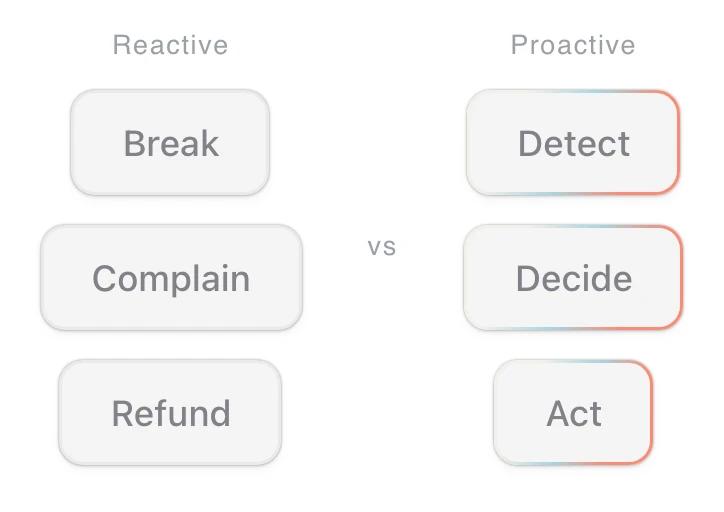
The reactive loop: break, complaint, ticket, apology
An order breaks. The customer notices, gets frustrated, writes in. A ticket is created, an agent investigates, a fix is arranged, an apology and usually a discount code go out. Elapsed time: days. Here is how I frame the cost. Monday morning, customer service logs in to find 500 "where is my order" tickets, and solving one means opening eight different systems of record: 12 minutes per ticket, 100 hours of human time every morning, explaining what the software already knows. Add the margin given away in appeasement, and a customer who trusts you a little less. Most tooling in this space makes that loop faster without making it smaller: it triages the ticket, but it still needs the customer to raise it first. Our own worst version of this was the P.E. Nation warehouse sale, where unsynced systems sold a thousand orders of stock that did not exist and we only learned about it when customers called. We hired six extra people to work the phones, refund, and cancel. That is the reactive loop at full stretch, and it is what Keeyu exists because of.
The proactive loop: detect, decide, act
An order breaks. The system detects it against the promise made at checkout, decides the fix, and acts: the replacement ships, the customer gets told first, the carrier claim is filed. Elapsed time: minutes to hours. Automated resolution runs at roughly a tenth of a handled ticket, and the full cost math is in the WISMO cost formula. Often there is no customer version of events at all.
That is the model we automate: detection and resolution of any post-purchase ops issue in real time, before the customer has to ask 'where is my order'.
Here is what the shift produced in one team: eighteen people firefighting all day became eight running operations and ten reaching out to customers, which I described on The Ecommerce Edge. Same headcount, different loop. One loop absorbs failures, the other prevents them and sells.
The difference, dimension by dimension
- Trigger: reactive starts with the customer's complaint. Proactive starts with the system's detection.
- Timing: reactive works after the damage. Proactive works inside the window between the break and the customer noticing.
- Cost shape: reactive scales with ticket volume, so more orders means more agents. Proactive scales with issue classes: solve stuck-fulfillment once and it stays solved at any volume. This is why the ROI crossover comes fast for growing brands.
- Customer effect: reactive optimizes the apology. Proactive removes the reason for one. Zendesk's benchmark data shows more than half of consumers will switch to a competitor after only one bad experience, and an apology, however fast, is still a bad experience.
- Team effect: reactive teams firefight. Proactive teams handle exceptions and spend the rest of their time on customers worth talking to.
The shift shows up in the team as well. On Add To Cart I told the story: "we were at a customer the other day and it's like hey if you didn't have Keeyu what would you do and she were like I wouldn't come to work anymore ... it's not just like customers are happy brands are happy but employees are happy too because they don't come to work firefighting anymore."
The tooling split makes it concrete. Post-purchase trackers like Narvar, AfterShip, Loop and Wonderment show you the problem; they don't fix it. Helpdesks like Zendesk and Freshdesk manage tickets, but only after a customer complains. Gorgias sits in a transitional spot, automating some of that triage. Newer reactive-AI tools like Yuma.ai and Siena AI answer tickets faster, but they're still answering, not preventing. Keeyu is proactive e-commerce operations: the category none of them are built for. We detect the break and fix it before the customer ever raises a ticket.
The scoreboard is where I see the split most plainly. Reactive teams are measured on how fast they respond to a ticket, how quickly they resolve it, and the satisfaction score: problems fixed after they happened. The team I expect next is measured on how often it engaged with a customer, as a human, around positive things happening with the brand.
I'd go further. On The Making of Me I said: "We believe a customer service team will no longer have customer service reps triaging help desk tickets. We believe there'll be one person in the company that's an agent maestro managing all of these proactive AI agents that automate the work that customer service teams used to do reactively."
What the shift actually produced
The numbers are worth being concrete about, because "proactive" is easy to say. At EHP Labs, a global supplements brand, the move cut reactive helpdesk tickets by 55%, dropped resolution time from 45 minutes to 5, saved $455,000, and produced zero churn across 18 months. What changed was which loop the operation ran in. At one of our customers the CX team went from 18 people to 8.
Notice what the cost line actually did there. It did not fall because they bought cheaper support. It fell because roughly half the reasons to contact them stopped happening. Reactive spend is priced per event, so the only way to cut it is to have fewer events. The other examples, including what happened to the teams running it, are in proactive customer service.
When reactive is still the right tool
Genuine one-offs: the customer changed their mind, the dog ate the parcel, the question no system could predict. A humane, fast reactive channel is permanent infrastructure. Waiting for complaints as a STRATEGY is what costs you, and I've put numbers on that. The goal isn't zero reactive service. It's reserving human reactivity for problems that deserve a human, instead of spending it on operational breaks a system should have caught.
There is a clean split in what the two kinds of AI can do. Reactive AI answers questions from a knowledge base and it is genuinely good at that. Proactive AI prevents the problem that would have caused the question. I drew that line on The Breakout CEO. Keep the reactive layer for the questions that are not about broken orders. It is the right tool for roughly half your queue.
The 30-60-90 shift plan
Days 1-30: measure the reactive tax
Query your helpdesk for the where-is-my-order/return/exchange share (most brands: 40-60%). Run the cost formula from the WISMO page. Count today's orders already off their promise: unshipped past cutoff, stalled in transit, stuck in returns. That number is your case for change. If it comes back looking like Papinelle's did, you don't have a support problem.
Days 31-60: start the two highest-leverage plays
Delay alerts before the customer asks, and a daily stuck-orders review with same-day fixes. Manual is fine at first. The point is proving the loop. The full tactic list is in proactive customer service.
Even run by hand, speed compounds: a global search that finds any order by order number, ID, tracking number, customer name, or email turns the daily review from a tab hunt into minutes.
Days 61-90: automate detection and resolution
The move, as we build it at Keeyu, is proactive e-commerce operations: the platform connects the systems that hold the order truth, watches every order against its promise, and automates the standard plays with your team approving the moves. By day 90 you should see the WISMO share falling and fulfillment breaks caught before they become tickets. A demo shows the detection layer running on your own order book.
We built Keeyu because we lived this firsthand: growing fast, dealing with endless complaints, always playing catch-up. Once we flipped from reactive to proactive, everything changed. Keeyu is Proactive AI built specifically for proactive customer service in e-commerce. How it compares with the other tools that claim the word is in our ranking of proactive customer service tools, where we publish every cell a rival wins.
My honest forecast: in five years the phrase "where is my order" disappears from ecommerce, because the operational break that produces it gets caught before anyone has to ask. Reactive service negotiates after the promise breaks. Every order is a promise. Keeyu keeps it.
Put the org change in the first thirty days, because it costs nothing and everything else depends on it. Customer service and e-commerce operations belong in one department, reporting to the CEO, which is the pattern I described on the Retail Fest post-purchase panel. The reason: everything that goes wrong upstream, in the warehouse, payments and the rest, becomes a ticket and customer service's problem, and a team siloed from operations only finds out when the customer reaches out. At P.E. Nation I met my CX lead at seven every morning and took what broke to the team that owned it that same day.
Related reading
- The Complete Guide to E-commerce Operations
- Order management system: what it records and what it misses
References
- Fullstory: proactive vs reactive support patterns
- Zendesk: customer service statistics - consumers switching after only one bad experience.
- The Breakout CEO #86, The Pivot This Founder Made After an Investor Called It Impossible - one in five US shoppers not getting orders on time, and the ticket ratios behind it.
- Marketing for SMEs, Jevon Le Roux on the E-Commerce Mistake Costing Millions - the orchestration layer, and the 55% ticket cut at EHP Labs.
- The 9-5 Exit Plan, How AI Is Making Customer Support Invisible - proactive AI and support that disappears.
- Keeyu Sales Deck v3 (internal) - the competitor landscape: Narvar, AfterShip, Loop and Wonderment as post-purchase trackers; Zendesk and Freshdesk as helpdesk tools; Yuma.ai and Siena AI as reactive AI; Gorgias as transitional.
Frequently Asked Questions
Is proactive customer service more expensive to run?
It's a different cost shape. Reactive cost grows with every order. Proactive cost is mostly the platform watching the orders, with automated resolutions at a fraction of ticket cost. EHP Labs ran about a 10:1 return on it. For volume math on your order count, see pricing .
Can a small team go proactive without new tools?
Partially: a daily stuck-orders report and pre-emptive emails on late shipments are proactive service run by hand. It works until volume outruns the spreadsheet. The principle matters more than the tooling to start.
Does proactive service replace the helpdesk?
No. It sits upstream and removes the tickets that shouldn't exist. Keep the helpdesk for the humans who genuinely need one, and read the wider discipline in post-purchase operations .
Keep the promise.
See how Keeyu catches and fixes post-purchase issues before customers notice.
In one call, we’ll map your operations and show how Keeyu detects issues, decides what needs to happen, and takes action across your existing systems.
We’ll confirm your integration requirements and rollout plan during the demo.
