
Order management system: what it records and what it misses
 Verified & Reviewed


 Copy Link
What an order management system is
An order management system (OMS) is the software that tracks an order from checkout through to delivery. It holds the record of what was bought, allocates stock against it, routes it to a fulfillment location, and updates its status as it moves. In a mid-market e-commerce stack it usually sits between the storefront and the warehouse, and often overlaps with an ERP.
The theory is that the OMS is the single source of truth for an order. In practice, for most brands I have worked with, it is one of several systems that each hold a partial and slightly different version of that truth.
Every order is a promise. Keeyu keeps it. The OMS records the promise. It does not usually notice when it breaks.
The gap between what the OMS says and what is actually happening
I once watched a customer service person at a retailer work with 65 browser tabs open. Storefronts, warehouses, carriers, ERP locations, all open at once so they could alt-tab between them to answer questions about orders. Every one of those systems was working correctly. The problem was that no one of them held the whole picture, and stitching them together was a human job done one order at a time.
I have been on the receiving end of it too. It once took a retailer two and a half weeks to locate an order of mine. Not to deliver it, to locate it. The order existed in their system the whole time. Nothing in that system was designed to raise its hand and say this one has been sitting still for eleven days.
The gap has a size: around eighty points of failure across the post-purchase journey, which is what we monitor and the number I gave on eCommerce Australia. An OMS records the state each system reports. The gap is everything happening between those reports, and it is where the orders actually go wrong.
Where orders actually break
The failures that generate support tickets are rarely failures of the OMS itself. They are failures in the seams between systems:
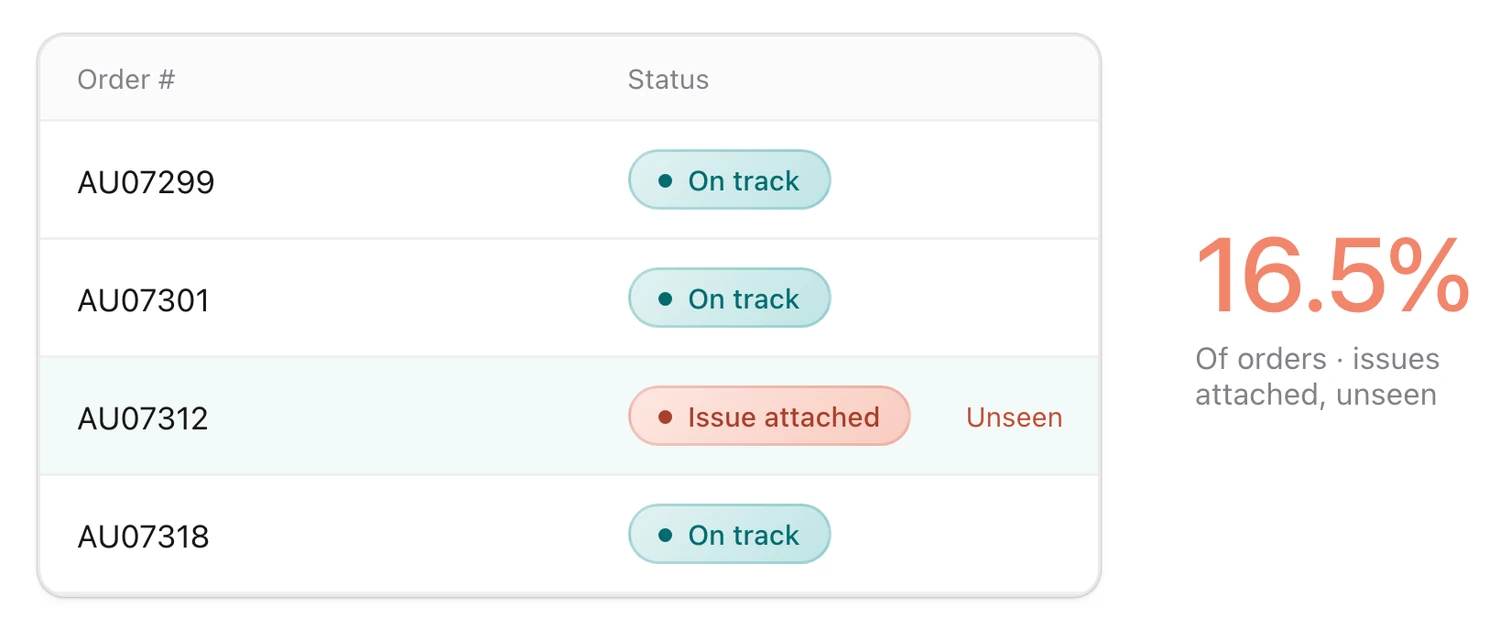
- Orders that never sync from the storefront to the warehouse and simply sit
- Stock that sells after it is gone because sync lagged during a volume spike
- Fulfillment holds that exist in the WMS but were never written back
- Shipments that stop moving at the carrier with no exception raised anywhere
At the start of COVID in 2020 our warehouse sale revenue went vertical and our Shopify store stopped syncing with the warehouse. It oversold. We ended up with a thousand orders for stock that did not exist. Every system involved was running normally. The break lived in the space between them.
Peak trade is where the seams show
During peak, retailers reliably overinvest in customer acquisition and underprepare fulfillment for the volume that acquisition creates. At P.E Nation and SurfStitch I made sure the warehouses had the staff to process what we were about to sell them, because the marketing spend was already committed and the orders were coming either way.
An OMS will happily accept ten times the normal order volume. It will not tell you that your 3PL cannot pick it, and it will not tell you which specific orders are now sitting still as a result.
The seam that shows first is the dispatch SLA. Under Black Friday volume an order that normally leaves inside twenty-four hours stretches to seven days, or the stock is not where the system believed it was, which is the failure I described on Add To Cart. The OMS keeps recording the order correctly the whole time. What changed is the promise, and nothing in the stack is watching that.
What to add on top of the OMS
The missing layer is not another system of record. It is a system of action: something watching across the store, the warehouse and the carrier that knows what an order is supposed to be doing right now and notices when it stops.
That is proactive e-commerce operations. Detect the break, decide what should happen, act on it. Detect. Decide. Act.
A worked example: our out-of-stock workflow triggers when the warehouse types 'out of stock' into NetSuite, searches other stores for inventory, finds product alternatives, checks the ERP for next shipments, and if nothing can replace the item, cancels the order and processes the refund.
At Clutch Glue, 70 Shopify orders in the US did not sync to the warehouse and went three days without shipping. We detected it in real time. At EHP Labs an out-of-stock workflow that took the team 45 minutes now runs in five, and their CX function went from 18 people to 8.
The point is not that their OMS was bad. It is that no OMS is watching for the order that quietly stopped moving.
The watching layer reaches where helpdesk AI cannot: Return to Sender, Lost in Transit, awaiting collection, out-of-stock, handled end-to-end before the helpdesk ever sees them.
See how the workflows run or book a demo.
Add the layer with write access. A system of record processes the order, a system of notification reports on it, and a system of action can cancel, replace, reorder and reship inside the systems that own it, which is the distinction I drew on The Ecommerce Edge. Your OMS is the first kind by design, and nothing about buying a better one changes that.
Related reading
For the tickets this generates, read WISMO. For the operational layer overall, see post-purchase operations. For fulfillment specifically, read fulfillment.
Frequently Asked Questions
What does an order management system do?
An OMS tracks an order from checkout to delivery: it records the purchase, allocates stock, routes fulfillment, and updates status as the order moves. It is the system of record for the promise. It rarely notices when the promise breaks.
What is the difference between a CRM and an OMS?
A CRM holds the relationship: who the customer is, what they bought, every conversation. An OMS holds the transaction: the order, the stock, the fulfillment state. Neither watches whether the current order is actually going to arrive as promised.
Which order management system is best?
The honest answer is the one that fits your channel mix and warehouse setup, then a watching layer on top. Ask any candidate: how do I find every order that has not moved in 24 hours? The demo answer to that question is worth more than the feature list.
References
- DeHoratius and Raman, Management Science, on inventory record inaccuracy: the research on inventory record inaccuracy.
- SCOR Digital Standard, RL.1.1 Perfect Order Fulfillment: perfect order fulfillment as the cross-system measure.
- Marketing for SMEs, Jevon Le Roux on the E-Commerce Mistake Costing Millions - the orchestration layer, and the 55% ticket cut at EHP Labs.
- Add To Cart #578, Stop Customer Problems Before They Start: Inside Keeyu's AI Ops - stuck returns, failed payments and orders caught mid-flight.
- The Breakout CEO #86, The Pivot This Founder Made After an Investor Called It Impossible - one in five US shoppers not getting orders on time, and the ticket ratios behind it.
Ready to Stop Reacting?
The fastest way to see how Keeyu prevents complaints is to see it in action.
In one call, we’ll map your current operations, show how our AI Agent fits in, and walk through real examples of issues fixed before customers notice.
Most teams go live within 48 hours. We never share your data.

