




 Copy Link
Every order is a promise. Post-purchase operations is everything your store does to keep it: payment processing, fulfillment, shipping, delivery, returns, and the customer communication wrapped around all of it. I built Keeyu because one in five online shoppers don't get what they want on time, as promised, and the first time most brands find out is when the shopper calls to ask where the order is. Helpdesks manage complaints. Keeyu prevents them - proactive e-commerce operations, the system of action for e-commerce. If you're searching this term at work, you want three things: less customer service workload, better retention, and operations that don't leak margin after the buy button. This hub covers all three, topic by topic.
Start here: the live guides
The deep guides, in the order I'd read them.
WISMO: the ticket that tells you a promise broke
WISMO stands for "where is my order", and Salesforce describes those inquiries as one of the highest-volume, lowest-value interactions in ecommerce and logistics. Every one of those tickets means a promise already broke and the customer found out before you did. Read the WISMO guide.
Fulfillment: where most breaks happen
Most broken promises start in fulfillment: stuck orders, split shipments, warehouse handoffs, and the 3PL decision. This guide covers how fulfillment works and when to outsource it. Read the fulfillment guide.
Proactive customer service: the playbook Download the PDF version.
Six tactics for reaching the customer before the complaint, from delay notifications to automatic remediation, and how to sequence them. Read the playbook.
Proactive vs reactive customer service
The two operating modes side by side, and a 30-60-90 plan for moving from one to the other without rebuilding your support team. Read the comparison.
The post-purchase operations guide
The narrative version of this hub: what happens to an order after checkout, where it breaks, and what good looks like. Read the guide.
What waiting for complaints costs
The cost math of the reactive model: what it actually costs to let the customer be your monitoring system. Read the breakdown.
Customer experience
The reactive tax is real: most CX cost is cleanup after operational breaks. The essentials, answered below. The full guides land on this hub as they publish.
What is CX?
CX is customer experience: the sum of every interaction a customer has with your brand, from first click to delivery and beyond. In e-commerce the post-purchase half is mostly operational, so CX after checkout is really promise-keeping. Get the order there on time, as promised, and most "experience" problems never exist.
What are customer satisfaction metrics?
The standard set is CSAT (satisfaction with an interaction), NPS (willingness to recommend), and CES (how much effort the customer spent). They are useful, but they all measure how well you fixed a problem the shopper never wanted. Brands should be measured on how well they prevent that problem from ever existing. So the number I'd watch first is how many orders broke a promise this week, because that is the metric the others follow.
What are customer retention strategies?
Retention strategies are everything a brand does to win the second order: loyalty programs, win-back flows, subscriptions, and service quality. The cheapest one is rarely named: keep the first promise. Sifted's 2025 consumer survey found that nearly half of consumers stop buying from a brand after a poor delivery or packaging experience.
What is a CSAT score?
CSAT is the percentage of customers who rate an interaction positively, usually on a 1-5 scale after a support conversation or delivery. It is easy to game and easy to misread: a great CSAT on WISMO tickets just means you apologized well for a promise that should not have broken.
What is customer experience automation?
Customer experience automation uses software to trigger the right customer touch automatically: order updates, delay notices, review requests, replacements. The distinction that matters is whether it automates the reply or the fix. Automating apologies scales apologies. Automating the fix removes the reason to apologize.
What is retail customer engagement?
Retail customer engagement is how a brand keeps customers interacting between purchases: email, SMS, loyalty, community. Post-purchase is the most under-used engagement window: the customer is checking your tracking page daily, which makes it the one moment they actually want to hear from you.
Support & helpdesk
Half your tickets shouldn't exist. What helpdesks do, what they can't do, and what support costs when operations create the queue.
What is a helpdesk?
A helpdesk is the software layer that receives, routes, and resolves customer messages across email, chat, and social. Every e-commerce brand needs one. But a helpdesk manages complaints the way an emergency room manages heart attacks: essential, and structurally unable to prevent the thing it treats.
What is customer service automation?
Customer service automation handles routine support work with software: auto-replies, routing, macros, chatbots, and increasingly AI agents. It cuts cost per ticket. The bigger lever is cutting tickets per order, which means fixing the operational breaks that generate the queue in the first place.
What is a support ticket?
A support ticket is one tracked customer issue inside a helpdesk. In most e-commerce brands I look at, "where is my order" balloons to 50 to 60% of ticket volume, and every one of those questions is about an order that already broke. Those are not service problems. They are operations problems arriving through the service door.
What is helpdesk automation?
Helpdesk automation is the workflow layer inside your support tool: rules that tag, route, prioritize, and auto-answer tickets. It makes the queue cheaper to run. It does not make the queue smaller, because the queue is created upstream, in fulfillment and shipping.
What are customer service metrics?
The classics are first response time, resolution time, CSAT, and cost per ticket. They measure how well you handle contact volume. Add one more: contacts per hundred orders. It is the only number in the set that improves when your operations improve rather than when your agents get faster.
What is service desk automation?
Service desk automation is the same idea as helpdesk automation, usually said by teams coming from ITSM tooling: automated intake, categorization, and resolution of internal or customer requests. In e-commerce the highest-value version acts on the order systems themselves, not just the conversation.
Order management
One in five orders breaks. The systems that hold order truth, and seeing the break before the customer does.
Seeing the break starts with three trackers we build for every brand: a first-in-first-out tracker for orders, a delivery tracker, and a returns tracker.
What is an order management system?
An order management system (OMS) is the software that tracks every order from checkout to delivery and returns, across sales channels, warehouses, and carriers. It is a system of record: designed to do a specific task, and it does that task well, but it is not designed to surface broken service levels. What most stacks still lack is the system of action. That is what we build at Keeyu: we stitch those systems together, check every order against the customer promise, and flag and resolve the one that has stopped moving.
What is order management software?
Order management software is the buying-search version of the same category: tools that centralize orders, inventory, and fulfillment status. When evaluating, ask one question early: when an order gets stuck, does the tool tell you, or does it wait for you to look?
What is ecommerce automation?
E-commerce automation is using software to run store operations that were manual: inventory syncs, order routing, tagging, notifications, reporting. Done well it removes swivel-chair work between systems. The frontier is automating judgment calls, deciding what to do about a problem order, not just moving data.
What does OMS mean in e-commerce?
OMS stands for order management system. In e-commerce it usually means the hub that takes orders from every channel (site, marketplaces, retail) and orchestrates fulfillment across locations. If you run one store and one warehouse, your platform may be enough. Complexity is what makes an OMS earn its keep.
What is omnichannel order management?
Omnichannel order management coordinates orders and inventory across every place you sell and every place you ship from, so a store shelf can serve a web order and a marketplace sale draws the same stock pool. More channels means more handoffs, and every handoff is a place a promise can break.
How do I choose an OMS for an online store?
Start from your failure modes, not the feature list: split shipments, oversells, stuck orders, returns volume. Then check integration depth with your actual stack (storefront, 3PL, carriers, helpdesk) and what the system does when something goes wrong. Reporting on breaks is table stakes. Acting on them is the differentiator.
Root & definitional
The definitional layer: the terms the whole post-purchase conversation is built on.
What is an automated ticketing system?
An automated ticketing system converts inbound customer messages into tracked, routed, prioritized tickets without human triage. It is the plumbing of modern support. The strategic question is what share of those tickets a better operation would have prevented from existing.
What is an ecommerce application?
An e-commerce application is any software in the stack that runs an online store: the storefront platform, plus the apps layered on it for marketing, logistics, support, and operations. The average brand runs dozens. Fragmentation across them is where order problems hide.
What is order entry software?
Order entry software captures orders that don't arrive through the storefront: phone, B2B, wholesale, marketplaces without native sync. Every manually entered order is a promise made without the storefront's guardrails, which makes them disproportionately likely to break.
What is customer self-service?
Customer self-service lets customers resolve issues without contacting support: order tracking pages, returns portals, help centers, account tools. It deflects contact well. The ceiling is that self-service still makes the customer do the work. The next step is the brand fixing the issue before the customer needs the portal.
What are the key ecommerce KPIs?
The usual dashboard: conversion rate, AOV, CAC, LTV, repeat purchase rate, and on the ops side fulfillment speed, on-time delivery, and return rate. The one I push brands to add is broken-promise rate: the share of orders that miss what checkout promised. It quietly drives LTV, repeat rate, and support cost all at once.
What is churn risk?
Churn risk is the probability a customer stops buying. Models usually score it from recency and engagement. In e-commerce, one of the strongest and least-used signals is operational: a customer whose last order arrived late, broken, or wrong is a churn risk no email campaign will fix.
AI customer service
AI that acts on orders, not just answers chats. Agents, chatbots, conversational AI, and where each fits.
What is AI customer service?
AI customer service uses machine learning and language models to handle support work: answering questions, drafting replies, routing, summarizing. The current generation is very good at conversation. The gap is action: most AI support tools can tell a customer their order is stuck, but cannot unstick it.
What is conversational AI for customer service?
Conversational AI is the technology layer that lets software hold natural dialogue: understanding intent, holding context, responding in language. In support it powers chatbots and voice agents. Judge it on resolution rate, not conversation quality. A fluent agent that can't touch your order systems is a nicer FAQ.
What is generative AI for customer service?
Generative AI drafts original responses rather than picking from scripts, which makes support feel human at scale. It also inherits the same limit: generating an empathetic apology for a late order is easy. Re-routing the shipment so the apology isn't needed is the hard, valuable part.
How is AI used in customer service?
Today, mostly four ways: answering common questions, assisting human agents with drafts and summaries, routing and tagging tickets, and mining conversations for insight. The fifth use, still rare, is the one I care about: monitoring the order journey in real time across the warehouse, the ERP and the carriers, and offering a resolution before a complaint is even generated. That matters more as buying moves into AI agents. You can't wait for a customer to ask where the order is if they bought it through an agent, because they expect the agent to know.
What is AI customer experience?
AI customer experience is the broader application of AI across the customer journey: personalization, recommendations, service, and proactive communication. Post-purchase is where it pays fastest, because the data is structured (orders, shipments, scans) and the customer's question is always the same: is the promise on track?
What is an AI chatbot for customer service?
An AI chatbot answers customer questions in chat using AI rather than decision trees. For e-commerce it deflects WISMO and policy questions cheaply. Worth deploying, and worth being honest about: a chatbot still waits for the question. The key is automating the resolution of the issue before the customer even needs to ask "where is my order?"
Platforms & integrations
Keeyu stitches the whole stack: storefront, warehouse, carrier, helpdesk. The integration layer, term by term.
What is Shopify automation?
Shopify automation covers the tools that run store workflows automatically, from Shopify Flow to third-party apps: tagging orders, syncing inventory, triggering notifications. It is the entry point to running an operation that scales past founder-does-everything.
What is Shopify email automation?
Shopify email automation sends triggered messages off store events: order confirmation, shipping updates, abandoned cart, win-back. The most valuable trigger is the one most brands never wire up: the order that has stopped moving and needs a proactive heads-up before the customer notices.
What is Shopify post-purchase?
Shopify post-purchase covers everything after checkout on a Shopify store: the thank-you page, upsells, tracking, notifications, and returns. Shopify handles the transaction cleanly. Keeping the delivery promise across the warehouse, carrier, and helpdesk is where brands add their own layer.
What is a courier API?
A courier API is the programmatic interface to a shipping carrier: create labels, fetch rates, and pull tracking events. Multi-carrier APIs normalize this across dozens of carriers. Tracking webhooks from courier APIs are the raw signal a proactive operation runs on. The promise's heartbeat, if you read them in real time.
What is a post-purchase survey on Shopify?
A post-purchase survey asks customers a question right after checkout or delivery: how did you hear about us, how was the experience. Attribution surveys are popular. Experience surveys are under-used. Ask after delivery, not after checkout, because the promise hasn't been kept yet at checkout.
How Keeyu runs it: Detect. Decide. Act.
The playbook in one story
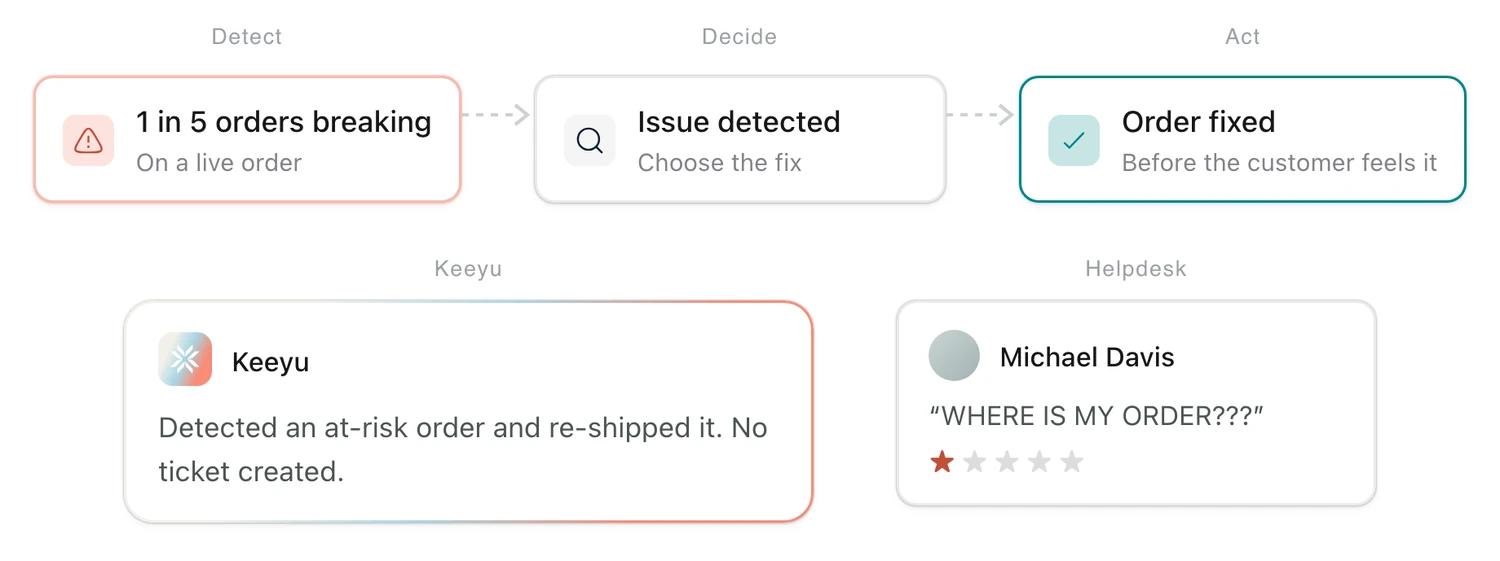
Our Detect. Decide. Act. playbook cut EHP Labs' helpdesk tickets by 55%. Detection found the breaking orders in real time, decision logic picked the fix, and the action - a replacement order, a proactive email, a carrier escalation - happened before the WISMO ticket did. My bet: "We believe the phrase 'Where is my order?' won't exist in e-commerce in 10 years, because shoppers will always get what they want, on time, as promised."
Where should a brand start?
Measure the gap: how many of your current tickets are about orders that already broke? For most brands it is half the inbox - the WISMO class. Then work upstream one issue class at a time, starting with stuck fulfillment. If you'd rather see it than read it, book a demo and watch the platform light up your own broken promises live - or start with the white paper. Every order is a promise. Keeyu keeps it.
All guides in this hub
Every live guide in the post-purchase operations cluster, in one list.
- AI customer service: answering well is not resolving
- AI customer service agent: what it is allowed to do
- AI in customer service: why inbox gains plateau
- Customer experience automation: what it actually automates
- Customer journey mapping: the branches nobody draws
- Customer retention strategies: fix the leak before the campaign
- Customer satisfaction metrics: measuring recovery, not operations
- Customer service automation: automate resolution, not just replies
- CX optimization: start from cause, not from feedback
- Automating ecommerce work: the nine jobs, and the one everyone skips
- Ecommerce automation services: what you are actually buying
- Ecommerce automation software: what it can and cannot fix
- Ecommerce customer experience, and the half that runs after checkout
- Helpdesk: why your ticket volume is an operations number
- Helpdesk automation: the ceiling and what sits above it
- Omnichannel order management: the promise nobody watches
- The order management process, and the step nobody maps
- Order management software: evaluate it on the failure path
- Order management system: what it records and what it misses
- Order management systems: what a small team actually needs
- Order management in the supply chain: who owns which handoff
- Poor customer experience, and where it actually comes from
- Post-purchase customer experience: the surface your operations show
- The post-purchase customer journey, and the stage nobody draws
- Customer experience management: what it misses after checkout
- Post-purchase operations: get every order right after checkout
- Reducing customer effort where it's actually created
- Shopify customer retention, and the cohort report's blind spot
- Shopify ecommerce automation: what it covers and where it stops
Related reading
References
Keep the promise.
See how Keeyu catches and fixes post-purchase issues before customers notice.
In one call, we’ll map your operations and show how Keeyu detects issues, decides what needs to happen, and takes action across your existing systems.
We’ll confirm your integration requirements and rollout plan during the demo.
