
Customer satisfaction metrics: measuring recovery, not operations
 Verified & Reviewed


 Copy Link
What customer satisfaction metrics measure
Customer satisfaction metrics quantify how customers feel about their experience with you. The standard set is CSAT, which asks how satisfied someone was with a specific interaction, NPS, which asks how likely they are to recommend you, and CES, which asks how much effort the interaction cost them. Support teams add operational measures like first response time and resolution time.
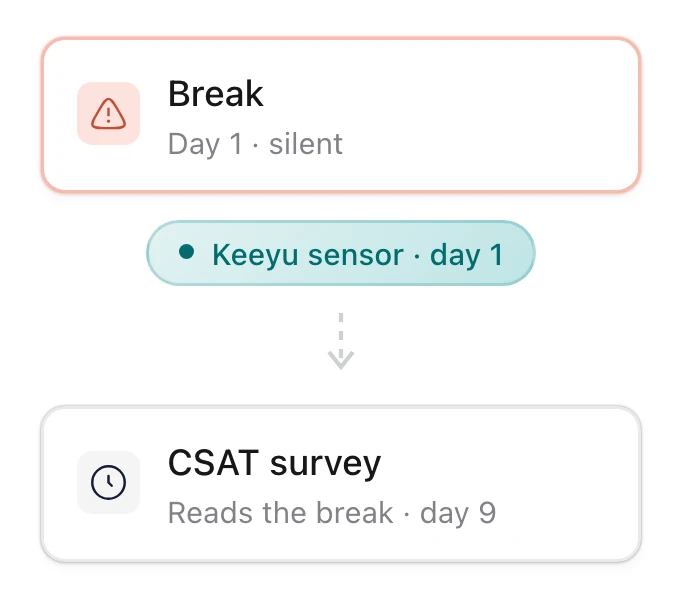
The sharpest way I can put it: CSAT measures recovery from an issue. It does not measure retention, and it cannot see the customer who never raised the issue and simply left.
They are useful and you should track them. The caution is that in e-commerce they mostly measure the quality of your recovery, not the quality of your operation.
Every order is a promise. Keeyu keeps it. Satisfaction metrics tell you how people felt about how you handled a promise you already broke.
The survivorship problem
CSAT is typically triggered by a support interaction. That means it samples customers who contacted you, and it scores the conversation rather than the underlying event.
An agent who responds in four minutes, apologizes well and refunds promptly will score highly on a ticket that exists only because an order never left the warehouse. The score says the recovery was good. It says nothing about the fact that the order failed.
Taken to the extreme, a team can improve CSAT quarter after quarter while the operation gets worse, because they are getting better at apologizing to more people.
The customers who never appear
The larger gap is the people who never contact you. Some share of customers who have a bad experience simply do not come back and never file a ticket or a survey. They are invisible to every satisfaction metric you run.
At Papinelle I found complaint tickets running at 110% of order volume, essentially all about orders. That was the visible portion. Nothing in the satisfaction reporting captured the customers who had the same experience and quietly stopped buying.
There are two populations in a broken promise and your dashboard only holds one of them. Around 70% of the shoppers who did not get what they ordered on time move to a competitor, and most of them never file the ticket that would have told you, which is the number I gave on The Ecommerce Edge. Satisfaction scores are computed on the people who complained. The expensive group is the people who did not.
The operational counters worth adding
Put these next to CSAT, because they measure the event rather than the conversation:
- Exception rate: share of orders that hit an operational break
- Customer-detected rate: share of those the customer discovered before you did
- Time to detection: how long a break sits before anything notices
- Time to resolution from the break, not from the ticket
- Unresolved returns: received but not refunded inside your promised window
Customer-detected rate is the one I would put on the wall. It is a direct measure of whether you are running proactively or reactively, and it cannot be improved by getting better at apologizing.
The arithmetic is worth doing on your own numbers. Take a brand at 100,000 orders a year with 10,000 tickets, prevent half of those, and price the recovered revenue at the average order value and repeat rate you already know, which is how I ran it on eCommerce Australia. It lands as a few points of revenue that never had to be re-acquired, and it is a counter your CFO can check.
What moves when the operation holds
At EHP Labs, proactive detection cut reactive tickets 55% and resolution time from 45 minutes to 5, alongside 116% net revenue retention and zero churn over 18 months. The satisfaction scores followed, but the causal chain ran through fewer broken orders rather than better replies.
If your CSAT is strong and your repeat purchase rate is weak, you are probably measuring recovery quality on an operation that is failing more than you think.
What moves is the number your CFO already watches. Profit, by one to one and a half percentage points where these workflows run, which I said on The Ecommerce Edge. Satisfaction scores move too, and they have never once been the reason a budget was approved.
Where this sits
This is proactive e-commerce operations: detect the break across store, warehouse and carrier, decide the remedy, act before the customer feels it. Detect. Decide. Act. The customer gets what they want, on time, as promised, and never has to rate how well you said sorry.
See how our customers run this or book a demo.
Related reading
For the experience layer, read customer experience management. For retention, see customer retention strategies. For the operational picture, read post-purchase operations.
Frequently Asked Questions
What are the best metrics to track customer satisfaction?
The standard three are CSAT for a single interaction, NPS for willingness to recommend, and CES for effort. Add the ones that count broken promises rather than conversations: break rate, time to detection, and promise-kept rate. The survey metrics measure recovery. The operational metrics measure whether recovery was needed.
What are five ways to measure customer satisfaction?
CSAT surveys after an interaction, NPS surveys on relationship health, CES on how much work the customer did, repeat purchase rate as the behavioral truth, and contacts per hundred orders as the operational signal. The last two do not rely on anyone answering a survey.
References
- Harvard Business Review, 2010: the Customer Effort Score's origin.
- American Customer Satisfaction Index, retail study 2025: satisfaction benchmarks for online retail.
- Gartner, 2024: why channel-level resolution numbers flatter the channel.
- The Breakout CEO #86, The Pivot This Founder Made After an Investor Called It Impossible - one in five US shoppers not getting orders on time, and the ticket ratios behind it.
- Marketing for SMEs, Jevon Le Roux on the E-Commerce Mistake Costing Millions - the orchestration layer, and the 55% ticket cut at EHP Labs.
- The 9-5 Exit Plan, How AI Is Making Customer Support Invisible - proactive AI and support that disappears.
Ready to Stop Reacting?
The fastest way to see how Keeyu prevents complaints is to see it in action.
In one call, we’ll map your current operations, show how our AI Agent fits in, and walk through real examples of issues fixed before customers notice.
Most teams go live within 48 hours. We never share your data.

