
Helpdesk: why your ticket volume is an operations number
 Verified & Reviewed


 Copy Link
What a helpdesk is
A helpdesk is the software your support team works out of. It collects incoming customer messages from email, chat, social and SMS into a single queue, assigns them to agents, and tracks each one until it is closed. In e-commerce the common platforms are Gorgias, Zendesk, Freshdesk and Re:amaze.
A helpdesk is very good at what it does. My argument is not that it is a bad tool, it is that most e-commerce brands are using it to absorb a problem it was never designed to solve.
Every order is a promise. Keeyu keeps it. A helpdesk is where you find out you broke one.
Why your ticket volume is an operations number, not a support number
Mal Chia of Ecom Nation names the measurement problem underneath this: brands optimize for "closing tickets" rather than "keeping customers". A template reply closes the ticket fast and does nothing for the relationship. That gap is why a helpdesk, which is a system of record, cannot do the job of a system of action. Full framework in the post-purchase operations playbook. Download the PDF version.
After P.E Nation I went into Papinelle and found an absolute mess: complaint tickets were running at 110% of order volume. More complaints than orders. And when I read them, essentially all of them were about orders. Not product questions, not sizing, not returns policy. Orders that had gone wrong somewhere between checkout and the doorstep.
That number reframed the whole function for me. The support team was not underperforming. They were absorbing the output of an operation that was failing quietly and telling nobody.
I later watched a customer service person at one retailer work with 65 browser tabs open, alt-tabbing between storefronts, warehouses, carriers and ERP locations to answer questions about orders. That is not a support problem you fix by hiring another agent or buying a better inbox.
The counter-example is one search box. Our global search finds any order by order number, ID, tracking number, customer name, or email, and shows the status instantly, like 'awaiting collection'. Sixty-five tabs become one.
The categories of ticket a helpdesk should never receive
Sort your last thousand tickets by root cause instead of by topic and you will usually find four buckets that are purely operational:
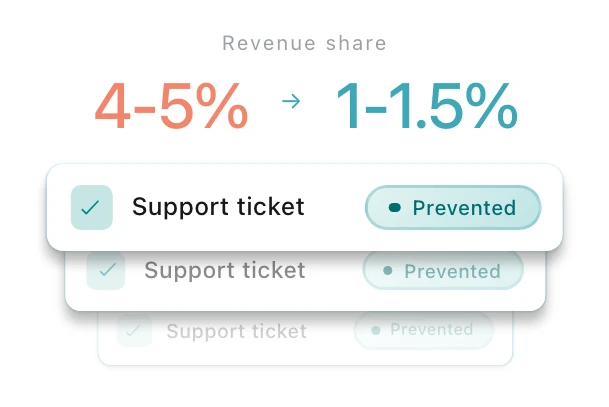
- Order status questions where nothing is actually wrong, the customer just has no visibility
- Fulfillment holds where the order never reached the warehouse or was stuck without an alert
- Oversells where stock sold that did not exist
- Shipments that are late, lost or stuck with the carrier
None of those are questions. They are notifications the customer had to come and collect themselves, because your systems knew something was wrong and never said so.
Deflection is not prevention
The standard answer to high ticket volume is deflection: a chatbot, a tracking page, a better macro. That reduces the cost of handling the conversation. It does not reduce the number of customers whose order broke.
A hospital cannot prevent a heart attack the same way a help desk cannot prevent a broken promise. Both are built to respond to an event that has already happened. Deflection just makes the response cheaper.
The alternative is proactive e-commerce operations: detect the break in the systems that hold the truth, decide what should happen, and act before the customer notices. Detect. Decide. Act.
What happens to helpdesk volume when you prevent instead of deflect
At EHP Labs we ran that playbook across their orders. Reactive helpdesk tickets fell 55%. Resolution time went from 45 minutes to 5. The CX team went from 18 people to 8, they saved $455,000, and they held zero churn for 18 months.
At Clutch Glue, 70 Shopify orders in the US failed to sync to the warehouse and sat unshipped for three days. We detected it immediately. Those 70 orders would have become 70 "where is my order" tickets over the following week, plus the refund requests and the reviews that follow a silent three-day delay.
How to think about the two tools together
You still need a helpdesk. Customers will always have real questions, and high-value conversations deserve a person. What changes is what reaches it.
Keeyu sits underneath the helpdesk as the system of action, watching the store, the warehouse and the carrier, and resolving the operational breaks that generate the repetitive queue. The helpdesk keeps the conversations that are genuinely conversations. The customer gets what they want, on time, as promised.
That layer reaches where helpdesk AI cannot: Return to Sender, Lost in Transit, awaiting collection, out-of-stock, resolved end-to-end before the helpdesk ever sees them.
See how the workflows run or book a demo against your own ticket mix.
Related reading
For the specific case of order-status tickets, read WISMO. For the wider operational layer, see post-purchase operations. For the operating-posture shift, read proactive versus reactive customer service.
Frequently Asked Questions
What does a helpdesk do?
A helpdesk collects incoming customer messages from email, chat, social and SMS into one queue, assigns them to agents, and tracks each conversation until it closes. It manages complaints well. It cannot prevent the operational breaks that cause them.
Is it helpdesk or help desk?
Both are in use. Software vendors mostly write 'helpdesk' as one word, and the traditional IT function is 'help desk' as two. They mean the same queue.
Do I still need a helpdesk if issues are fixed proactively?
Yes. Customers always have real questions, and high-value conversations deserve a person. Proactive operations sit underneath the helpdesk and remove the tickets that should never have existed, which is typically about half the queue.
References
- Gartner, 2024: resolution rates across service channels.
- US Bureau of Labor Statistics, customer service representatives: customer service representative employment and wages.
- The Breakout CEO #86, The Pivot This Founder Made After an Investor Called It Impossible - one in five US shoppers not getting orders on time, and the ticket ratios behind it.
- Marketing for SMEs, Jevon Le Roux on the E-Commerce Mistake Costing Millions - the orchestration layer, and the 55% ticket cut at EHP Labs.
- The 9-5 Exit Plan, How AI Is Making Customer Support Invisible - proactive AI and support that disappears.
Ready to Stop Reacting?
The fastest way to see how Keeyu prevents complaints is to see it in action.
In one call, we’ll map your current operations, show how our AI Agent fits in, and walk through real examples of issues fixed before customers notice.
Most teams go live within 48 hours. We never share your data.

