
Communication preferences
 Verified & Reviewed


 Copy Link
Communication preferences are the settings that record how, and about what, a customer wants to be contacted: which channels, which message types, and at what frequency. In ecommerce they matter operationally because transactional messages about an order and promotional messages about the business are governed differently, both by regulation and by customer expectation, and a preference model that fails to separate them either over-messages customers or suppresses updates they needed. The operational message set itself is shipping notifications and the tooling that sends it is delivery notification software.
Customer retention and trust
Preference handling affects retention through two mechanisms. Sending messages a customer did not want produces unsubscribes, spam complaints, and channel-level deliverability damage that then suppresses the messages they did want. Failing to send messages they expected, particularly about a delayed or failed order, produces the contact and the dissatisfaction the message would have prevented. What a good version of that message looks like is how to inform a customer about a delivery delay. The reliable position is that operational updates about an order in progress should be treated as expected by default, with preference control over channel and granularity rather than over whether the customer is told at all.
The default position in that last sentence is the one worth defending, and returns are where it is tested hardest. Proactive communication during a return matters as much as during a delivery, and brands that give a real-time status the whole way through see it in their repeat rates. The reason is not that customers enjoy notifications. It is that a return is the point at which somebody has already decided the purchase did not work, and silence during it confirms the decision. The process around it is returns management, and what the silence costs is reasons for customer churn.
Operational cost reduction
Preferences reduce cost when they route the right message to the cheapest effective channel. Email is inexpensive and carries detail. SMS costs more per message and is warranted for time-critical events such as out-for-delivery and delay notices. App push is free where an app exists but reaches only installed users. The flow layer that fires all three is ecommerce email marketing automation. A preference framework that lets customers select channel by message type, rather than opting out entirely, preserves the operational messages that deflect contact while removing the promotional volume that generates opt-outs. The measure is contacts deflected per message sent, tracked by channel and message type, and it belongs beside the rest of the set on ecommerce KPIs.
There is a version of this that costs nothing and is quietly doing damage. We assess these setups often enough now for the pattern to be familiar, across 15-plus retailers and 25 brands. On one large retailer, the tool they used for customer communication could only send bulk, depersonalized messages, with no customer name and no order number in them. So the message went out at the cheapest cost per send and told the customer almost nothing about their own order, which meant they contacted support anyway to find out whether it applied to them. That is the failure mode to watch for in any cost-per-channel calculation. A message that does not identify the order is not a cheaper message, it is a more expensive one with a lower unit price, because the customer asks where their order is anyway.
Privacy and compliance
Transactional and promotional messages sit under different rules. Marketing email is governed by consent and unsubscribe requirements that vary by jurisdiction: the US CAN-SPAM regime, EU consent rules under the General Data Protection Regulation with the UK's PECR alongside it, and separate telecoms rules for SMS, which in the US sit at 47 CFR 64.1200. Transactional messages relating to an existing order generally have more latitude, but the boundary is defined by content rather than by intent, so adding a promotional offer to a shipping notification can reclassify the message. The editorial version of that rule, suppressing promotion while an order is in trouble, is post-purchase marketing. Practical requirements are storing consent with its timestamp and source, honoring withdrawal promptly across channels, and keeping a suppression list that all sending systems respect.
Platform integration and tooling
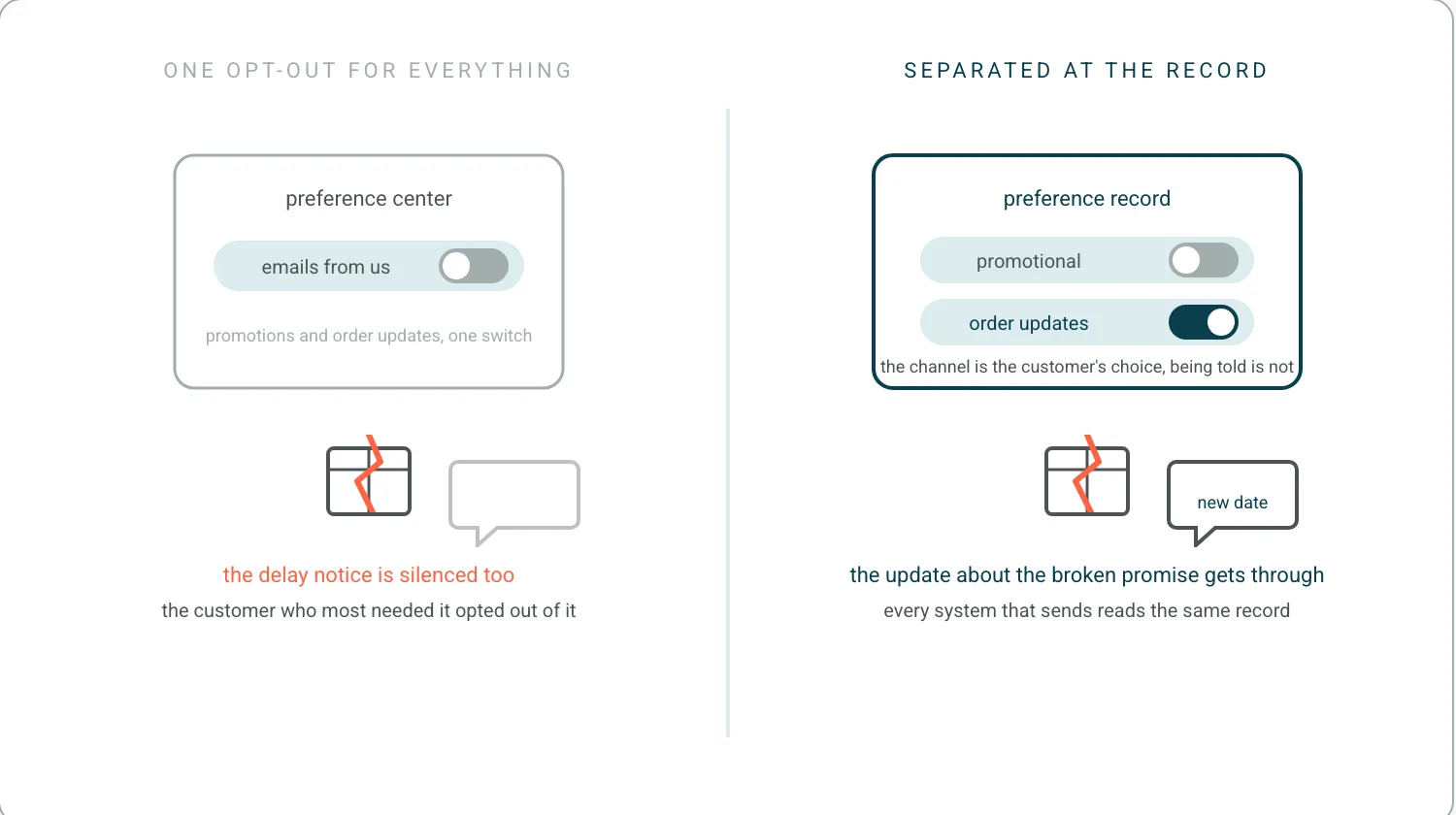
Preferences must be enforced everywhere messages originate: the ecommerce platform, the marketing tool, the helpdesk, the returns platform, and any shipping or tracking notification service. The characteristic failure is a preference recorded in one system and unknown to another, so a customer who opted out still receives messages from the shipping tool. The architectural requirement is a single preference record other systems query, rather than per-system settings, plus a test that verifies suppression end to end from each sending system. Getting several systems to agree on one record is third-party integrations work.
The single preference record is the right architecture and there is a sharper way to say why it matters. Every order is a promise, and the preference model decides who gets told when one breaks. Most preference centers are built to manage marketing volume, so the operational updates get swept into the same opt-out, and the customer who most needed to hear about their delay is the one who has already silenced it. Separate the two at the record level, not at the send level, or every system that sends will make its own judgement and one of them will get it wrong. Getting there is the operating model on post-purchase operations, and the argument for the update mattering at all is proactive customer service.
Reducing delivery friction
Preference data also includes delivery-specific choices: safe-place instructions, access notes, preferred delivery windows, and collection-point alternatives. These reduce failed deliveries directly, which is the most expensive avoidable event in the post-purchase window because it produces a redelivery, a contact, and often a refund. Where a US parcel goes when that fails is set out in the USPS Missing Mail process, which is a slow route to an answer the customer wanted days earlier. Capturing them at checkout is more effective than capturing them after dispatch, though carrier support for passing them through varies and should be verified per carrier rather than assumed, which is a carrier integration question.
Frequently Asked Questions
What are communication preferences?
The settings that record how, and about what, a customer wants to be contacted: which channels, which message types, and at what frequency. In ecommerce they matter operationally because transactional messages about an order and promotional messages about the business are governed differently, both by regulation and by expectation, and a model that fails to separate them either over-messages customers or suppresses updates they needed.
References
- US Federal Trade Commission. US CAN-SPAM regime. Consent and unsubscribe for marketing email.
- Publications Office of the European Union. General Data Protection Regulation. The EU consent rules named in the same sentence.
- US Electronic Code of Federal Regulations. 47 CFR 64.1200. The separate US rules for marketing SMS.
- United States Postal Service. USPS Missing Mail process. Where a failed delivery actually ends up.
Ready to Stop Reacting?
The fastest way to see how Keeyu prevents complaints is to see it in action.
In one call, we’ll map your current operations, show how our AI Agent fits in, and walk through real examples of issues fixed before customers notice.
Most teams go live within 48 hours. We never share your data.

