
Ecommerce email marketing automation
 Verified & Reviewed


 Copy Link
Ecommerce email marketing automation is the set of email and SMS flows that send from a data event rather than from a scheduled campaign. In a post-purchase context the events are operational: an order is confirmed, a parcel is scanned, a shipment stalls, a return is received, a refund clears. A flow is defined by three parts, which are the trigger event, the audience condition it applies to, and the message it sends. The accuracy of the whole system depends on the first part, because a flow can only be as current as the event feed underneath it. The category above this one is marketing automation for ecommerce and the selection criteria are on best marketing automation for ecommerce.
Timing and the link target carry most of the outcome
The core post-purchase set is order confirmation, dispatch, in transit, out for delivery, delivered, and a delivery follow-up. Each maps to a carrier or fulfillment event, and each exists to answer a question the customer would otherwise ask, usually where is my order. The message set itself is documented on shipping notifications and the tooling on delivery notification software. Two design decisions carry most of the outcome. The first is timing relative to the physical event, since a message that arrives after the parcel has already landed is noise. The second is what the message links to, because a tracking link that opens a carrier page loses the customer to a third-party experience, while a branded tracking page keeps the answer and the next action in one place. Volume is worth capping, since over-messaging a single order produces unsubscribes that later suppress the messages that matter. Which sends a customer can decline, and which they cannot, is communication preferences, and where the legal line falls between an update and a promotion is the FTC's CAN-SPAM guidance for email and the TCPA rules at 47 CFR 64.1200 for text.
The event is an absence, not an arrival
Exception triggers fire when an order leaves its expected path. The recurring set is a carrier delay or failed delivery attempt, a customs or address hold, a backorder or allocation failure, a partial or split shipment, and a canceled line. These are the messages that decide whether a customer contacts support, because an unexplained silence is what converts a late parcel into a ticket. Exception flows are harder to build than status flows for a specific reason: the event is an absence rather than an arrival. Nothing is scanned when a parcel stops moving, so the trigger has to be derived from an expected time that has passed rather than from a webhook that fired. The expectation has to come from somewhere real: the USPS Track and Confirm API supplies the scans and USPS publishes the service standards they should be measured against. Joining several carriers' versions is carrier integration.
The absence-not-an-arrival point is the technical half. Here is what it looks like on the floor. An oversell gets discovered days after it happened, and then somebody sits down and emails every affected customer by hand. Forty follow-ups on one backorder issue is about three hours of an operator's day, on one operator's own count in the 786 pain points we mined from 270 customer call transcripts between May 2025 and May 2026, and in the same dataset the weeks after Black Friday were the recurring example: the volume of that manual outbound is the thing teams describe first when you ask what went wrong. None of it is a copywriting problem. Every one of those emails exists because nothing noticed the exception while there was still time to act on it, which is the whole of proactive customer service. I have described that morning on SmartCompany's account of what we built.
Every untold stage generates a status enquiry
A returns sequence covers return request received, label issued, item scanned into the carrier network, item received at the warehouse, inspection outcome, and refund or exchange completed. The process in full is returns management. Each stage has a status the customer can be told about, and each untold stage generates a status enquiry. The exchange path differs from the refund path in one important way, which is that the replacement has to be reserved against live stock or the sequence ends in a second disappointment. Refund timing is the most common complaint in this sequence, because the merchant's release of the refund and the customer's sight of the money in their account are separated by the payment provider's settlement window. The merchant's half of that clock has a legal outer bound in 16 CFR Part 435, and the faster version of the same step is instant refunds.
Storefront data ends at the order, and the flows need what comes after
The data an email platform receives from a storefront covers the order and stops there. Post-purchase flows need the layers past it, which are the order management or ERP system, the warehouse management system or third-party logistics provider, the carriers, the returns platform, and the helpdesk. Connecting them is third-party integrations work. Integration quality has two dimensions worth testing separately. Coverage asks whether every channel and every warehouse is connected, since one unconnected source produces orders that silently receive no messages. Freshness asks how quickly a state change reaches the flow, since a delay of hours means the customer learns about a state their order has already left.
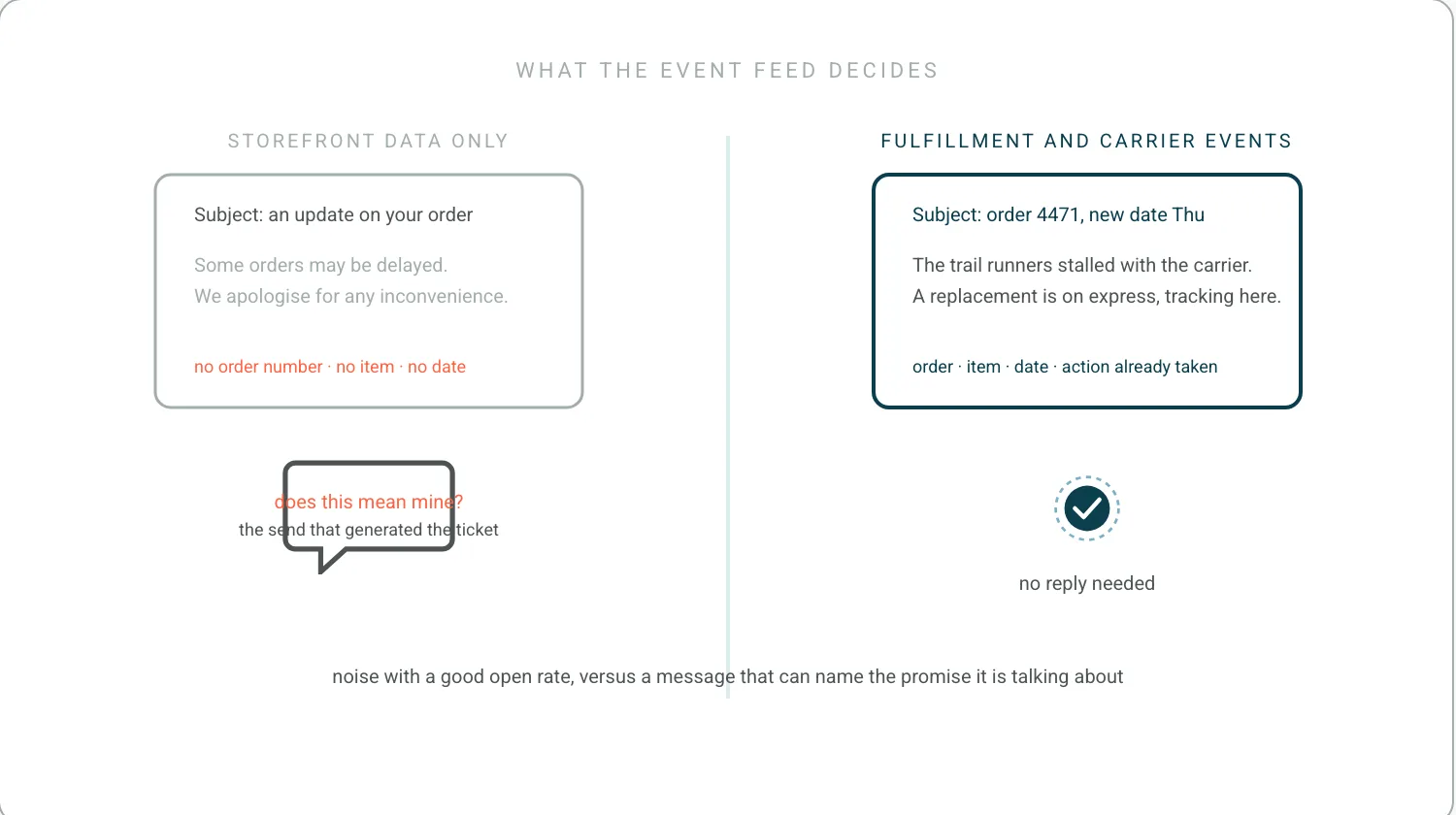
This is where the storefront-only reading of email automation breaks, and the symptom is specific. Without order-level data the tool can still send at volume, so teams fall back on a generic bulk message, and a generic message about a specific order confuses more than it settles because it carries no order number and no item. The customer cannot tell whether it applies to them, so they contact support to ask, and the send that was meant to deflect has generated the ticket. Every order is a promise, and a message that cannot name the promise it is talking about is not communication, it is noise with a good open rate. The operating model that fixes the cause rather than the copy is post-purchase operations.
Fire on the outcome, not on the order
Read operationally, re-engagement flows are triggered by consumption and delivery rather than by a promotional calendar. A replenishment reminder timed to a consumable's expected run-out uses the delivery date and the pack size, not a fixed interval after purchase. A cross-sell for a compatible accessory is only accurate if the original order actually arrived and was not returned. This is the reason the operational and marketing readings of the same flow diverge: the marketing version fires on the order, and the operational version fires on the outcome. Suppression rules matter more here than creative, because a promotional message sent to a customer with an open complaint reliably makes the complaint worse. That argument in full is post-purchase marketing.
Hold the reason code constant and compare the rate
Deflection is measured as contacts per hundred orders, segmented by reason code, and compared before and after a flow launches. Supporting measures include first response time, time to resolution, and the share of contacts that arrive through a self-service path rather than a ticket. Attribution is the hard part, because contact volume also moves with order volume, carrier performance, and seasonality. The usable method is to hold the reason code constant and compare the rate rather than the count, then check whether the change survives a peak period. A drop in tickets with no matching drop in the underlying problem is deflection in name only, since the problem still reaches the customer. The measures sit with ecommerce KPIs and the honest version of the deflection argument is on customer self-service.
Frequently Asked Questions
What are the 5 essential email flows every ecommerce brand should have?
For post-purchase specifically: order confirmation, dispatch with tracking, delivery confirmation, an exception notice for an order that has left its expected path, and a returns sequence that keeps the customer informed after the label is issued. The fourth is the one usually built last and the one that decides whether a customer contacts support.
What is the best email marketing software for ecommerce?
This page does not rank products. The criterion that matters for post-purchase is which event feeds the flow: storefront data ends at dispatch, and every milestone customers actually ask about happens after it. Ask which sources a tool listens to and at what latency, rather than which templates ship with it.
What is the 80/20 rule in email marketing?
Usually quoted as a ratio of value to promotion in a sending calendar. Read operationally it lands differently: a small number of order events generate most of the messages that matter, and the ones that matter most are triggered by an event that did not happen, which no calendar can schedule.
References
- US Federal Trade Commission. FTC's CAN-SPAM guidance. The line between an order update and a promotion.
- US Electronic Code of Federal Regulations. TCPA rules at 47 CFR 64.1200. The same line for text messages.
- United States Postal Service. USPS Track and Confirm API. The scan feed a status flow reads.
- United States Postal Service. USPS publishes the service standards. The expectation an absence-of-scan trigger has to be derived from.
- US Electronic Code of Federal Regulations. 16 CFR Part 435. The merchant's half of the refund clock.
Ready to Stop Reacting?
The fastest way to see how Keeyu prevents complaints is to see it in action.
In one call, we’ll map your current operations, show how our AI Agent fits in, and walk through real examples of issues fixed before customers notice.
Most teams go live within 48 hours. We never share your data.

