
Post-purchase marketing
 Verified & Reviewed


 Copy Link
Post-purchase marketing is the set of communications and offers a business directs at customers after they have bought: order and delivery messaging, review and referral requests, replenishment prompts, cross-sell offers, and loyalty enrollment. It differs from acquisition marketing in that its audience is already known, its timing is driven by order events rather than by campaign schedules, and its performance is bounded by whether the order it accompanies actually goes well. What the customer is doing while it arrives is post-purchase behaviour, and the judgement it lands inside is post-purchase evaluation.
Actionable post-purchase workflows
The standard workflows are the order confirmation, the dispatch notification, the delivery confirmation, the review request, the replenishment reminder for consumables, and the win-back for lapsed buyers. Two of those carry rules rather than only conventions: review requests sit under the FTC's Endorsement Guides the moment an incentive is attached, and any message carrying an offer sits under the CAN-SPAM guidance rather than the lighter transactional treatment. Sequencing and timing determine most of the outcome. Review requests timed to dispatch rather than to delivery arrive before the customer has the product and depress ratings. Replenishment prompts timed to a fixed interval rather than to the product's actual consumption cycle arrive early for heavy users and late for light ones. Each workflow needs its trigger tied to a real event rather than to elapsed time.
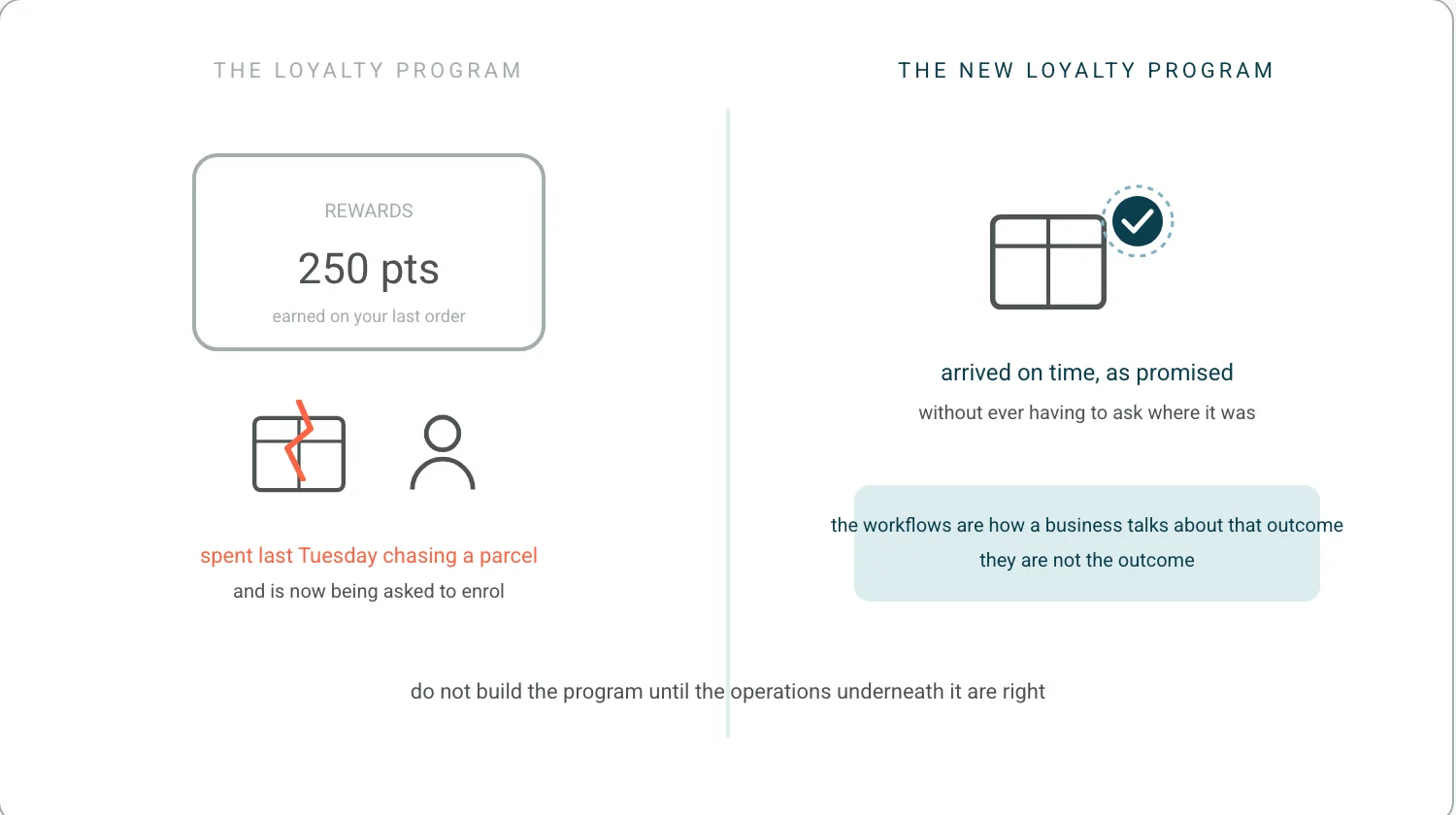
Before any of those workflows, the term itself needs correcting, because most of this category has it backwards. Post-purchase is not email notifications and it is not reactivation campaigns. Every order is a promise. It is making sure customers get what they ordered, on time, as promised, without ever having to ask where their order is. The workflows above are how a business talks about that outcome. They are not the outcome, and a beautifully built flow describing an order that is four days late has done its job and failed the customer. Whether it is late at all is on-time delivery, and the workflows that fire when it is not are proactive customer service.
What the messaging layer looks like when the operation underneath it fails is in the 786 pain points we mined from 270 customer call transcripts between May 2025 and May 2026. The weeks after Black Friday were the recurring example: teams sending huge volumes of manual outbound email because nothing in the stack could message everyone affected by one operational problem, and operators saying plainly that manual bulk communication outside a unified system was not sustainable at peak. The flows were built. The event that should have fired them never reached them.
Branded tracking pages and portals
The tracking page is the highest-traffic post-purchase surface, which is why it attracts merchandising. It works as a marketing surface because the visit is high-intent and repeated, and it fails as one when the underlying order is in trouble. The design principle that follows is conditional content: promotional modules on a tracking page should be suppressed when the order is late, stalled, or incomplete. Few implementations do this, and it is the single most common way post-purchase marketing damages the relationship it is meant to build.
Which is the awkward thing about the most-recommended asset in post-purchase marketing. A tracking page, the order tracking surface itself, is a marketing surface making continuous claims about an order the marketing team does not control, and its credibility is entirely borrowed from the operation underneath it. The customer's version of it is customer order tracking. Post-purchase has been retail's blind spot for twenty years and it is where brands now win or lose repeat revenue, where support pressure builds or disappears, and where trust is quietly earned or eroded. A tracking page inherits all of that and can improve none of it. Build it, and be clear that what it is measuring is somebody else's work. The category that sells it is post-purchase experience platforms.
Customer retention strategies
Retention in this context comes from three sources. Reducing the reasons customers leave, which is operational. Increasing purchase frequency through relevant prompts. Increasing switching cost through loyalty mechanics. The first is usually outside the marketing function's control and has the largest effect, which is why post-purchase marketing programs measured only on campaign performance can show good results while overall retention falls. Attribution should separate the operational and promotional contributions rather than crediting campaigns with retention that better fulfillment delivered. The operational half is reduce churn and its value is customer lifetime value.
Here is the position I will defend against any loyalty consultant. Post-purchase operations is the new loyalty program. Do not bother building a loyalty program if you have not got your post-purchase operations right, because points do not compensate for an order that never arrived, and the customer you are trying to enrol is the same customer who spent last Tuesday chasing a parcel. Most brands still treat post-purchase as an afterthought, which is exactly why it is still wide open as a place to compete. Startmate wrote the same argument up when we came through the program, and the fuller case is post-purchase is loyalty.
Operational tools and software recommendations
The tooling splits into marketing platforms with post-purchase flows, post-purchase experience platforms that own tracking and returns surfaces, and operations layers that supply the order events both depend on. The dependency runs one way: the marketing layer cannot send an accurate delay notice unless something upstream knows the order is delayed. Which channel it goes out on is communication preferences, and what has to be connected for the event to exist at all is third-party integrations. Evaluations that compare only the messaging layers tend to miss that the differentiating input is event quality rather than template quality.
Return and exchange optimization
Returns are a post-purchase marketing moment as well as an operational one. The optimization is conversion of refunds into exchanges or store credit, achieved by presenting alternatives at the point of return initiation, making the exchange path faster than the refund path, and handling the reverse logistics well enough that the customer would use it again. The constraint is honesty: an exchange flow that obstructs refunds converts short-term revenue into long-term churn and, in several jurisdictions, into a regulatory problem. In the US the relevant text is 16 CFR Part 435, which sets when a refund is owed rather than offered.
Metrics and KPIs
The measures are repeat purchase rate, time to second order, revenue per customer from post-purchase channels, review submission rate, and exchange conversion on returns. The measure that keeps the discipline honest is repeat purchase rate segmented by whether the order had an operational failure, because it exposes how much of the program's result is attributable to messaging and how much to the underlying experience. Definitions sit with ecommerce KPIs, and the operating model underneath all of it is post-purchase operations.
Frequently Asked Questions
What is an example of post-purchase behavior?
A customer who checks the tracking page three times, contacts support once, receives the parcel late, and does not order again. Every step of that is observable in systems the business already has, and the last one is the only step most businesses measure. Behavior in full is on post-purchase behaviour.
What are examples of post-purchase questions?
For a marketing program the questions worth asking are about the transaction rather than the product: whether the order arrived when promised, whether anything had to be chased, and whether the customer would buy again. Survey design and timing belong to post-purchase evaluation.
What are the 4 P's in sales?
Product, price, place and promotion, the classical marketing mix. Post-purchase marketing sits underneath all four and is bounded by none of them, because its performance depends on whether the order it accompanies actually goes well. That is the argument this page makes: the messages are how a business talks about the outcome, and they are not the outcome.
References
- US Federal Trade Commission. FTC's Endorsement Guides. What changes when a review request carries an incentive.
- US Federal Trade Commission. CAN-SPAM guidance. Promotional against transactional treatment.
- US Electronic Code of Federal Regulations. 16 CFR Part 435. When a refund is owed rather than offered.
Ready to Stop Reacting?
The fastest way to see how Keeyu prevents complaints is to see it in action.
In one call, we’ll map your current operations, show how our AI Agent fits in, and walk through real examples of issues fixed before customers notice.
Most teams go live within 48 hours. We never share your data.

