
Post-purchase evaluation
 Verified & Reviewed


 Copy Link
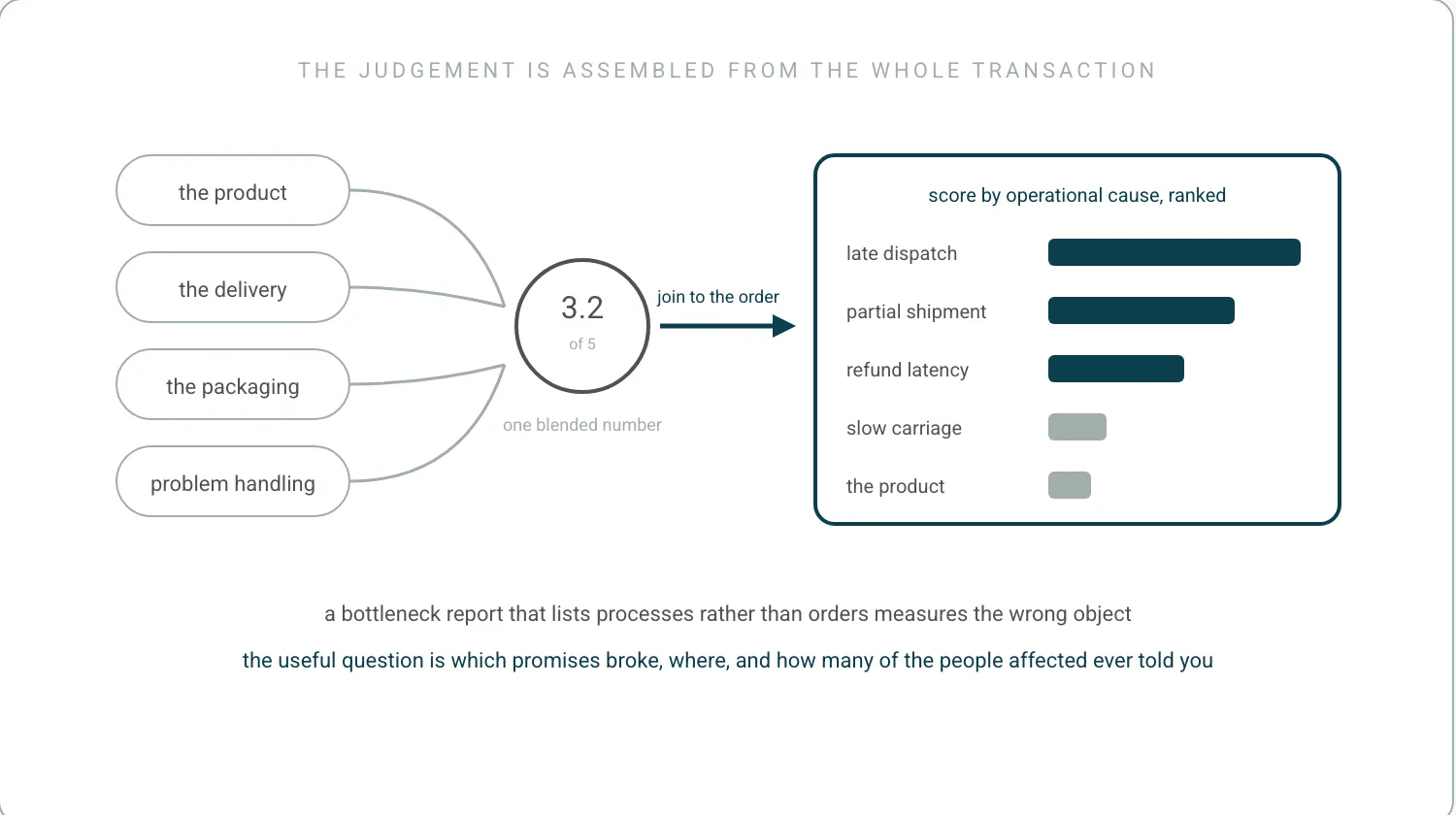
Post-purchase evaluation is the judgement a customer forms after receiving a purchase, comparing what they expected against what they got. In consumer-behavior terms it is the confirmation or disconfirmation of expectations, and it determines satisfaction, repeat intent, and whether the customer tells anyone. The doubt that precedes the judgement is post-purchase dissonance, what the customer does with the judgement is post-purchase behaviour, and the negative outcome is post-purchase regret. For ecommerce it is worth noting that the object of the evaluation is not only the product: the customer evaluates the whole transaction, and delivery, packaging, and any problem handling form part of the judgement.
Effort is the diagnostic measure, repurchase is the ground truth
Three measures are established. Satisfaction, typically captured as a rating shortly after delivery. Effort, which asks how much work the customer had to do, and which the Harvard Business Review research that introduced it found predicts loyalty better than delight does. Likelihood to recommend, proposed in Harvard Business Review as the single measure worth tracking, which is contested and still the most widely reported. Each answers a different question, and effort is the most diagnostic for post-purchase specifically, because the experiences that damage evaluation are usually those that required the customer to chase, repeat themselves, or resolve something the business should have handled. Behavioral measures, principally repeat purchase, are the ground truth against which declared measures should be validated. Definitions for the whole set sit with ecommerce KPIs and customer satisfaction metrics.
One thing to know before running any self-assessment against a framework like this: your own read of your operational maturity is usually about two levels too generous. Almost every team I talk to places itself near the top, and it is not vanity. It is that the failures they cannot see are exactly the ones the framework is asking about, so the honest answer is unavailable from the inside. That is why a maturity score is worth less than a sample of fifty real orders followed end to end, which is the audit set out on ecommerce benchmark, and why any framework should start with evidence rather than with a questionnaire. The maturity levels themselves are on post-purchase ops maturity, and I have argued the same point on The Ecommerce Edge.
Time the survey to delivery, and ask about the delivery separately
Survey design determines what is measured. Timing relative to delivery rather than to dispatch is the single most important choice, since a survey arriving before the parcel measures anticipation. Question scope matters next: asking about "your experience" returns a blended judgement, while asking separately about the product, the delivery, and any support interaction produces actionable data. Response bias is severe in this area because customers with problems respond more readily, which is an argument for pairing surveys with behavioral data rather than treating response rates as representative. It is the reason research groups that publish their method, such as Baymard Institute, are worth more than a survey result quoted without one.
Join the score to the order and it becomes a ranked list of causes
Feedback becomes operationally useful when it is joined to order data. Linking each response to its order allows evaluation scores to be segmented by delivery performance, carrier, warehouse, fulfillment method, and whether the order was complete. That segmentation converts a satisfaction score into a ranked list of operational causes. The bottlenecks that surface most often are late dispatch rather than slow carriage, partial shipments, and refund latency, all of which are internally controlled and none of which are visible in an unsegmented score. The causes behind them are ranked on reasons for customer churn.
This is the section that turns a score into work, and the reframe underneath it is that the customer relationship actually starts post-purchase. Everything before checkout was courtship. The judgement the customer forms is assembled from what happened to their order, so a bottleneck report that lists processes rather than orders is measuring the wrong object. Every order is a promise, and the useful evaluation question is not how satisfied customers are, it is which promises broke, where, and how many of the people affected ever told you. Finding that out before they tell you is proactive customer service, and the operating model is post-purchase operations.
The join between feedback and order records is the tool that matters
The tooling divides into survey and feedback platforms, review platforms, analytics that join feedback to transactional data, and the operational systems that hold the events being evaluated. The integration that matters is the join between feedback and order records, because without it the feedback can be reported but not diagnosed. What that join actually involves is third-party integrations. Review platforms serve a second purpose as an unsolicited feedback channel, capturing customers who would not complete a survey, and their free text is frequently more specific about operational causes than survey scales are.
Fix the cause, then recover, then reward
The playbook that follows from evaluation data is: measure the judgement, join it to the operational cause, fix the largest causes, and use recovery to change the evaluation of customers who already had a poor experience. Recovery works when it is prompt and when the underlying problem is resolved first, and it fails when it substitutes compensation for resolution. Loyalty mechanics sit on top of this rather than replacing it, since a program cannot outweigh a transaction the customer judged badly, which is the argument post-purchase marketing makes at length. The interventions themselves are reduce churn.
Frequently Asked Questions
What are examples of post-purchase questions?
Asked of a customer, the useful ones separate what is being judged: how satisfied they were with the product, with the delivery, and with any support interaction, as three questions rather than one about "your experience". Add an effort question, which asks how much work they had to do, because it is the most diagnostic of the three for post-purchase specifically.
What are the 5 stages of the purchase decision process?
Problem recognition, information search, evaluation of alternatives, purchase, and post-purchase evaluation. The last stage is this page. It is the one an ecommerce operator influences most and the one most marketing frameworks treat as an afterthought, which is why it is usually measured with a survey rather than with the order data that explains the result.
What does post-purchase behavior mean?
What the customer actually does after buying, as distinct from the judgement they form, which is this page. The behavior, including contact, returns and whether they buy again, is on post-purchase behaviour.
References
- American Psychological Association. expectations. The confirmation-or-disconfirmation framing in the definition.
- Harvard Business Review. Harvard Business Review research. Effort as the more diagnostic measure.
- Harvard Business Review. proposed in Harvard Business Review. Where likelihood to recommend comes from, named as contested.
- Baymard Institute. Baymard Institute. Why a published method beats a quoted response rate.
Ready to Stop Reacting?
The fastest way to see how Keeyu prevents complaints is to see it in action.
In one call, we’ll map your current operations, show how our AI Agent fits in, and walk through real examples of issues fixed before customers notice.
Most teams go live within 48 hours. We never share your data.

