
Post-purchase dissonance
 Verified & Reviewed


 Copy Link
Post-purchase dissonance is the doubt a buyer feels after committing to a purchase, when the decision can no longer be revisited but its outcome is not yet known. It is the consumer-behavior application of cognitive dissonance, which the APA Dictionary of Psychology defines as postdecisional dissonance, and it rises with price, with the number of alternatives considered, and with the length of the wait between paying and receiving. In ecommerce the waiting period is the dissonance window, which makes it an operational problem as much as a psychological one: the business controls how much silence sits inside it. The behaviour that follows it is post-purchase behaviour, the judgement formed on arrival is post-purchase evaluation, and the case where the doubt hardens is post-purchase regret.
Silence is read as risk
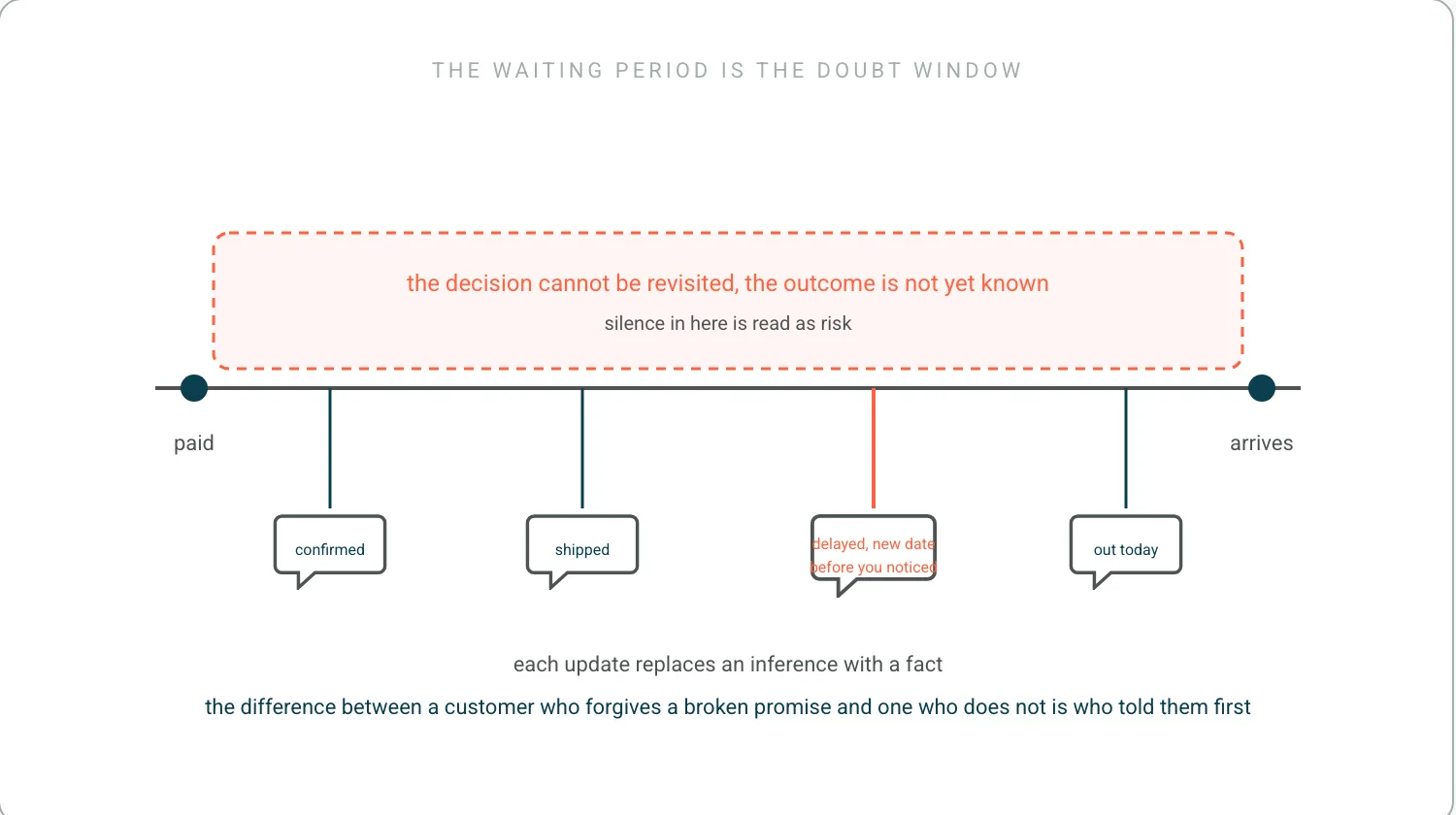
The reassurance levers are largely informational. Order confirmation that restates exactly what was bought and when it will arrive closes the immediate uncertainty. Dispatch confirmation with working tracking converts an abstract promise into an observable process. Proactive updates at the points where a customer would otherwise wonder, particularly any gap longer than their expectation, prevent the doubt from becoming a contact. The general principle is that silence during the waiting period is read as risk, and each update the business sends is an opportunity to replace inference with fact.
None of that needs a transformation program, which is the thing worth saying before a reader closes the tab. The received wisdom is that fixing post-purchase takes six months and a six-figure budget and leaves the team as burnt out as it started. It does not. It takes about six weeks and one fix at a time, and the first fix is almost always closing a specific silence rather than rebuilding a stack, usually the one around where is my order.
A doubting customer evaluates the item more critically
Dissonance and returns are linked, because a customer already doubting a purchase evaluates the delivered item more critically. Operational contributions to that doubt include a delivery that arrives later than promised, packaging that suggests less care than the price implied, and an order that arrives incomplete. Reducing them lowers the return rate independently of the product itself. The measurable version is return rate split by whether the order was delivered on time and complete, which most businesses can calculate from data they already hold and rarely do. The arithmetic is the product return rate formula.
Who told them first
Proactive support means initiating contact when the business knows something the customer does not, rather than waiting to be asked. The triggers are operational: a delayed dispatch, a stalled shipment, a partial fulfillment, a failed delivery attempt. The reason this reduces dissonance rather than amplifying it is that a customer told about a problem by the brand retains their model of a competent seller, whereas a customer who discovers the problem themselves revises it. The workflow requirement is detection early enough that the message precedes the discovery.
The mechanism in that last sentence is the whole page. An issue in the post-purchase journey is nearly always established after the fact rather than in real time, and after the fact means the moment the customer reaches out. That is why the doubt turns into a ticket: the business genuinely did not know either. I was running P.E Nation, an appointment Internet Retailing reported at the time, when our site went down under the traffic from a warehouse sale, and I can tell you what that day is like for the team on the other end of it. Every order is a promise, and the difference between a customer who forgives a broken one and a customer who does not is usually just who told them first. That is proactive customer service in one sentence.
The silence has a measured shape. In the 786 pain points we mined from 270 customer call transcripts between May 2025 and May 2026, every brand described the period after the parcel leaves the warehouse as a black hole, unprompted, and the largest single category was systems failing silently, with the customer's message as the first signal. Subscriptions were the sharpest case: a SKU hits zero, the order fails quietly, and the subscriber hears nothing at all.
Pre-delay contact rate is the diagnostic number
The measures that track dissonance indirectly are contact rate during the waiting period, the proportion of contacts occurring before any delay has actually happened, return rate by delivery performance, and post-delivery satisfaction. The most diagnostic is the pre-delay contact rate, because a customer contacting before anything has gone wrong is expressing exactly this uncertainty, and that volume responds to communication design rather than to operational performance. Definitions for the rest sit with ecommerce KPIs.
Fire from order events, never from elapsed time
Automation makes reassurance affordable at volume. The requirement is that messages fire from real order events rather than from elapsed time, since a time-based message that says an order is on its way when it has not shipped increases dissonance sharply. Channel choice matters at the margins, with time-critical events warranting SMS and detail-bearing updates suiting email. The choice is not purely editorial, since US marketing texts sit under the TCPA consent rules at 47 CFR 64.1200 while a genuine shipping update does not, and letting the customer set the channel is communication preferences. The message set itself is shipping notifications. Frequency has an upper bound: past a certain density, updates signal anxiety on the seller's part rather than confidence.
An easy returns path reduces doubt before it is used
A visible, easy returns path reduces dissonance before it is ever used, because it lowers the perceived cost of having chosen wrongly. This is the well-established finding that clear return policies increase conversion, applied after the sale rather than before it, and it comes from the same body of checkout research Baymard Institute publishes with its method attached. Operationally the components are policy clarity at the point of purchase, a self-service initiation path, transparent status while the return is in transit, and prompt refunds. Refund latency in particular converts a resolved return into a fresh grievance, and it has a legal outer bound as well as a commercial one under 16 CFR Part 435. The faster version of the same step is instant refunds.
Route the cause to the team that owns it
Feedback closes the loop by measuring the outcome and feeding it back into the operation. Post-delivery surveys capture the experience rather than the product when timed to arrival. Review content identifies recurring causes. The operationally valuable step, and the one usually missing, is routing feedback that names an operational cause to the team that owns that cause, so the loop changes something rather than reporting on it. What that ownership looks like is post-purchase operations.
Frequently Asked Questions
What does post-purchase cognitive dissonance mean?
It is the consumer-behavior application of cognitive dissonance: the discomfort of holding a decision that can no longer be revisited while its outcome is still unknown. The psychology is documented as postdecisional dissonance. What makes it an operations problem in ecommerce is that the business controls how much silence sits inside the waiting period.
What is postpurchase behavior?
What a customer does and feels after buying, of which dissonance is one part. The wider stage, including contacting, returning, reviewing and deciding whether to buy again, is on post-purchase behaviour. This page is about the specific doubt that forms between paying and receiving.
What emotion is associated with postpurchase dissonance?
Anxiety rather than anger, which is why it is easy to miss. It presents as checking the tracking page repeatedly, not as a complaint, and the operational tell is a contact that arrives before anything has actually gone wrong. That pre-delay contact rate is the most diagnostic measure on this page.
References
- American Psychological Association. APA Dictionary of Psychology defines as postdecisional dissonance. The theory the page's definition rests on, from the discipline that owns it.
- US Electronic Code of Federal Regulations. TCPA consent rules at 47 CFR 64.1200. Why a marketing text and a shipping update are different sends.
- Baymard Institute. Baymard Institute. The returns-clarity and checkout research behind the frictionless-returns claim.
- US Electronic Code of Federal Regulations. 16 CFR Part 435. The outer bound on refund latency.
Ready to Stop Reacting?
The fastest way to see how Keeyu prevents complaints is to see it in action.
In one call, we’ll map your current operations, show how our AI Agent fits in, and walk through real examples of issues fixed before customers notice.
Most teams go live within 48 hours. We never share your data.

