
Post-purchase regret
 Verified & Reviewed


 Copy Link
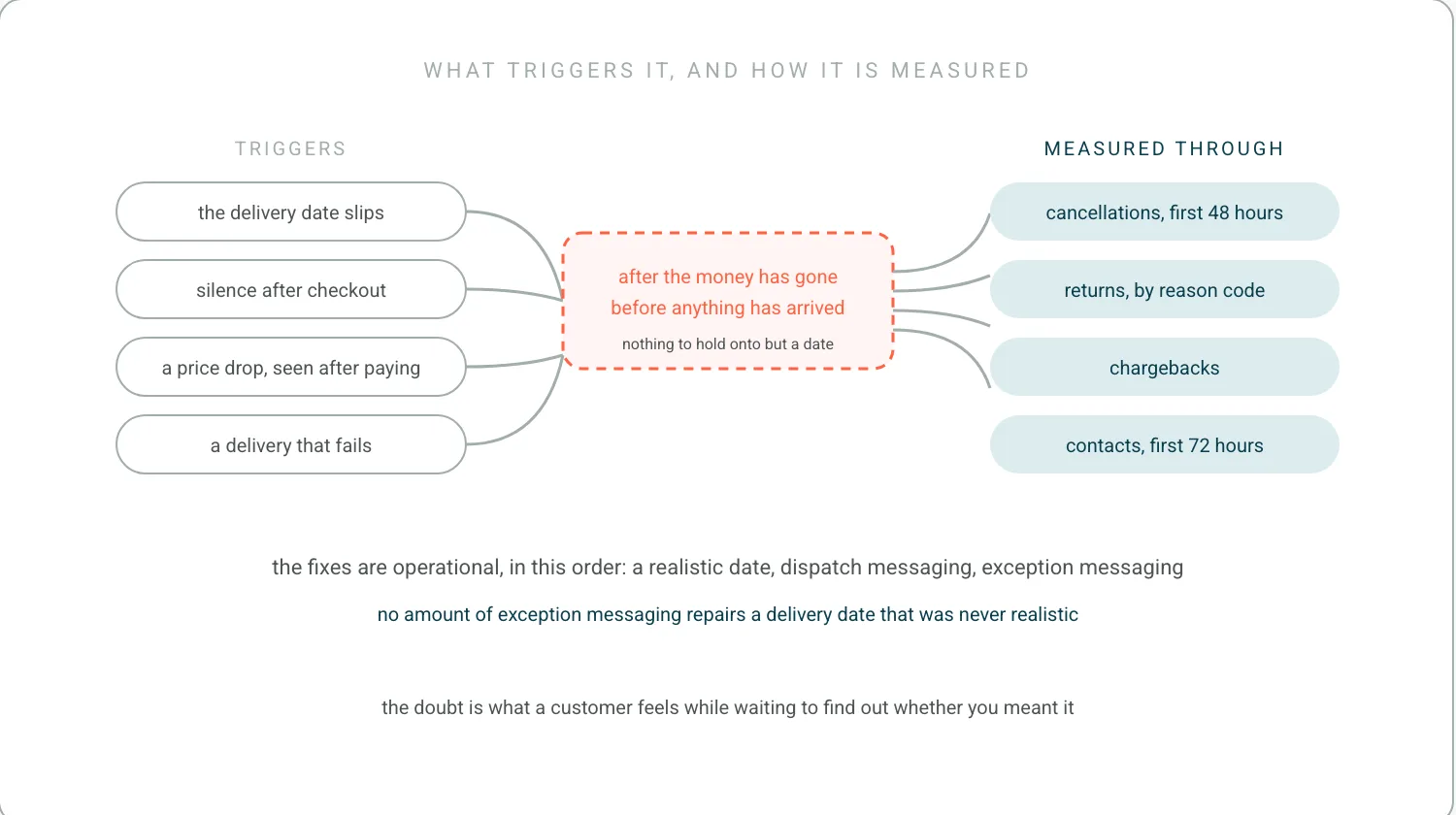
Post-purchase regret is the doubt a customer feels about a purchase after committing to it, and in ecommerce it is most often triggered by something the operation did rather than by the product. The psychology behind it is documented as buyer's remorse in the APA Dictionary of Psychology and as post-purchase dissonance in consumer-behavior writing, which is the sibling page carrying the concept in full. The operational triggers are a delivery date that slips, a period of silence after checkout, a price drop the customer sees after paying, and a delivery experience that fails. Regret is measurable through its consequences rather than directly, and those consequences are cancellation requests, return rates, chargebacks, and support contacts within the first days after purchase. What customers do next, more broadly, is post-purchase behaviour, and the judgement they form once the parcel lands is post-purchase evaluation.
Four measures that are cleaner than regret itself
Four measures carry the operational cost and each has a cleaner definition than regret itself. Cancellation rate within the first 48 hours captures the fastest form, before fulfillment has committed cost. Return rate split by reason code separates the returns caused by the product from those caused by the experience, and only the second responds to operational change. Chargeback rate captures the most expensive outcome, since a chargeback costs the goods, the fee, and the dispute handling. Contact rate in the first 72 hours is the leading indicator of all three, because a customer who writes in early is usually a customer whose confidence has already moved. Tracking the four together is what distinguishes a product problem from an operational one, and the causes behind the second group are ranked on reasons for customer churn. Definitions for the measures sit with ecommerce KPIs.
Three interventions, in an order that matters
Three interventions address regret at the point it forms. Expectation setting at checkout, using a delivery date the operation can actually hit, removes the most common trigger before it exists. In the US that date is also a commitment rather than an estimate, since the FTC's Mail, Internet, or Telephone Order Merchandise Rule obliges a seller who cannot meet it to offer the customer a choice. Whether it is being hit is on-time delivery. Confirmation and dispatch messaging closes the silence between payment and the first physical sign that anything is happening, which is the window in which doubt has nothing to work against. Exception messaging handles the orders that slip, and is the intervention with the largest effect, because a delay the customer is told about is an inconvenience while a delay they discover is a broken promise. I went through that sequence in detail on Add To Cart, and the operating model behind it is proactive customer service. The ordering matters: no amount of exception messaging repairs a delivery date that was never realistic.
Those three run in that order for a reason. Regret in ecommerce is mostly manufactured by the operation rather than by the product, and it forms in a specific window: after the money has gone and before anything physical has arrived to argue with. A brand can win on product and on price and still hand the customer nothing to hold onto during that window except a date that slipped. Every order is a promise, and the doubt this page is about is what a customer feels while waiting to find out whether you meant it.
How much of that window is silence, in practice, is in the 786 pain points we mined from 270 customer call transcripts between May 2025 and May 2026. Every brand described the period after the parcel leaves the warehouse as a black hole, and the largest single category of pain was systems failing silently between the storefront, the ERP and the warehouse, with the customer's message as the first signal anyone received. The doubt is not irrational. For most of that window the business does not know either.
Different triggers, different handling
The triggers listed above have different handling and lumping them together is what produces blunt policy. A shipping delay is answered with a revised date and a choice, since a customer given an option is materially less likely to cancel than one given an apology, and the FTC rule requires that choice to be offered anyway once the original date is missed. A post-checkout price drop is answered with a stated policy applied consistently, because the cost of honoring the difference is almost always lower than the cost of a return and a repurchase at the lower price. Buyer panic in the first hours, where the customer simply changes their mind, is answered with a cancellation window that is honest about when fulfillment commits, since a refusal at that point converts a cheap cancellation into an expensive return. A stated refund policy applied consistently is doing more work here than any individual decision.
No promotion reaches an order in an exception state
The post-purchase window is where a purchase decision is either confirmed or undermined, and the content that confirms it is practical rather than promotional. Delivery and setup information, product guidance, and a clear route to help all reduce the doubt directly. The sequencing rule that governs this window is that no promotional message should reach a customer whose order is currently in an exception state, because a marketing email arriving while a parcel is missing reliably converts doubt into a complaint. That requires the marketing system to know the order state, which is the same integration requirement the exception messaging depends on, and it is the most common reason otherwise well-run programs generate their own complaints. It is also a legal distinction rather than only an editorial one, since the FTC's CAN-SPAM guidance treats a promotional message differently from a transactional one. The wider argument is post-purchase marketing, and the operating context is post-purchase operations.
Frequently Asked Questions
Why do I feel regret after buying something?
In ecommerce it is most often triggered by something the operation did rather than by the product: a delivery date that slips, a period of silence after checkout, a price drop seen after paying, or a delivery that fails. Each is addressable, which is what separates this from the general psychology of regret.
What is it called when you regret a purchase?
Buyer's remorse in everyday use, and post-purchase dissonance in the consumer-behavior literature. The concept in full is on post-purchase dissonance. This page stays on the operational triggers and their handling.
What is post-purchase guilt?
The version driven by the spend rather than by the outcome, which an operator cannot do much about. What an operator can address is the version driven by the transaction going wrong, and the two are easy to confuse in a returns reason code, which is one reason reason mix is worth splitting into product causes and operational causes.
References
- American Psychological Association. buyer's remorse. The psychology the operational reading sits on top of.
- US Federal Trade Commission. FTC's Mail, Internet, or Telephone Order Merchandise Rule. The promised date as a commitment.
- US Electronic Code of Federal Regulations. FTC rule. The choice a seller owes once the date is missed.
- US Federal Trade Commission. FTC's CAN-SPAM guidance. Promotional against transactional, for the suppression rule.
Ready to Stop Reacting?
The fastest way to see how Keeyu prevents complaints is to see it in action.
In one call, we’ll map your current operations, show how our AI Agent fits in, and walk through real examples of issues fixed before customers notice.
Most teams go live within 48 hours. We never share your data.

