
Post-purchase behaviour
 Verified & Reviewed


 Copy Link
Post-purchase behavior is what a customer does and feels after buying: waiting, evaluating, contacting, returning, reviewing, recommending, and deciding whether to buy again. In consumer-behavior terms it is the final stage of the purchase process. For an ecommerce operator it is the stage the business influences most directly through execution rather than persuasion, because almost everything the customer experiences in it is produced by operations. The doubt inside the waiting period is post-purchase dissonance, the judgement formed on arrival is post-purchase evaluation, and the negative case is post-purchase regret.
Contact is the most measurable behavior and the most tractable
Contact is the most measurable post-purchase behavior and the most tractable. The dominant categories are order status, delivery problems, returns initiation, and refund chasing, and each maps to an operational cause rather than a communication failure alone. What people report when they complain formally is a narrower and different set, which the FTC's Consumer Sentinel Network Data Book records, and the gap between the two is most of this page. Reducing contact means answering earlier through proactive updates and self-service, and removing the reasons for contact by improving dispatch reliability, exception detection, and refund latency. The reason the second half matters more than the first is the Harvard Business Review finding on customer effort: what predicts disloyalty is how much work the customer was made to do, not how pleasant the reply was. The measure that survives volume growth is contacts per hundred orders, split by reason.
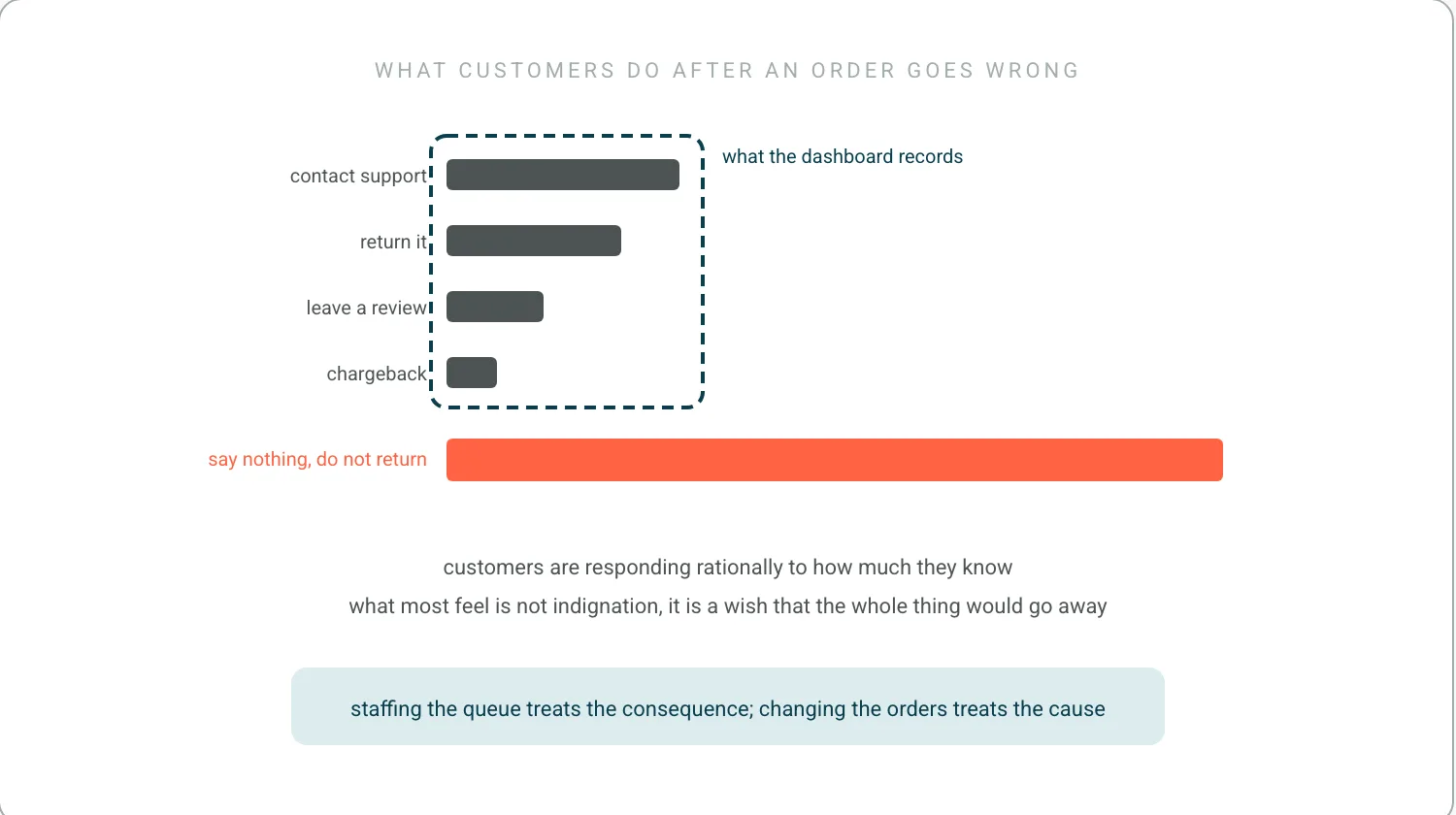
Worth having a number in your head before starting: about half of an ecommerce support queue is post-purchase. The exact share moves with category and fulfillment model, and it does not matter much where in the range a given business sits, because every point of it means the same thing. The majority of what a support team handles is not questions about products. It is consequences of orders. Staffing that queue treats the consequence. Changing the orders treats the cause.
Split repurchase by whether the first order failed
The behavior that matters commercially is repurchase. Useful internal benchmarks are second-order rate by intake cohort, time to second order, and repurchase rate split by whether the customer's first order had an operational failure. That last split is the one that connects this topic to revenue, and most businesses can construct it from data they already hold. It is the same comparison churn rate in ecommerce sets out, valued using customer lifetime value, and acted on through reduce churn. Cross-industry retention benchmarks are weak comparators because repurchase cadence is category-determined, so internal trajectory is the more defensible standard.
Proactive programs succeed or fail on monitoring, not copy
The recurring pattern in documented cases is that customers told about a problem by the business behave differently from customers who discover it themselves, even when the underlying failure and the eventual remedy are identical. The operational precondition is detection early enough to message first, which is why proactive communication programs succeed or fail on their monitoring rather than their copy. That is the distinction proactive versus reactive customer service is built on, and I argued it on the Retail Fest post-purchase panel. Case evidence should be read for what triggered the message and how early, since those determine whether a result is reproducible.
The thing that gets studied as psychology here is mostly produced by logistics. Customers are not behaving unpredictably after a purchase, they are responding rationally to how much they know. When post-purchase breaks, what most of them feel is not indignation. It is a low-grade wish that the whole thing would go away, and that is the finding an operator should build around, because it means the most common post-purchase behavior is one no dashboard records. Every order is a promise, and the customer who says nothing about a broken one has not forgiven it. They have decided it is not worth the argument.
How little the business hears is measurable. In the 786 pain points we mined from 270 customer call transcripts between May 2025 and May 2026, every brand described the period after the parcel leaves the warehouse as a black hole, unprompted, and the largest single category of pain was systems failing silently, where the customer's message was the first signal anyone received. The behavior that follows a broken promise is mostly invisible because the promise broke invisibly first.
Separate product causes from operational causes
Returns are post-purchase behavior with a direct cost attached. A working framework separates return reasons into product causes, such as fit or expectation mismatch, and operational causes, such as wrong item, damage in transit, or late arrival, because only the second group is addressable by operations. The process itself then has its own behavioral effects: ease of initiation, visibility while the return is in transit, and refund speed each influence whether the customer buys again, which is why returns handled well can retain customers that returns handled poorly would lose. The full process is returns management, and the reason codes that separate the two groups are on reasons for returning an item.
Businesses buy measurement and messaging, then blame the messaging
Tooling in this space divides into three groups. Measurement captures behavior through surveys, reviews, and analytics. Communication sends the proactive updates. Operations detects and resolves the underlying events. The common gap is that businesses buy the first two and attribute disappointing results to the messaging, when the behavior is responding to the operational reality the messaging describes. It is also worth being careful with the measurement layer itself, since survey and panel findings in ecommerce vary enormously with how the question was framed, which is why research groups such as Baymard Institute publish their method alongside the number. The operating model that acts on the cause is post-purchase operations. Evaluation should start from which category of behavior is being targeted and whether the tool can influence its cause.
Frequently Asked Questions
What does post-purchase mean?
The stage after a customer has paid: waiting, evaluating, contacting, returning, reviewing, recommending, and deciding whether to buy again. For an operator it is the stage the business influences most directly through execution rather than persuasion, because almost everything the customer experiences in it is produced by operations.
What is post-purchase dissonance?
The doubt a buyer feels once a purchase is committed and its outcome is not yet known. It rises with price, with the number of alternatives considered, and with the length of the wait. In ecommerce the waiting period is the dissonance window, which makes it operational as much as psychological. Covered in full on post-purchase dissonance.
What are the four types of buying behavior?
The consumer-behavior literature splits them by how involved the decision is and how different the options are, running from habitual repeat buying to complex considered purchases. The split matters here for one reason: the higher the involvement, the longer the wait feels and the more the post-purchase window decides whether the customer returns.
References
- US Federal Trade Commission. FTC's Consumer Sentinel Network Data Book. What customers report formally, against what they contact a brand about.
- Harvard Business Review. Harvard Business Review finding on customer effort. Effort, not delight, as the predictor of the behaviour that follows.
- Baymard Institute. Baymard Institute. Why a measurement tool's method matters more than its number.
Ready to Stop Reacting?
The fastest way to see how Keeyu prevents complaints is to see it in action.
In one call, we’ll map your current operations, show how our AI Agent fits in, and walk through real examples of issues fixed before customers notice.
Most teams go live within 48 hours. We never share your data.

