
What is customer lifetime value?
 Verified & Reviewed


 Copy Link
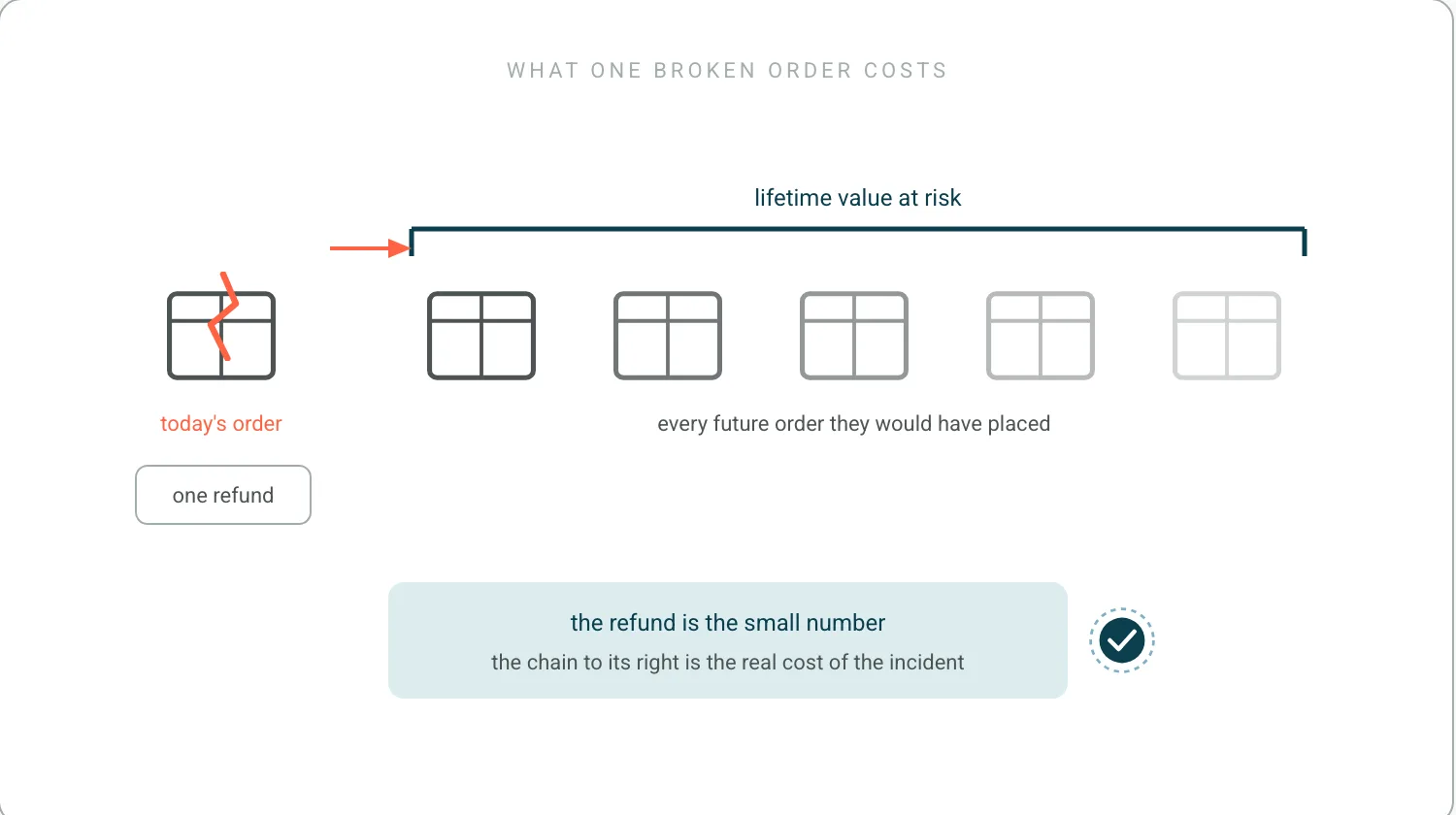
Customer lifetime value (CLV, sometimes CLTV) is the total profit a business expects to earn from one customer across the whole relationship, not just their first order. It combines how much they spend per order, how often they order, and how long they keep ordering, minus the cost of serving them. For an ecommerce operations team the number matters because it converts a support or fulfillment failure into a figure: a customer lost to a broken order does not cost one refund, it costs every future order they would have placed.
Retention and lifetime value are one measurement, read from two ends
Retention and lifetime value are the same measurement viewed from two ends. Lifetime value rises when the repeat-purchase rate rises and falls when customers churn early, so any operational failure that makes a customer not come back reduces it directly. The economics of that were set out by Reichheld and Sasser in Harvard Business Review, whose central finding was that small reductions in defection produce disproportionate profit gains, because the retained customer keeps buying while the acquisition cost is only paid once. Post-purchase failures are disproportionately represented here because they happen after the customer has already paid, when expectation is highest and tolerance is lowest. A late delivery, a split order, or an unanswered return request each carry a probability that the customer does not return, and that probability applied to their remaining expected orders is the real cost of the incident. Operations teams typically see this reflected in the gap between first-order and second-order conversion rates.
Most brands are playing one of two games. Some compete on brand and pricing power, some compete on logistics and unit economics, and post-purchase operations is the layer where both games are either reinforced or undone. You can win on brand and still lose the customer to a late delivery, a refund that never arrives, or a promise you did not keep. You can run beautiful unit economics and still leak margin through support, churn and rework, because the issues are only ever fixed after the customer complains. Every order is a promise, and lifetime value is simply the compound interest on keeping it.
The business case is usually built the wrong way round
Lifetime value is the standard denominator in a business case for post-purchase tooling or support headcount. The argument runs: a given number of orders hit an operational failure each month, some share of affected customers churn, and each churned customer forfeits their remaining lifetime value. Multiplying the three gives an annual revenue-at-risk figure that can be set against the cost of the tool or the hire, which is the arithmetic our ROI calculator runs. This framing is why teams asking what customer lifetime value is are usually not asking for a textbook definition but for a defensible input to a spreadsheet someone senior will challenge. The number is contested easily, so most finance functions expect it derived from the business's own cohort data rather than an industry benchmark, and the customer lifetime value formula page sets out that cohort calculation step by step.
The case is almost always built the wrong way round. Vendors in this space sell on deflection and headcount, and a business case written to that shape argues about the cost of answering customers rather than the cost of losing them. It costs so much to acquire a customer that keeping one has a bigger effect on the bottom line than any saving on the support roster, a point Harvard Business Review makes with the acquisition-to-retention cost multiples most finance teams already accept. A dollar saved on operating cost is still a dollar that drops straight through, so the saving is real and worth counting. It is just the smaller half, and putting it first is what makes a post-purchase business case sound like a cost-cutting exercise when it is a retention one.
The formula is fine, the link to this morning is missing
The workable formula is average order value, multiplied by purchase frequency over a period, multiplied by the expected retained lifespan, less the cost to serve. A common simplification is average order value times annual order count times average retained years, with gross margin applied. There are only four levers: increase order value, increase order frequency, extend the retained lifespan, or reduce the cost to serve. Post-purchase operations touch three of the four, since a failed delivery suppresses repeat frequency, shortens lifespan, and raises cost to serve through the support ticket it generates. Cohort-based calculation, tracking each intake month separately, is more reliable than a blended average, which flatters the number when acquisition is growing. Where a business needs a forecast rather than a historical read, the probability models published by Fader and Hardie at Wharton are the standard reference, and the customer lifetime value model page covers which one suits a non-contractual ecommerce business.
The formula is fine. The problem is that almost nobody can connect it to what is happening in the warehouse this morning. Most teams have the acquisition cost in one system and the operational failures in another, with no link between them, so they cannot tell you which customers are currently at risk or what that risk is worth. That gap is the reason proactive e-commerce operations reads lifetime value per order rather than per quarter. When an order breaks a promise, the lifetime value attached to that customer is the amount now exposed, and our platform shows it as a number on a screen the same day rather than leaving it to be inferred from a cohort table three months later. The service level it measures against is the promise the business made at checkout, shipping within two business days for example, so the number is a count of broken promises with the lifetime value attached to each one. The formula has not changed. What changes is that the number is attached to an order somebody can still do something about, which is also the difference between seeing churn coming and reading about it afterwards.
Every recovery decision is made too late
The practical decision most teams are trying to make is how much to spend recovering a customer relationship after something goes wrong. The bound is the customer's remaining expected lifetime value, not the value of the order in dispute. That is why a refund, a replacement at cost, or an expedited reship is frequently the cheaper option even when the immediate transaction becomes unprofitable. Where the customer is entitled to a refund rather than a goodwill gesture, the FTC's Mail, Internet, or Telephone Order Merchandise Rule sets the shipping and refund timing a US seller has to meet, and it is the floor the policy sits on rather than the policy itself. The corollary is that recovery spend is worth less on a customer with no repeat history and more on a returning one, so mature teams tier their goodwill policy by cohort rather than applying a single rule to every case, and the practical version of that tiering is on our reduce churn page.
Every recovery decision is a decision you are making too late. By the time you are pricing a goodwill gesture, the customer already knows the order went wrong, and the cheapest version of that whole conversation is the one where the issue was caught and fixed before they noticed. That is where the real balance sits, not between the refund and the reship. I said as much on Add To Cart: prevention costs the fix, recovery costs the fix plus the trust, and a post-purchase platform earns its place by moving spend from the second into the first. The brands pulling ahead are the ones who decided that getting orders to people on time, as promised, is the retention program.
Frequently Asked Questions
How is CLV calculated?
Average order value, multiplied by purchase frequency over a period, multiplied by the expected retained lifespan, less the cost to serve. Apply gross margin rather than revenue, and calculate per acquisition cohort rather than blended, because a blended figure flatters the number while acquisition is growing. The arithmetic, including the cost-to-serve adjustment most versions leave out, is on the customer lifetime value formula.
What is a good customer LTV?
There is no portable answer, because lifetime value moves with category, average order value and repurchase cadence more than it moves with performance. The usable standard is your own trajectory: second-order rate by intake month, tracked over time, and split by whether the first order hit an operational failure. That split is the one that connects the number to operations.
What is the difference between LTV and CAC?
Lifetime value is what a customer is worth across the relationship. Customer acquisition cost is what it cost to win them. The ratio between them is the standard health check on a business's unit economics, and the reason post-purchase work belongs in that conversation: an operational failure does not raise acquisition cost, it destroys the lifetime value the cost already bought.
What is a good LTV to CAC ratio?
The commonly quoted target is three to one, which is a rule of thumb rather than a finding, and it is worth treating as one. What matters more is which side of the ratio a business is trying to move. Most attention goes to lowering acquisition cost. Reducing churn moves the other side, and it compounds, because a failure removed stops producing lost customers permanently.
References
- Harvard Business Review. Reichheld and Sasser in Harvard Business Review. The retention-to-profit relationship the whole page rests on.
- Harvard Business Review. Harvard Business Review. The acquisition-versus-retention cost claim.
- Fader and Hardie, Wharton. probability models published by Fader and Hardie at Wharton. The forecasting models behind the formula.
- US Federal Trade Commission. FTC's Mail, Internet, or Telephone Order Merchandise Rule. The legal floor under a recovery policy.
Ready to Stop Reacting?
The fastest way to see how Keeyu prevents complaints is to see it in action.
In one call, we’ll map your current operations, show how our AI Agent fits in, and walk through real examples of issues fixed before customers notice.
Most teams go live within 48 hours. We never share your data.

