
Customer lifetime value model
 Verified & Reviewed


 Copy Link
A customer lifetime value model is the method a business uses to estimate the future value of a customer relationship, rather than the single number that method produces. Models range from a historical average, which reports what past customers were worth, to predictive models that estimate what a specific current customer will be worth. The modelling literature splits on whether the relationship is contractual, where a subscription tells you exactly when it ended, or non-contractual, where a customer simply stops ordering and nobody is told. Ecommerce is the second case, and the Wharton work on customer-base valuation sets out why the contractual math cannot be borrowed for it. The choice of model determines what it can be used for: historical models support planning and business cases, predictive models support per-customer decisions such as who to prioritize or who to intervene with.
Operationalizing retention
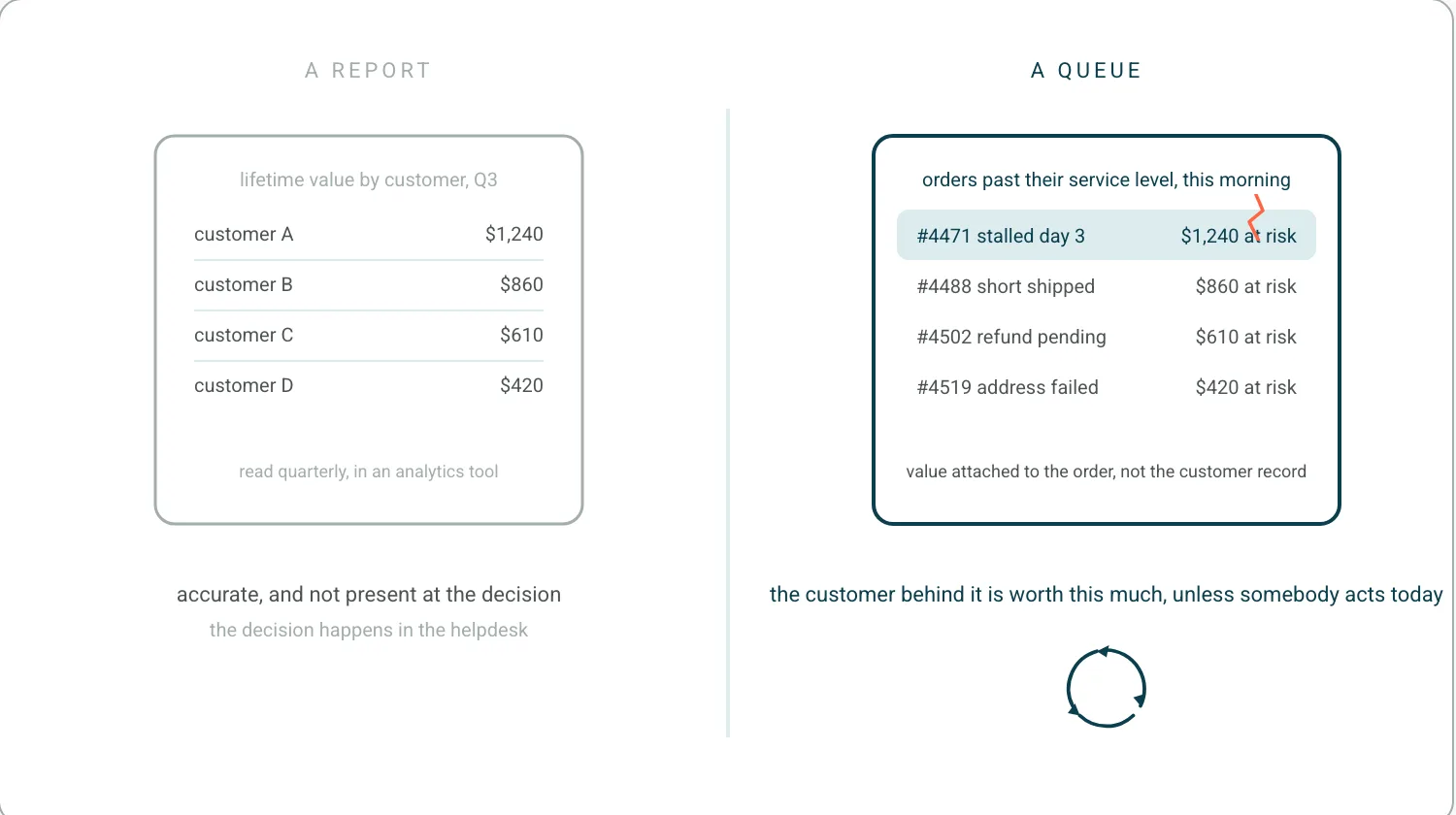
A model becomes operational when it is attached to a decision. There are three common attachments. A retention budget sets the maximum worth spending to retain a customer of a given value. A service policy sets the goodwill authority an agent can exercise without escalation. A prioritization rule orders the support and recovery queue. Operationalizing any of the three requires the value to be available at the moment of the decision, which usually means it must reach the helpdesk or order system rather than living in an analytics tool. A model that is accurate but not present at the point of decision changes nothing.
Presence at the point of decision is the requirement almost every implementation fails. The value sits in a business-intelligence tool, the decision happens in a helpdesk, and the two never meet. What makes it operational is attaching the number to an order rather than to a customer record: this order has broken its service level, the customer behind it is worth this much, and that amount is now at risk unless somebody acts today. Then the model is not a report. It is a queue.
Predictive churn prevention
Predictive use means estimating value alongside churn probability, so that intervention effort is directed at customers who are both valuable and at risk. In non-contractual ecommerce this normally uses purchase recency, frequency, and monetary value as the base, with the probability models published by Fader and Hardie estimating the likelihood a customer is still active. The addition worth making in an operations context is experience data: whether a recent order was late, incomplete, stalled in transit, or generated a complaint. Those events are strong short-horizon churn predictors and they are usually absent from models built purely on transaction history.
Almost every lifetime value model in ecommerce is built from transactions, and transactions are the one thing that cannot tell you a customer is about to leave. Recency, frequency and monetary value describe what somebody has already done. The late delivery, the parcel that stopped moving, the refund that took three weeks, none of those appear anywhere in that model, and they are the events that actually decide whether the next order happens. Every order is a promise, and a model that cannot see a broken promise is predicting churn from the symptom rather than the cause. That is the whole argument of the churn risk page, which covers the signals worth carrying into the model. Adding operational events is not a modelling upgrade, it is the difference between forecasting the loss and preventing it.
Support prioritization
Prioritization applies the model to the support queue: which contacts are handled first, which get more generous resolution, which are escalated. Value alone is a poor sole criterion, because it systematically deprioritizes new customers whose modeled value is low by construction, so most implementations combine value with severity signals such as a breached delivery promise, repeat contact on the same order, or order value in dispute. Resolution time covers how those severity signals change what the queue is actually measuring. The governance question worth settling before deployment is what the business is prepared to say publicly about differential service levels.
There is a cleaner way through that governance question than ranking customers by worth. Prioritize by broken promise rather than by value, and the ordering becomes defensible to anyone who asks: we serve the customers we have let down first. It also produces a better business outcome, because it catches the first-time buyer the model scores lowest and whose first experience decides whether there is ever a second order. This is the argument for treating a support team as something other than a cost line, and it is the one I made on the Retail Fest post-purchase panel. Given the right queue they are retaining customers and building relationships with the best ones, which is a different job from closing tickets quickly, and it is what proactive customer service means in practice.
Ready-to-use templates
Buyers searching this term frequently want a workable calculation rather than theory. The minimum viable model needs average order value, purchase frequency per period, expected retained lifespan or a retention rate, and gross margin, calculated per cohort rather than blended. The customer lifetime value formula page carries that sheet, including the cost-to-serve adjustment this section leaves out. A cohort table with intake month as rows and elapsed periods as columns supports both the historical average and a simple retention curve. Anything more sophisticated should wait until the simple version is being used, since most models fail on adoption rather than on accuracy.
Vendor & tool evaluation
Tools that produce lifetime value fall into three groups: analytics and business-intelligence platforms that compute it from warehouse data, customer-data platforms that compute and activate it into marketing tools, and point solutions inside ecommerce or retention products. The evaluation criteria that matter operationally are which data sources the tool can read, whether it computes per cohort, whether the value can be pushed to the systems where decisions happen, and whether it can incorporate non-transactional events such as delivery failures and support contacts. Ecommerce customer lifetime value covers what those inputs look like for a retail business specifically, and what customer lifetime value is covers the definition and the levers this page assumes.
Frequently Asked Questions
How do I calculate customer lifetime value?
Historically, sum a customer's order values, apply gross margin, and subtract their attributable service costs. Predictively, estimate value alongside the probability the customer is still active, which in non-contractual ecommerce is inferred from purchase recency, frequency and monetary value rather than observed. Which approach suits the business is what this page is about, and the sheet itself is on the customer lifetime value formula.
What is a good customer lifetime value?
Any external figure is weak evidence here, because repurchase cadence is category-determined. The defensible comparison is a business against its own cohorts. The addition worth making is a split on whether the customer's order experienced an operational failure, which is the only version of this number that tells an operations team anything they can act on.
What is a good CLV to CAC ratio?
Three to one is the figure usually quoted. Treat it as a convention rather than a benchmark, and note which lever a business is pulling to reach it. Cutting acquisition cost is the common route. Raising the retained lifespan by removing the failures that end relationships is the slower one, and it does not need re-running every quarter.
References
- Fader and Hardie, Wharton. Wharton work on customer-base valuation. The contractual versus non-contractual split in the definition.
- Fader and Hardie, Wharton. probability models published by Fader and Hardie. The recency, frequency and monetary base of a predictive model.
Ready to Stop Reacting?
The fastest way to see how Keeyu prevents complaints is to see it in action.
In one call, we’ll map your current operations, show how our AI Agent fits in, and walk through real examples of issues fixed before customers notice.
Most teams go live within 48 hours. We never share your data.

