
Ecommerce customer lifetime value
 Verified & Reviewed


 Copy Link
Customer lifetime value in ecommerce is the profit a customer produces across every order they place, and in a business with no subscription to cancel it is decided almost entirely by whether the second order happens. The largest influence on that decision after product satisfaction is the delivery and returns experience, which makes lifetime value an operational output rather than only a marketing one. This page traces the link from a late or incomplete order to the repeat rate, sets out the levers a support team holds, and shows how to build the financial case and the connecting metrics from records the business already keeps. The definition and the four levers sit with what customer lifetime value is, and the spreadsheet with the customer lifetime value formula.
The operational link to post-purchase
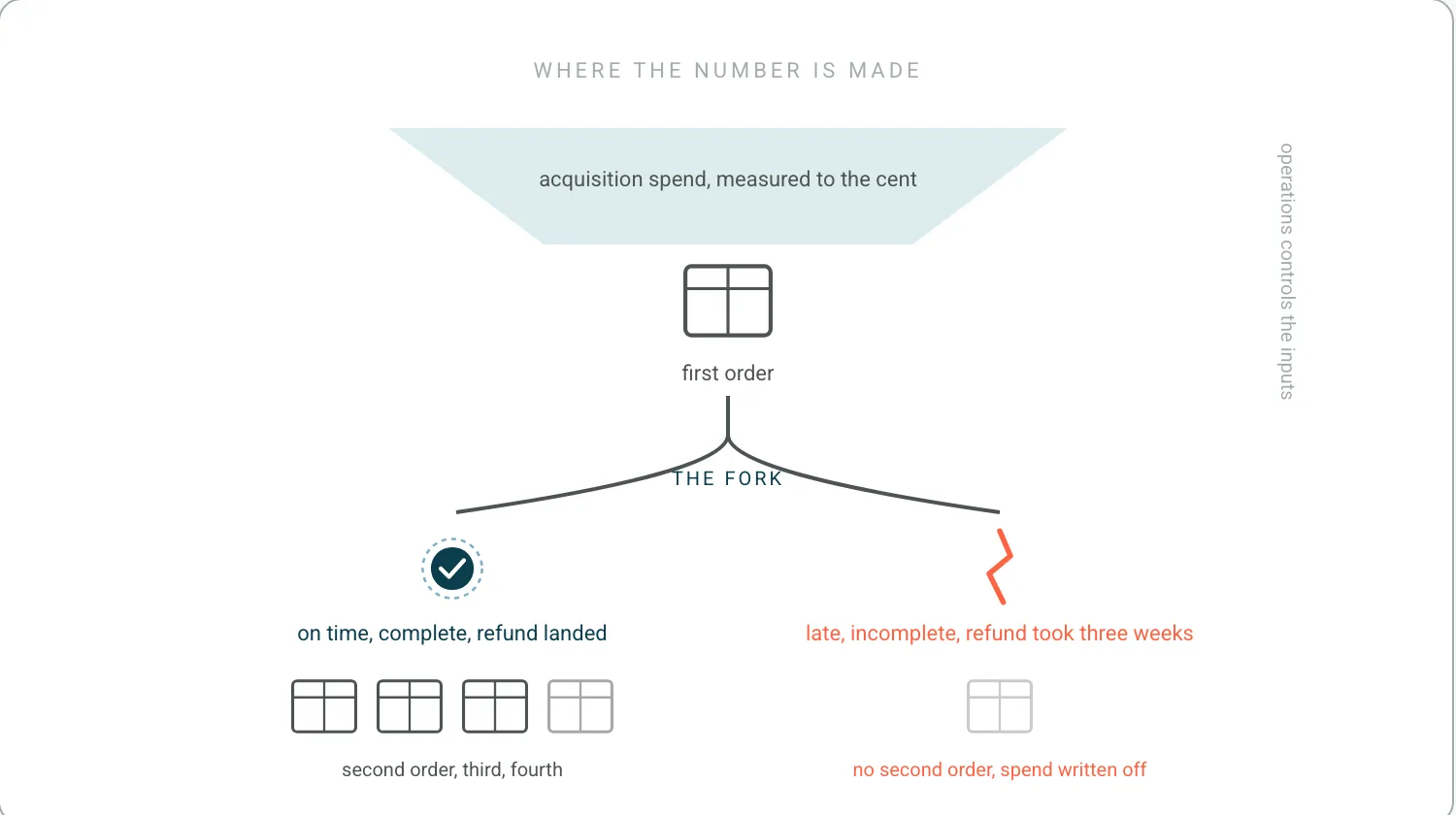
Customer lifetime value in ecommerce is determined largely by whether customers order a second time, and the single largest influence on that decision after product satisfaction is the delivery and returns experience. This makes lifetime value an operational output, not only a marketing one. The chain is direct. An order that arrives late, incomplete, or not at all reduces the probability of a repeat purchase. That probability applied across affected orders is a measurable revenue effect. The operations team controls the inputs. Most businesses hold every record needed to quantify it and analyze it in neither marketing nor operations, because the question sits in the gap between them.
The link is real and the reason most teams miss it is a sequencing problem rather than an analytical one. Lifetime value gets prioritized as a metric late, once acquisition cost has stopped working, and by then the operational failures that suppress it have been running for years without anyone attributing them. Prioritize it from day one, alongside acquisition cost and first-purchase behavior rather than after them, and post-purchase stops being a service function and starts being the place the number is actually made. That is the argument I took to the eCommerce Australia podcast, and it is why churn risk belongs to operations rather than to a quarterly report.
Actionable levers for support teams
Support influences lifetime value through resolution quality rather than resolution speed. The levers available are recovery generosity calibrated to the customer's value and the severity of the failure, first-contact resolution so the customer is not made to chase, and proactive contact where the business knows about a problem first. The research case for putting effort ahead of delight is Harvard Business Review's, and it is the reason chasing is the expensive part rather than the tone of the reply. A practical implementation surfaces the customer's value and order history in the agent's view, and sets goodwill authority limits by value band so recovery decisions do not require escalation. The measure of whether it works is repurchase rate among customers who contacted, compared against those who did not.
Financial justification for better tools
Lifetime value is what converts a post-purchase tooling case from a cost argument into a revenue one. The structure is: the number of orders per period experiencing an operational failure, the difference in repurchase rate between affected and unaffected customers, and the lifetime value of the customers that difference represents. That produces an annual revenue-at-risk figure, against which tooling cost is compared. Finance functions generally challenge the churn-delta input hardest, so it should come from the business's own cohort analysis rather than a published figure. The customer lifetime value formula page carries that cohort sheet, and customer lifetime value model covers which model the delta belongs in.
Cost-to-serve vs. CLV balance
Cost to serve is the other half of lifetime value and is frequently ignored, which produces a distorted view of which customers are valuable. It includes shipping and returns costs, support contacts, and the cost of recovery actions such as reships and goodwill credits. A high-revenue customer with a high return rate and frequent contact can be worth less than a lower-revenue one who never contacts. Calculating value net of cost to serve changes retention priorities and, in some categories, changes which segments are worth acquiring at all. What customer lifetime value is covers the four levers this trade-off sits inside.
Metrics that connect retention to logistics
There are three connecting measures. Repurchase rate, split by on-time delivery, by order completeness, and by whether a return occurred. Time to second order, compared between customers with and without a failed delivery. Lifetime value by cohort, segmented on delivery performance. These are the measures that let an operations team demonstrate a revenue effect rather than a service-level one, and they are constructible from order, shipment, and support records that most businesses already retain. Where the shipment events come from more than one carrier or warehouse, the GS1 EPCIS standard is the vocabulary the industry uses to make them comparable, which matters more than it sounds when the same event is called three different things by three systems. Producing them once is usually enough to change how post-purchase performance is discussed internally.
There is one metric that does this connecting on its own and it is worth naming. Attach the lifetime value to the order rather than to the customer, then flag the orders that have broken a service level, and the result is the amount of future revenue currently sitting inside orders that are going wrong today. It reads as a number a team can work through this morning rather than as a quarterly analysis, and it puts the two halves of this page in the same view: the logistics event on the left, the retention consequence on the right. What to do with the resulting queue is reduce churn. Every order is a promise, and this is what an unkept one costs, before it costs it.
Frequently Asked Questions
How do I calculate lifetime value for my ecommerce store?
Start from your own cohorts rather than a formula. Group customers by the month of their first order, track what share order again at 30, 60, 90 and 365 days, apply gross margin, and subtract cost to serve. The customer lifetime value formula carries the sheet. The ecommerce-specific addition is to split those cohorts on whether the order was delivered on time and complete.
What is a good customer lifetime value?
Not a number anyone else can give you. Repurchase cadence differs enough between consumables, apparel and considered purchases that a single ecommerce figure describes none of them. What travels is the shape of the comparison: your own repurchase rate, split by delivery performance, tracked over time.
What is customer lifetime value?
The total profit expected from one customer across the whole relationship, not just their first order. Covered in full on what customer lifetime value is. What this page adds is that in ecommerce it is an operational output as much as a marketing one, because the largest influence on a second order after product satisfaction is the delivery and returns experience.
References
- Harvard Business Review. Harvard Business Review's. Effort, not delight, as the support lever.
- GS1. GS1 EPCIS standard. Making shipment events comparable across carriers and warehouses.
Ready to Stop Reacting?
The fastest way to see how Keeyu prevents complaints is to see it in action.
In one call, we’ll map your current operations, show how our AI Agent fits in, and walk through real examples of issues fixed before customers notice.
Most teams go live within 48 hours. We never share your data.

