
How to reduce churn in ecommerce
 Verified & Reviewed


 Copy Link
Reducing churn means increasing the share of customers who buy again, by removing the reasons they stop. In ecommerce, where there is no subscription to cancel, the levers divide into two groups: preventing the experiences that make customers leave, and intervening with customers showing signs of leaving. The first is an operations problem and the second is a marketing one, and they are usually owned by different teams, which is why churn work often addresses only half of it.
Remove reasons to leave before adding reasons to stay
The experiences most strongly associated with customers not returning are concentrated in the post-purchase window: a delivery that arrives late or not at all, an order that ships incomplete, a return that is difficult to initiate, and a refund that takes longer than expected. The last one has a floor set in law rather than by policy, since 16 CFR Part 435 requires a US seller to refund within a defined period once an order cannot be shipped as promised. Each is addressable through operations rather than incentives. The practical sequence is to measure repurchase rate for customers who experienced each failure type against those who did not, rank the failure types by the revenue that gap represents, and fix in that order. This produces a retention program that costs nothing in discounts, because it removes reasons to leave rather than adding reasons to stay. That is the effect Reichheld and Sasser measured in Harvard Business Review, where small reductions in defection produced disproportionate profit, and it is why the failure types are worth ranking before anything is spent. Reasons for customer churn covers that ranking.
The arithmetic here is what makes it worth doing before anything else. A brand will spend fifty dollars acquiring a customer and then lose them over a two dollar shipping delay that nobody told them about. The delay is not usually the thing that loses them either. The silence is. Retention in ecommerce is not really a strategy problem, it is a blind spot: the failures that cost the most are the ones nobody in the business can see while they are happening, because the only system that knows is the one nobody is watching. Which orders those are is what churn risk exists to surface, and closing the loop on them is what a post-purchase experience platform is for.
How common that blind spot is showed up in our own research. Of the 786 pain points we mined from 270 customer call transcripts between May 2025 and May 2026, the most repeated theme was CX teams running fully reactive, discovering a system problem only when a customer raised a ticket. Delivery exceptions were a large share of it, from lost-in-transit parcels to carrier-network failures with no detection and no workflow behind them. The failure types that lose the most customers are exactly the ones the brand cannot see.
Timing beats the offer
The second group is the intervention layer: service recovery immediately after a failure, reactivation as a customer's purchase gap extends past their own norm, win-back offers for lapsed customers, and payment recovery where a subscription card fails. Effectiveness depends more on timing and sequencing than on the offer. Recovery should follow the fix rather than substitute for it, since compensation offered while a problem is unresolved reads as a payoff. Reactivation should be calibrated to each customer's own cadence rather than a fixed interval, because a fixed interval is early for some categories and far too late for others. Whether the send is even permitted is a separate test from whether it is well timed, and the CAN-SPAM compliance guide is where that line sits for US email.
Split the cohort by whether the order failed
Churn reduction should be measured on repeat-purchase rate by cohort rather than on a blended churn figure, which moves with acquisition volume and hides the effect of the work. The clearest read is the second-order rate for a given intake month, tracked over time, and the same rate split by whether the customer experienced an operational failure. Where the failure in question is a late delivery, the carrier's own definition is worth borrowing rather than inventing: USPS publishes how it measures service performance against a stated standard. The blended-rate problem itself belongs to churn rate in ecommerce. Lifetime value follows from those, and is the number that makes the case to a finance audience.
There is one pairing worth putting on the same slide, and it exposes almost everything. High satisfaction scores next to high churn means recovery is working and prevention is broken. You are handling the complaints beautifully, and the customers who never complained are gone. That is the measurement problem in a sentence, because attrition does not arrive as a complaint. It arrives as silence, and silence does not appear in any support metric ever designed. Split the cohort by whether the order had an operational failure and the silence becomes visible.
Prevention compounds, campaigns repeat
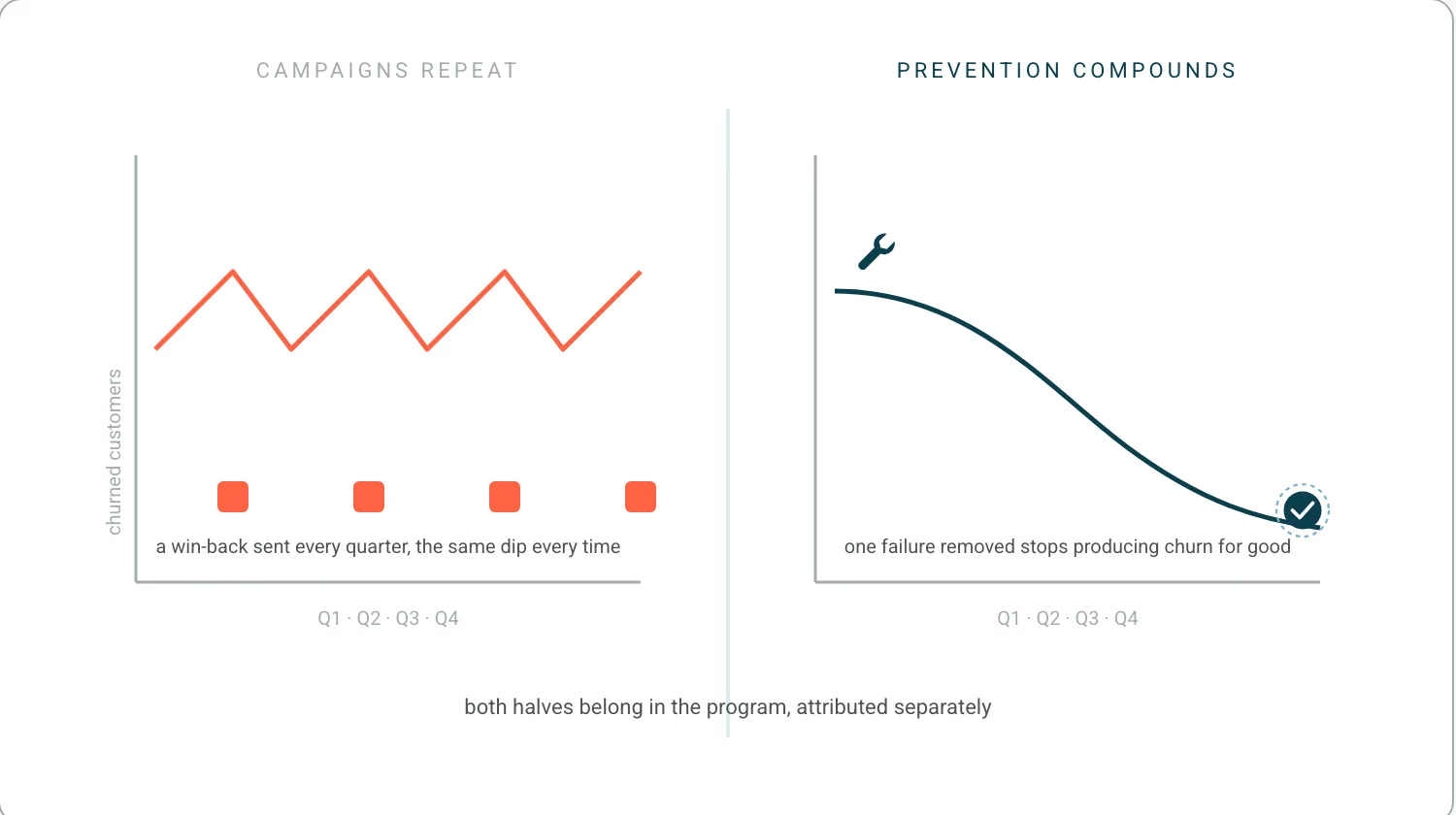
Most churn programs are staffed on the intervention half, because it sits with marketing and is easy to launch. The operational half is slower, cheaper per unit of effect, and compounding. A serious program runs both and attributes them separately, so the intervention layer is not credited with retention that better operations delivered. That separation is also what stops a business concluding its win-back campaign works when what changed was its dispatch performance.
Everyone told us deflection was the future of customer experience. Faster bots, smarter responses, better answers. We disagreed, and I have said so often enough that it is on the record, including on This Week In Startups Australia. The reason is the same reason this section exists: deflection is still reactive, you are only reacting faster, which is the whole of proactive versus reactive customer service. The customer still had the problem and still had to come to you. The intervention half of a churn program has exactly that shape. The operations half is slower and it compounds, because a failure you remove stops producing churned customers for good while a campaign has to be run again every quarter. Every order is a promise, and the cheapest retention program is the one where the promise was kept.
Frequently Asked Questions
How do you prevent churning?
Two halves, usually owned by different teams. Prevent the experiences that make customers leave, which is operational, and intervene with customers showing signs of leaving, which is marketing. Most programs are staffed on the second because it is easier to launch. The first is slower, cheaper per unit of effect, and compounds, because a failure removed stops producing lost customers permanently.
What is churn in business?
Customers ending the relationship. In ecommerce there is no cancellation event, so it is inferred from a repurchase that does not happen. Churn rate in ecommerce covers how the rate is defined and why two businesses reporting different numbers are often reporting different windows.
What does a 20% churn rate mean?
One customer in five did not return inside the measurement window. The figure is only actionable once it is split: the same 20% means something different when it is concentrated in customers whose orders went wrong than when it is spread evenly, and only the first version tells you what to fix.
References
- US Electronic Code of Federal Regulations. 16 CFR Part 435. The refund floor behind "a refund that takes longer than expected".
- Harvard Business Review. Reichheld and Sasser measured in Harvard Business Review. Why removing failures beats adding incentives.
- US Federal Trade Commission. CAN-SPAM compliance guide. Whether a reactivation send is permitted, separately from whether it is timely.
- United States Postal Service. USPS publishes how it measures service performance. A stated standard to measure late against.
Ready to Stop Reacting?
The fastest way to see how Keeyu prevents complaints is to see it in action.
In one call, we’ll map your current operations, show how our AI Agent fits in, and walk through real examples of issues fixed before customers notice.
Most teams go live within 48 hours. We never share your data.

