
Post-purchase experience platform
 Verified & Reviewed


 Copy Link
A post-purchase experience platform is software that manages the customer's experience between dispatch and settlement: tracking, notifications, returns, and the branded surfaces those appear on. The category emerged to fill the gap between the ecommerce platform, which ends at checkout, and the helpdesk, which begins at contact. Its defining characteristic is that it owns the customer-facing layer of the post-purchase journey rather than the operational layer beneath it.
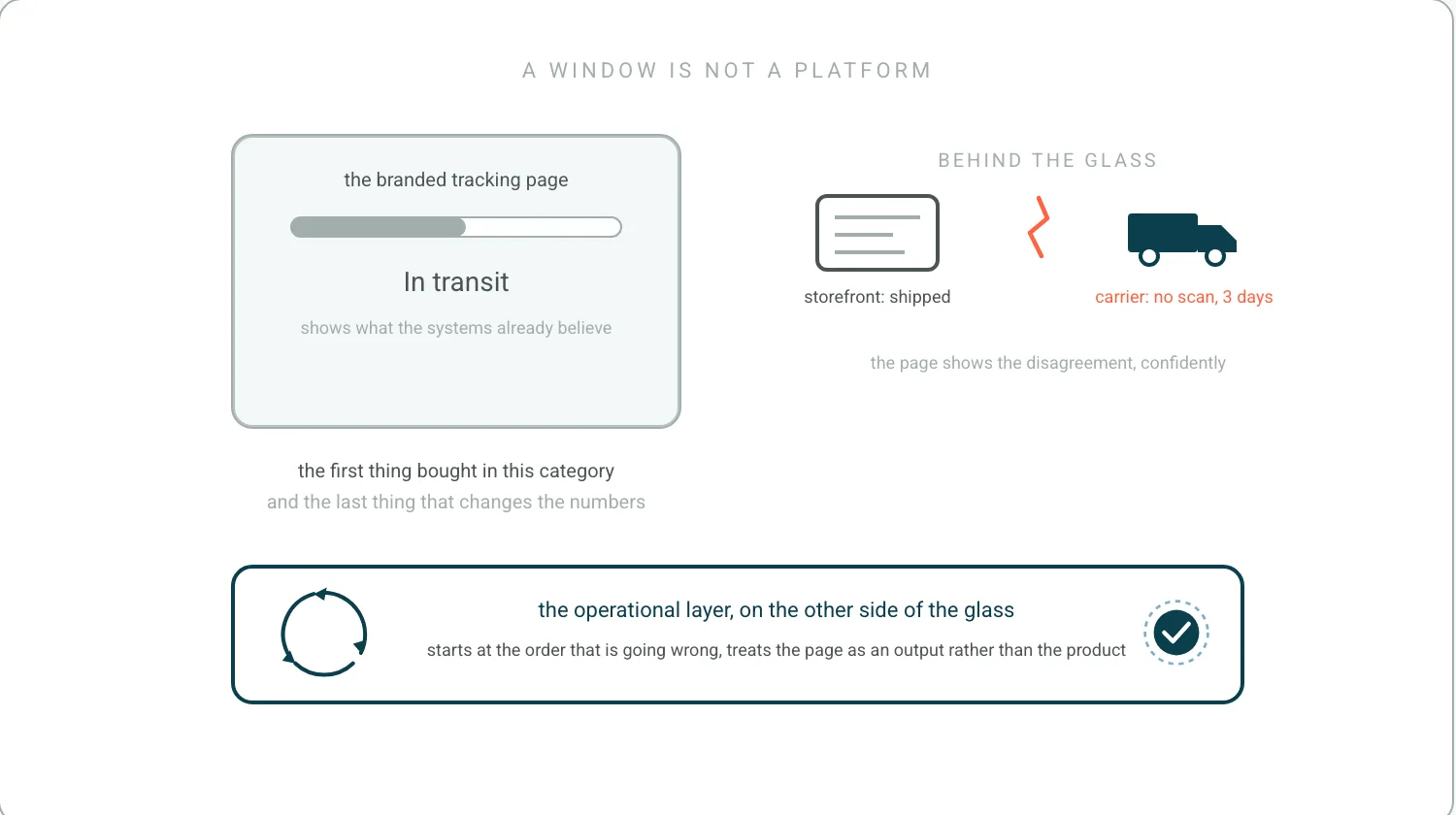
A tracking page is a window, and a window is not a platform
A branded tracking page replaces the carrier's page with one on the merchant's domain. Its value is that the highest-traffic page in the post-purchase journey stays under the brand's control, carrying its design, its support entry points, and often merchandising. Operationally it also normalizes a multi-carrier estate into a single customer experience. What it presents is status supplied by the carrier, so its accuracy is bounded by the carrier feed and its usefulness by whether the underlying order is progressing. The feed is a real constraint rather than a rhetorical one: the USPS Track and Confirm API reports scans, at the moments a parcel is scanned, and a page built on it can be no fresher than that. The customer-facing version is customer order tracking and the merchant-facing one is order tracking software. What a whole post-purchase sequence looks like when it is done well is an ecommerce experience example.
Worth saying plainly on the page that defines this category: a tracking page is a window, and a window is not a platform. It shows the customer what the systems already believe, and where those systems disagree with each other it shows the disagreement confidently. That is why the branded tracking page is the first thing bought in this category and the last thing that changes the numbers. Proactive e-commerce operations starts on the other side of the glass, at the order that is going wrong, and treats the page as an output rather than as the product. The distinction is proactive versus reactive customer service applied to a buying decision.
The hard capability is detecting the event that did not happen
Notifications push order events to the customer at defined milestones: confirmed, shipped, out for delivery, delivered, and in better implementations delayed. The message set is shipping notifications, and which channel each one uses is communication preferences. The category term "proactive" here means the message precedes the customer's enquiry, which is a lower bar than it sounds, since it requires only an event and a template. The harder capability, and the one that varies most between vendors, is detecting the absence of an expected event, such as a label created but never scanned, because that requires evaluating what should have happened rather than reacting to what did. Expressing what should have happened in a form several systems agree on is what the GS1 EPCIS standard exists for, and the promise being evaluated against is the delivery promise.
The one capability that touches goods and refunds, not just messages
Self-service returns give the customer a path to initiate a return, receive a label, and follow its progress without contacting anyone. The platform enforces policy, generates the label, tracks the inbound parcel, and communicates status. Where the policy meets US law rather than merchant preference is 16 CFR Part 435. Differentiation sits in policy flexibility, exchange and store-credit conversion, and the handling of exceptions such as items arriving unlabeled or outside policy. The full process is returns management. This is the most operationally consequential capability in the category because it touches physical goods and refunds rather than only messaging.
Same feature name, different product
Carrier coverage determines how much of a merchant's estate the platform can serve, and the practical questions are which carriers are supported in which regions, how tracking events are normalised across them, and how quickly events propagate. Coverage gaps are the common disappointment, since a platform that covers the primary carrier but not the regional one leaves a segment of orders outside the experience it was bought to unify. What that connection work actually involves is carrier integration, and the wider connector layer is third-party integrations.
The depth of these integrations is what separates platforms in this category and it is almost never on the comparison sheet. A returns status that comes from a deep connection to the delivery network means nobody on the merchant's team has to log into a carrier portal to answer a question, and the customer sees the status change as it happens rather than when somebody checked. A shallow connection produces the same page with older information in it. Same feature name, different product, and the difference shows up in resolution time rather than on the comparison sheet.
The size of that difference is in the 786 pain points we mined from 270 customer call transcripts between May 2025 and May 2026: tracking information was the most consistently broken integration layer of all, and feeds taken through an intermediate were routinely four to eight hours behind the carrier because of infrequent polling. A platform whose returns and delivery status come through a shallow connection is showing the customer where the parcel was this morning.
Display, alert, or resolve: the axis vendors never present
Pricing is typically per order, per shipment, or tiered by volume, which makes cost predictable and ties it to scale rather than to value delivered. The evaluation question that matters more is exception handling: what the platform does when an order goes wrong, as distinct from what it displays. Some products in this category detect exceptions and surface them. Fewer act on them. The boundary between displaying, alerting, and resolving is the most useful axis for comparing vendors and is rarely presented that way in their own materials.
The exception half is the reason this category exists and the reason it is hard, and I will be honest about why we ended up here. It is, as I put it on The Ecommerce Edge, an unsexy problem that a lot of people looked at and decided was too hard, which is exactly what makes it a natural moat for anyone willing to do it. Tracking pages and notification flows are pleasant to build and demo well. Watching every order against the promise made at checkout, across the storefront, the warehouse, the carriers and the returns platform, and acting when one of them slips, is neither. Every order is a promise, and the platform question is whether the thing you are buying keeps promises or just reports on them. What happens when one breaks is the complaint resolution process, what it costs when nobody acts is reduce churn, and the operating model is post-purchase operations.
Frequently Asked Questions
What is the post-purchase experience?
Everything the customer meets between paying and being satisfied: the confirmation, the status messages, the exception handling when something goes wrong, and the resolution path. The first two are near-universal. The last two are where experiences differ, which is also where this software category earns or fails to earn its price.
What does post-purchase mean?
The stage after payment, covering delivery, returns and support. This page is about the software category built for it, which sits between the ecommerce platform, which ends at checkout, and the helpdesk, which begins at contact.
What are CX products?
Software for managing the customer experience, which in ecommerce spans helpdesks, feedback and survey tools, tracking and returns platforms, and the operations layer underneath them. The distinction worth holding is between products that present what happened and products that change it, and most of this category does the first.
References
- United States Postal Service. USPS Track and Confirm API. What a carrier feed actually reports, and how fresh a page built on it can be.
- GS1. GS1 EPCIS standard. Expressing an expected event so several systems agree it did not happen.
- US Electronic Code of Federal Regulations. 16 CFR Part 435. Where returns policy stops being a merchant preference.
Ready to Stop Reacting?
The fastest way to see how Keeyu prevents complaints is to see it in action.
In one call, we’ll map your current operations, show how our AI Agent fits in, and walk through real examples of issues fixed before customers notice.
Most teams go live within 48 hours. We never share your data.

