
Resolution time
 Verified & Reviewed


 Copy Link
Settle what the clock measures before comparing it to anyone
Resolution time is the elapsed period between a customer raising an issue and that issue being settled. Published benchmarks vary widely because they measure different things: some count business hours and some elapsed hours, some stop at the agent's last reply and some at the customer's confirmation, and some exclude cases awaiting a third party. In ecommerce the last exclusion matters more than anywhere else, because a large share of post-purchase cases wait on a carrier, a warehouse, or a refund clearing. Some of those waits are published rather than guessed: FedEx sets out its own claim windows, and USPS publishes how it measures service performance against a stated standard. A benchmark that excludes third-party wait measures the support team. One that includes it measures the customer's experience.
Before comparing a resolution time to anybody else's, settle what the clock is measuring, because the industry standard measures the wrong interval. The whole helpdesk category is built to report first resolution time and average handle time, and neither one asks whether the customer's order was fixed. A ticket can close inside target while the parcel is still sitting wherever it stopped. Benchmarks assembled from that measure tell you how quickly businesses close conversations, which is not the same subject as how quickly they solve problems. Building a comparison against your own orders instead is ecommerce benchmark, and the measure definitions sit with ecommerce KPIs.
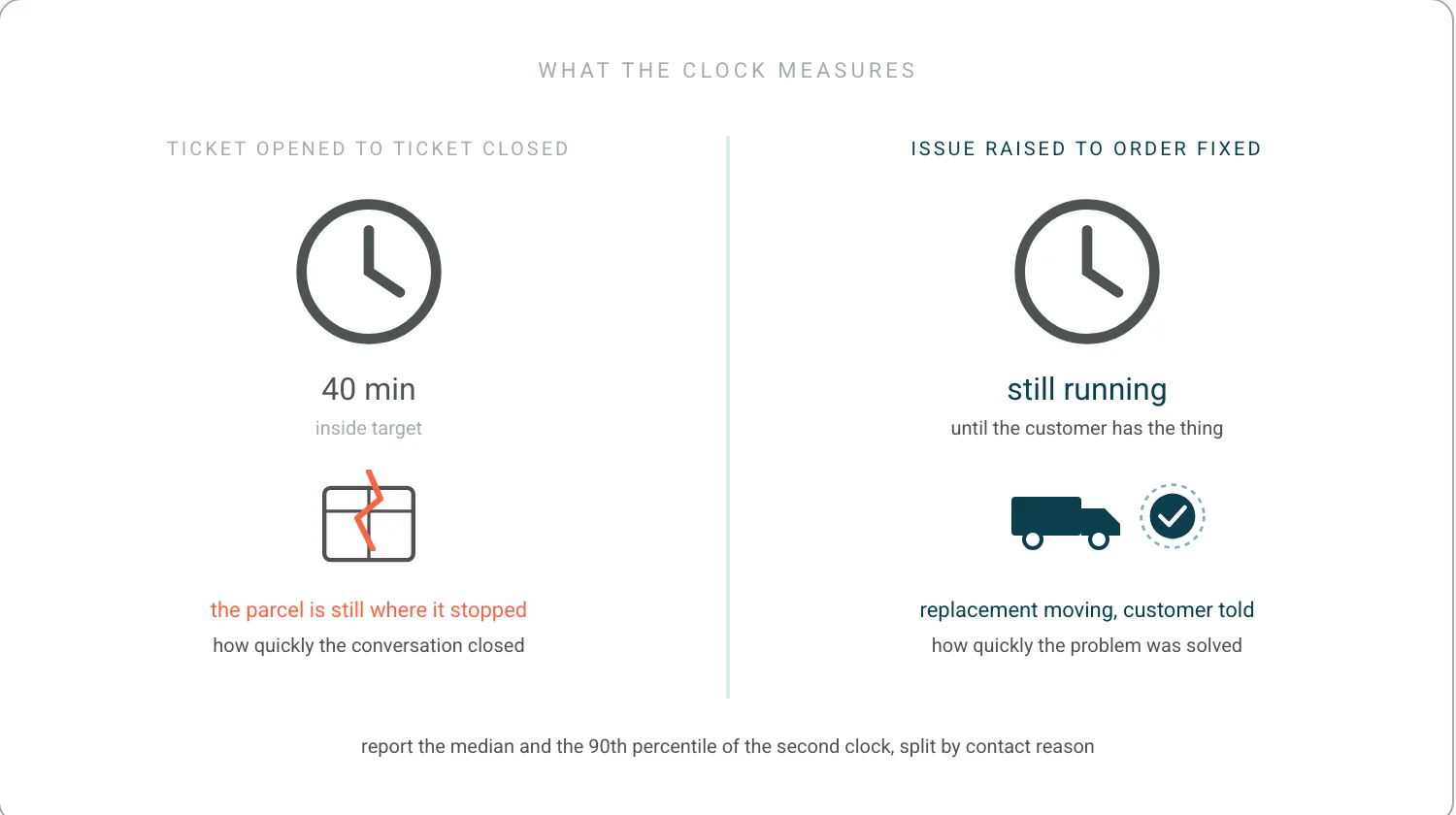
Report the median and the 90th percentile, never the average
Average resolution time is total resolution time divided by resolved cases in the period, and it is the least informative version of the measure because a small number of long-running cases distort it. More useful are the median, which describes the typical case, and a percentile such as the 90th, which describes the tail where dissatisfaction concentrates. Related measures are first response time, which sets the customer's expectation, and time to first meaningful update, which is more honest where an automated acknowledgement is sent instantly. Resolution time should be segmented by contact reason, since order-status and refund cases have structurally different floors.
First-contact resolution moves the number more than any speed initiative
First-contact resolution is the share of cases settled in one interaction without transfer or follow-up. It improves resolution time more reliably than any speed initiative, because most elapsed time in a case is queue time between touches rather than work time. Three things determine it. Agent access to order, fulfillment and carrier data in one view, which is a helpdesk question answered by third-party integrations. Authority to act without escalation within defined limits. The ability to execute the remedy directly rather than requesting it from another team. The research case for treating this as the priority is Harvard Business Review's finding on customer effort, where the work the customer is made to do predicts disloyalty better than how the reply was worded. Measuring it honestly requires counting reopens and repeat contacts about the same order, which are the two ways an apparent first-contact resolution turns out not to be one.
Three kinds of automation, and only one collapses the interval
Automation reduces resolution time in three distinct ways, and conflating them causes disappointment. Deflection removes cases entirely by answering before contact, which improves totals without improving the measure for the cases that remain. Assisted resolution shortens work time by assembling context and drafting responses. Automated resolution settles defined case types without a human, which is where the largest reductions come from and where the constraint is the ability to act on the underlying system rather than to compose a reply. Deflection is customer self-service, and the tooling layer is the automated ticketing system. Reporting should separate the three, since a rise in deflection can mask a deterioration in the resolution of real problems.
Which sets up the only automation that moves this number properly. Automating the reply shortens the part of the process that was already short. Automating the resolution means the system reads the order state across every connected platform, acts on it, and records what it did, and the interval collapses because the looking-up disappeared rather than because anyone typed faster. That is the difference between a fast support function and an operation where the ticket did not need to exist, which is proactive versus reactive customer service stated as a metric.
Most of the elapsed time is swivel-chair work
A substantial proportion of post-purchase cases cannot be resolved by the support function alone because the facts sit with a carrier or warehouse. Carrier investigation windows, claim processing periods, and warehouse inspection queues each impose a floor on resolution time regardless of support performance. A USPS Missing Mail search cannot be opened before the parcel qualifies, whatever the customer has been told, and that floor belongs in the report rather than in an apology. The operationally useful response is to distinguish cases blocked on a third party from cases in the team's own control, report them separately, and act on the blocked ones where policy allows, for instance by replacing a stalled parcel rather than waiting for the investigation to conclude. The connection work that makes the carrier state visible in the first place is carrier integration.
This is where most of the elapsed time actually lives, and it explains why resolution time resists improvement. When a business sees ticket volume spike, hiring more agents is the wrong response, because it puts humans on work that systems should be doing. Most of an agent's day on a post-purchase ticket is not resolution at all. It is swivel-chair work: opening the storefront, then the warehouse system, then the carrier portal, then back again, to assemble a picture that the systems could have assembled themselves. Every order is a promise, and the minutes being counted are mostly the minutes spent finding out whether it was kept. I made that argument on Add To Cart, and the process that surrounds this metric is the complaint resolution process, which also owns the complaint prevention rate.
The swivel-chair share is measurable. In the 786 pain points we mined from 270 customer call transcripts between May 2025 and May 2026, resolving a single ticket routinely meant toggling between three and ten or more systems, one 'where is my order' investigation opened more than 40 tabs, and one customer collapsed that investigation to a single screen. The minutes that came off their resolution time were not typing minutes.
The tail is where retention is lost
Resolution time correlates with repurchase behavior, and the relationship is not linear: the difference between same-day and next-day resolution matters less than the difference between resolved and still-waiting after several days. The tail is therefore where retention is lost, which is another argument for measuring percentiles rather than averages. The measure that connects this page to revenue is repurchase rate segmented by resolution time band, which most businesses can calculate and few do. What a retained customer is worth is customer lifetime value, and what the tail costs is reduce churn. The operating model behind all of it is post-purchase operations.
Frequently Asked Questions
What is resolution time?
The elapsed period between a customer raising an issue and that issue being settled. Published benchmarks vary widely because they measure different things: some count business hours and some elapsed hours, some stop at the agent's last reply and some at the customer's confirmation, and some exclude cases awaiting a third party.
What is a good expected resolution time?
It depends entirely on the contact reason, which is why an unsegmented target is not useful. An order-status question can be settled in minutes. A lost-parcel case cannot be settled before the carrier's own investigation window allows it, whatever the target says. Segment by reason code first, then set the target inside each.
What does resolution mean in customer service?
That the customer's problem is settled, not that the ticket is closed. The distinction is the whole argument of this page: a ticket closed while a replacement is still in transit has been resolved in the queue and not for the person waiting, and only one of those two readings predicts whether they order again.
References
- FedEx. FedEx sets out its own claim windows. A third-party floor on resolution time, published by the third party.
- United States Postal Service. USPS publishes how it measures service performance. What a stated delivery standard actually is.
- United States Postal Service. USPS Missing Mail search. When a lost-parcel case can be opened at all.
- Harvard Business Review. Harvard Business Review's finding on customer effort. Why first-contact resolution beats speed initiatives.
Ready to Stop Reacting?
The fastest way to see how Keeyu prevents complaints is to see it in action.
In one call, we’ll map your current operations, show how our AI Agent fits in, and walk through real examples of issues fixed before customers notice.
Most teams go live within 48 hours. We never share your data.

