
Automated ticketing system
 Verified & Reviewed


 Copy Link
An automated ticketing system is helpdesk software that creates, classifies, routes, and in some cases resolves customer support tickets without an agent handling each step. In ecommerce the inbound volume is dominated by order-status and returns questions, so automation in this category is judged less on natural-language quality than on whether it can reach order data and act on it. The term is used for two different things: automation of the ticket workflow, and automation of the answer. The distinction is not only editorial, since IEEE 2755 exists precisely because this vocabulary drifted, and the helpdesk the system sits inside is a different product from either.
It has to read the order, not just the message
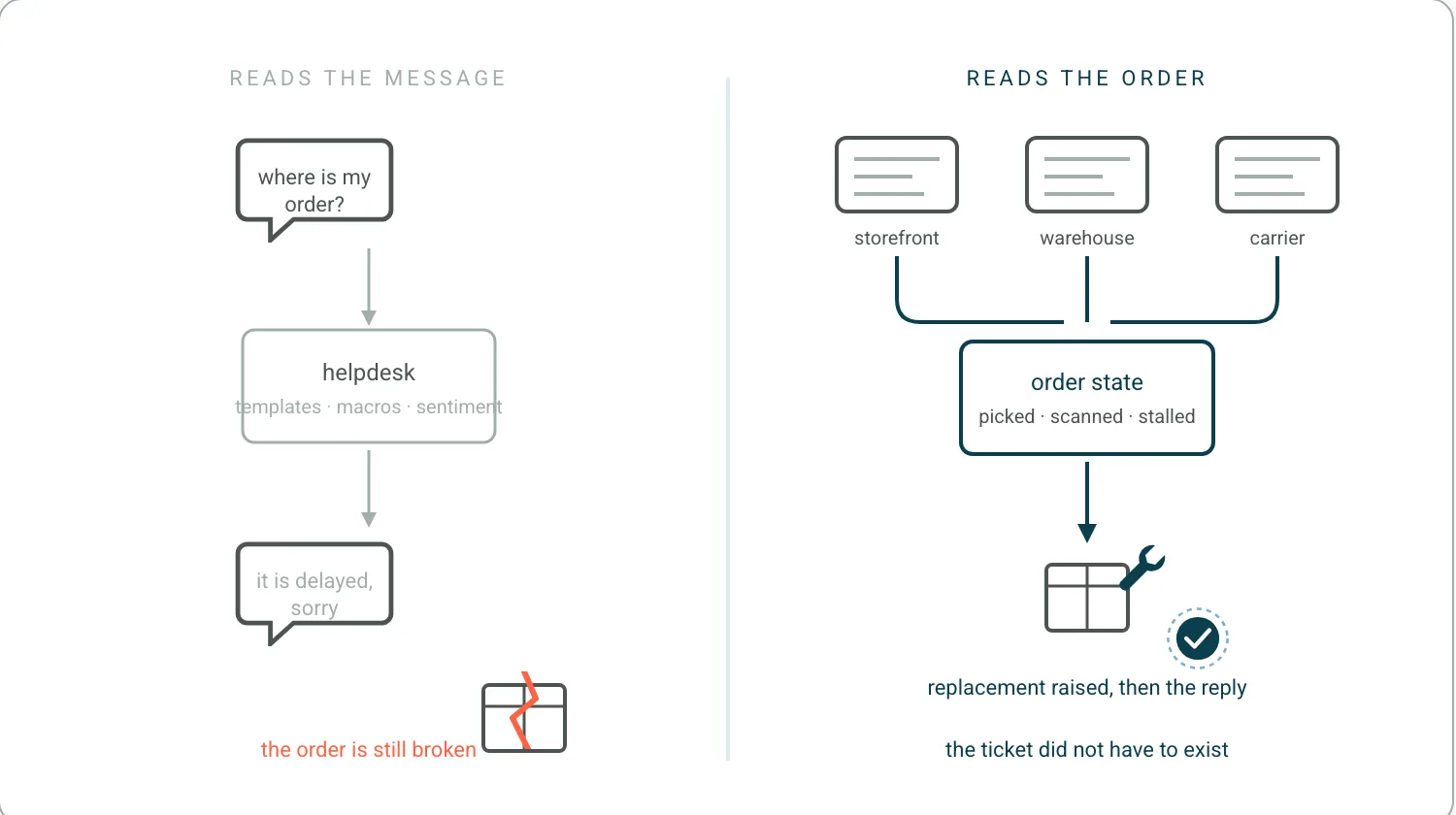
The distinguishing requirement is that the system reads order state, not just message text. That means a live connection to the storefront for order and customer records, to the fulfillment system or third-party logistics provider for pick and dispatch status, and to carriers for tracking events, which arrive as scans rather than as answers, as the USPS Track and Confirm API shows plainly. The connection work is third-party integrations. Without those, an automated reply can only restate what the customer already told it. Depth of integration also determines whether the system can identify the order a message refers to without asking, which is the difference between a one-touch resolution and a three-message exchange. Integration coverage should be assessed per channel and per warehouse, since partial coverage produces confidently wrong answers on the uncovered subset. The system layer that holds the order in the first place is the order management system.
Answering the ticket is not fixing the order
There is a meaningful line between systems that compose a reply and systems that change something. Answering "your parcel is delayed" resolves the ticket in the queue but not the problem, and the customer generally returns. Acting means issuing the replacement, processing the refund, reshipping, editing the order, or updating the address, then confirming what was done. Some of those are bounded by law rather than by policy, which 16 CFR Part 435 sets out for US sellers, and an unattended workflow has to respect the earlier of the two clocks. Buyers evaluating this category are increasingly asking which actions a system can take unattended, which require approval, and what audit trail exists for each. The practical test is whether resolution requires an agent to open another system afterwards.
This is the line that matters and it is not a feature gap, it is architectural. Helpdesk ticketing has been reactive since Zendesk created the category twenty years ago, and everything built on top of it assumes a ticket exists before the work starts. You cannot retrofit that into prevention by adding better automation to the reply, because the whole system, including how it is sold and priced, begins at the moment a customer complains. Proactive e-commerce operations starts one step earlier, at the order that is going wrong, and treats the message as the last step rather than the product. I put the same case on Add To Cart, and the distinction in full is proactive versus reactive customer service.
Deflection removes the contacts where nothing is wrong
Deflection is the pre-ticket layer: an order lookup, a tracking page, a returns portal, or a help-center flow that answers the question before a ticket exists. The concept is customer self-service and the catalogue is self-service options. Order-status enquiries are the highest-volume and most deflectable category, because the answer is deterministic when the data is available. Deflection has a natural ceiling, though. It resolves the cases where nothing is wrong, and leaves the cases where something is, which is why deflection rate and resolution rate should be tracked separately. A rising deflection rate alongside a rising escalation rate usually indicates the underlying operational failure rate is growing.
The ceiling is measurable. In the 786 pain points we mined from 270 customer call transcripts between May 2025 and May 2026, WISMO and delivery delays were the single largest customer-driven ticket category, and the teams behind them were spending 15 to 19 hours a month on manual outreach for orders marked fulfilled that had never arrived. Returns were the next largest, with one brand logging 5,000 return enquiries out of 21,000 annual tickets and another taking 400 'how do I return this' tickets a month while running a returns portal. A deflection layer was already in place in most of those businesses. The tickets it left behind were the ones where the order itself had gone wrong.
Sentiment is the wrong severity signal
Triage is classification plus prioritization: identifying what the ticket concerns, how urgent it is, and who should handle it. Useful signals in ecommerce include order value, delivery promise breach, repeat contact on the same order, and whether the customer is a repeat buyer. Routing then assigns by skill, language, or region. The known failure mode is sentiment-led prioritization, which escalates angry customers and quietly deprioritizes polite ones, so a customer who states a serious problem calmly can wait longer than one who does not. Choosing a proxy that measures something other than the thing you care about is the first failure the NIST AI Risk Management Framework asks a deployer to rule out, and it is worth reading before a triage model goes live. Teams that measure this usually add an objective severity signal, such as promise breach, alongside sentiment.
The sentiment problem is worse in practice than it looks on paper. One retailer had sixty percent of tickets running through helpdesk AI, and over peak it snowballed, because the system only escalated when a customer got frustrated. The polite ones never escalated. They did not shout, they were not flagged, and they simply did not come back. That brand scaled the automation back to ten percent. Sentiment is a measure of how somebody wrote to you, not of how badly their order is broken, and a triage model built on it will always find the loudest problem rather than the worst one. Every order is a promise, and a breached promise is the objective severity signal that belongs alongside the sentiment score. The customers who never escalate are the ones churn risk exists to find.
The pricing model tells you what the vendor is paid to do
Pricing in this category has moved from per-agent seat licensing towards per-resolution or per-action models, with hybrids that combine a platform fee with usage. Per-seat pricing rewards deflection, since fewer agents are needed. Per-resolution pricing can penalize it, because a deflected contact may still be billed as an automated resolution, so the definition of a billable event matters more than the headline rate. Buyers typically model cost per resolved contact across a realistic volume range, including a peak-season month, rather than comparing list prices.
Read the pricing model as a statement of what a vendor is paid to do. A per-seat licence pays a vendor for the size of your support team. A per-ticket or per-resolution model pays them for the number of conversations you have. Neither of those is aligned with a business that wants fewer of both, and that misalignment is not an oversight, it is the business model the category was built on. We price a flat fee, not per seat and not per ticket, regardless of how many automations run, precisely because our argument is that the ticket did not have to exist. That is also the honest caveat: Keeyu is not a helpdesk and does not replace your ticketing system. It sits upstream, finds the root cause, and where a ticket is still needed it hands one over. The two sit alongside each other, which is also how the customer complaint management system and complaint resolution process pages describe the same boundary. The operating model is post-purchase operations.
Frequently Asked Questions
What is an automated ticketing system?
Helpdesk software that creates, classifies, routes, and in some cases resolves support tickets without an agent handling each step. In ecommerce the inbound volume is dominated by order-status and returns questions, so it is judged less on natural-language quality than on whether it can reach order data and act on it.
How do I create my own ticketing system?
Building one is rarely the constraint, since the ticket record itself is straightforward. What is hard, and what decides whether the result is useful, is the connection to order, fulfillment and carrier data, plus write access to change something rather than only to reply. Those are the same requirements a bought system is judged on, covered on third-party integrations.
Is Zendesk a CRM or a ticketing system?
It is a helpdesk, built around the ticket, and it created that category roughly twenty years ago. A CRM is built around the customer record and a ticketing system around the conversation, which is a genuine difference and not the one that matters most in post-purchase. The question that separates products here is whether a system can act on the order or only describe it.
References
- IEEE. IEEE 2755. Why "automating the workflow" and "automating the answer" need separating.
- United States Postal Service. USPS Track and Confirm API. Carrier data arriving as scans rather than as answers.
- US Electronic Code of Federal Regulations. 16 CFR Part 435. The legal clock an unattended refund workflow has to respect.
- US National Institute of Standards and Technology. NIST AI Risk Management Framework. Choosing a proxy that measures something other than the thing you care about.
Ready to Stop Reacting?
The fastest way to see how Keeyu prevents complaints is to see it in action.
In one call, we’ll map your current operations, show how our AI Agent fits in, and walk through real examples of issues fixed before customers notice.
Most teams go live within 48 hours. We never share your data.

