
Self-service options
 Verified & Reviewed


 Copy Link
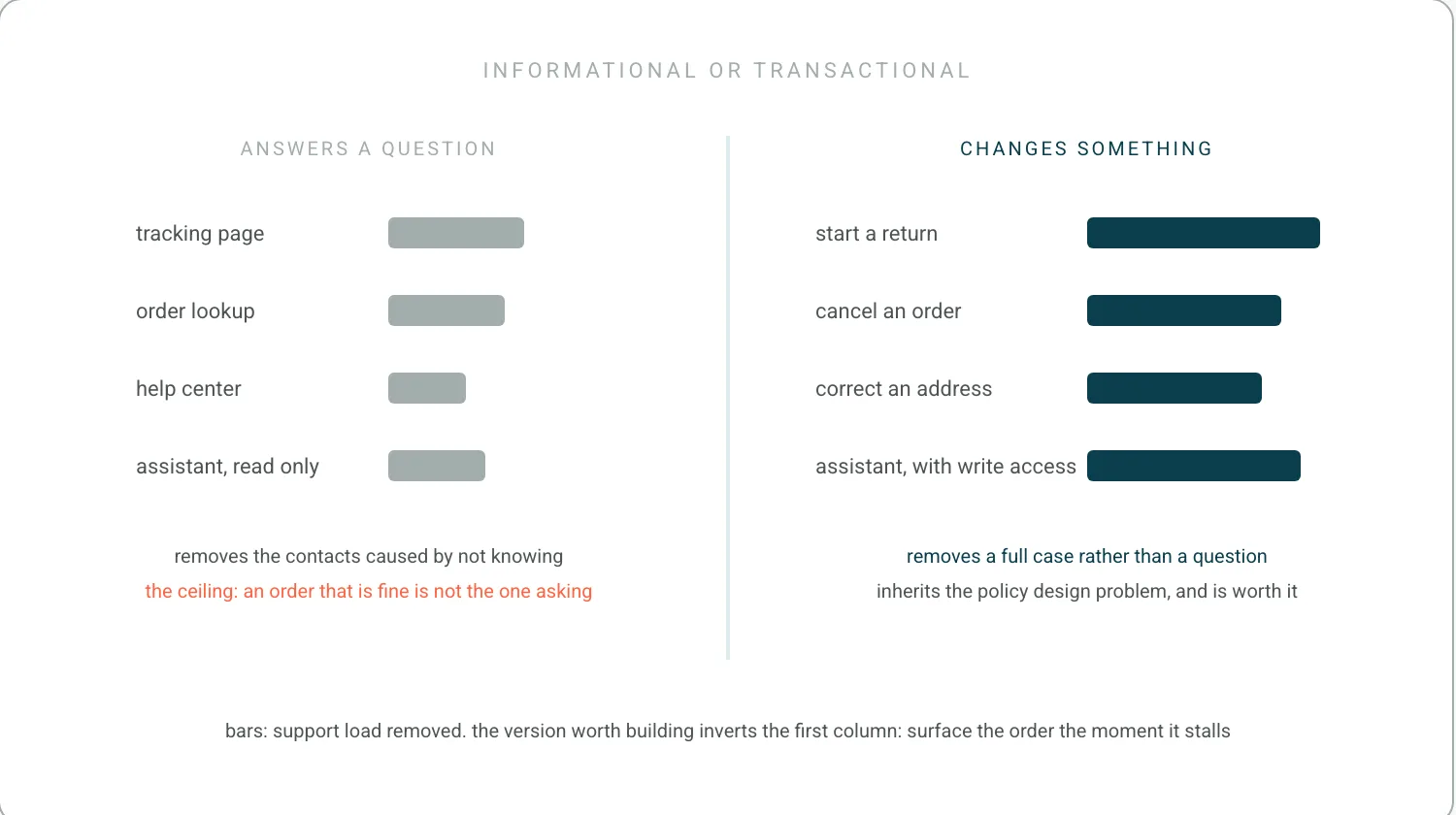
A self-service option in post-purchase operations is any capability that lets a customer complete a task themselves that would otherwise require an agent. The options divide into two classes, and the division decides how much support load each removes. Informational options answer a question, such as where an order is. Transactional options change something, such as starting a return, canceling an order, or correcting an address. Informational options are cheaper to build and reach a lower ceiling, because the contacts they remove are the ones caused by not knowing rather than by something being wrong. The concept behind the catalogue is customer self-service, the evidence base is customer self-service statistics, and the function they all serve is customer service strategy.
Tracking answers for the orders that are fine, and those are not the ones asking
A branded tracking page gives a customer the current state of their shipment on the merchant's own domain, and proactive notifications push the same information at each state change. Together they address the single largest category of post-purchase contact. What both are reading is a stream of carrier scans rather than a narrative, which the USPS Track and Confirm API sets out plainly, and joining several carriers' versions of that is carrier integration. The reach of this option is bounded in a specific way that is worth stating plainly: it answers the question for every order that is progressing normally, and an order progressing normally is not usually the one generating a ticket. The orders that produce contacts are late, stalled, split, or delivered to somewhere the customer did not find them, and for those the tracking page shows a status the customer already disputes. That contact type is WISMO.
The bound described above is the honest one, and the version of this option worth building inverts it. Rather than a page the customer visits to find out whether their order is fine, surface the order the moment it stalls, not when the customer chases. Same data, same integrations, opposite direction. One of them answers a question that has already formed and the other stops it forming, and only one of them helps the orders that are actually in trouble. That is proactive customer service applied to a feature rather than to a philosophy.
Approve the clear cases automatically, route the ambiguous ones
A self-service returns portal takes a return request, checks it against policy rules covering the order date, the item, and the reason, and issues a label or an in-store option without an agent. Some of those rules are not the merchant's to set: 16 CFR Part 435 governs refund timing for US sellers, and a policy engine that ignores it automates a breach. This is a transactional option and it removes a full case rather than a question. Exchange handling is the more valuable half and the harder one, because it needs live stock to reserve the replacement at the moment the customer chooses it. Policy design does most of the work here. A rule set that approves the clear cases automatically and routes the ambiguous ones to a person removes more load than a rule set that tries to decide everything, because the ambiguous cases are where an automatic decision creates an appeal.
The cases a portal cannot take are specific. In the 786 pain points we mined from 270 customer call transcripts between May 2025 and May 2026, brands running a dedicated returns platform still logged tickets the portal could not self-serve, most often a label that failed to generate, and 'where is my refund' tickets clustered at the nine-day mark, the point where the gap between the warehouse receiving the item and the money landing becomes visible to the customer. Neither is a policy question. Both are an operation the customer cannot see into.
The window is the entire design problem
Modification options let a customer cancel an order or correct a delivery address inside a window that closes when fulfillment commits the order. The window is the entire design problem. Set it too wide and the warehouse picks an order that is canceled a moment later, which creates the reverse-logistics cost the option was meant to avoid. Set it too narrow and the customer is refused a change that the warehouse could still have made, which produces a contact and often a return. The window has to be derived from the actual fulfillment cut-off for that location and shipping method rather than set as a single site-wide number, and it has to be communicated at the moment of purchase rather than discovered at the moment of regret. Where the cut-off actually sits is an order management question.
The label describes the interface, not the capability
A conversational assistant answers in natural language and, where it is connected to order data, can retrieve the specific order rather than an article about orders. Connection is the distinction that matters. An assistant with no order access can only restate policy, which deflects almost nothing in post-purchase, because policy is rarely what the customer is asking about. An assistant with read access can answer status questions. An assistant with write access can start a return or cancel an order, at which point it becomes a transactional option and inherits the same policy design problem as a returns portal. The category label describes the interface, not the capability, and deciding what a system is permitted to do unattended is the scoping question the NIST AI Risk Management Framework puts first. The option itself is ecommerce chatbots.
Pull rather than push, so it earns its place on repeat business
An account hub collects purchase history, invoices, subscriptions, and reorder actions in one place a customer can return to. Its contribution to deflection is different from the other options, because it is pull rather than push and depends on the customer thinking to visit it. Where it earns its place is on repeat and subscription businesses, where the same customer has several open commitments and the questions are about the relationship rather than about one order. Invoice and document access is the most reliably used feature in practice, because it serves the business buyer who needs a record and would otherwise email for it. Which features get used rather than admired is the sort of question Baymard Institute tests empirically.
High usage with high follow-on contact has moved work, not removed it
Deflection is measured as contacts per hundred orders by reason code, before and after an option launches, read as a rate rather than a count so that order growth does not disguise the result. Two supporting measures complete the picture. Self-service completion rate shows what share of customers who started a self-service task finished it, which distinguishes an option that works from one that is abandoned partway. Follow-on contact rate shows what share of self-service uses generated a ticket anyway, which is the honest test of whether the task was actually completed. An option with high usage and high follow-on contact has moved work rather than removed it. The measures sit with ecommerce KPIs and the queue behind them is the automated ticketing system.
The measures above tell you what deflection removed. They do not tell you what it freed up, and that is the more interesting number. I have watched a customer service team go from eighteen people firefighting all day to eight people handling the operational issues, with the other ten redeployed as salespeople doing positive outreach and generating revenue, which I set out on The Ecommerce Edge. Nobody lost a job. The work changed. That is the outcome worth putting in a business case alongside contacts per hundred orders, because a deflection program measured only on cost removed will always look like a smaller thing than it is. Every order is a promise, and the team freed up by not chasing broken ones is the part of the return nobody puts in the business case. What the retained customers are worth is customer lifetime value, and the operating model is post-purchase operations.
Frequently Asked Questions
What are self-service options?
Any capability that lets a customer complete a task themselves that would otherwise need an agent. They split two ways, and the split decides how much load each removes. Informational options answer a question, such as where an order is. Transactional options change something, such as starting a return, canceling an order, or correcting an address.
What are some examples of self-service services?
In post-purchase specifically: order tracking and proactive notifications, a returns and exchanges portal, order modification and cancellation inside a defined window, a conversational assistant, and an account dashboard. Each is covered above with what it deflects and where it stops.
What are the four types of services?
The services-marketing literature groups them by whether the recipient is a person or a possession and whether the action is tangible. Post-purchase support sits in the group acting on possessions, which is a useful reminder: the customer is not asking for information, they are asking about an object, and an option that cannot see the object can only answer half.
References
- United States Postal Service. USPS Track and Confirm API. What a tracking page is actually reading.
- US Electronic Code of Federal Regulations. 16 CFR Part 435. The refund rules a returns policy engine cannot override.
- US National Institute of Standards and Technology. NIST AI Risk Management Framework. Scoping what an assistant may do unattended.
- Baymard Institute. Baymard Institute. Which portal features get used rather than admired.
Ready to Stop Reacting?
The fastest way to see how Keeyu prevents complaints is to see it in action.
In one call, we’ll map your current operations, show how our AI Agent fits in, and walk through real examples of issues fixed before customers notice.
Most teams go live within 48 hours. We never share your data.

