
Ecommerce chatbots
 Verified & Reviewed


 Copy Link
An ecommerce chatbot is an automated conversational interface that handles customer questions on a store's site or messaging channels. In post-purchase use the questions are dominated by order status, returns, and refunds, which are answerable from data rather than from language. That makes the useful evaluation criteria different from general chatbot criteria: what the bot can see, and what it can do, matter more than how naturally it writes. There is also a disclosure question that is now settled law in some markets, since the EU AI Act requires a person to be told they are interacting with a machine, and a brand selling into Europe inherits that whatever its own policy says.
Deflection has a ceiling, and the ceiling is the interesting part
Deflection is the primary business case. Order-status questions are high volume, repetitive, and deterministic, which makes them the natural first target, followed by returns initiation and policy questions such as delivery windows and refund timing. The wider deflection layer is customer self-service and the option-by-option catalogue is self-service options. The metric is contacts resolved without an agent, tracked alongside the escalation rate and, critically, the reopen rate, since a bot that closes conversations without resolving them shows excellent deflection and produces repeat contact. Deflection has a structural ceiling: it removes the contacts where nothing is wrong.
Two years ago the whole industry agreed that chatbots were the future of customer experience. Faster deflection, smarter responses, better bots. We took the other side of that, and the reason is the ceiling named above. Deflecting a contact gets rid of the customer more quickly. It does not do anything about the reason they got in touch. For the questions where nothing is wrong that is a genuinely good outcome and worth building. For the rest, a deflected customer is a customer whose problem is still sitting in your warehouse. The queue that inherits those is the automated ticketing system.
The ceiling is visible in our data. Across the 786 pain points we mined from 270 customer call transcripts between May 2025 and May 2026, returns were the highest-volume category after WISMO, one brand took 400 'how do I return this' tickets a month with a returns portal already live, and 'where is my refund' tickets clustered at the nine-day mark, the point where the gap between the warehouse and the refund becomes visible to the customer. None of those is a conversation a bot can close, because the answer the customer needs is a label that generates or a refund that lands.
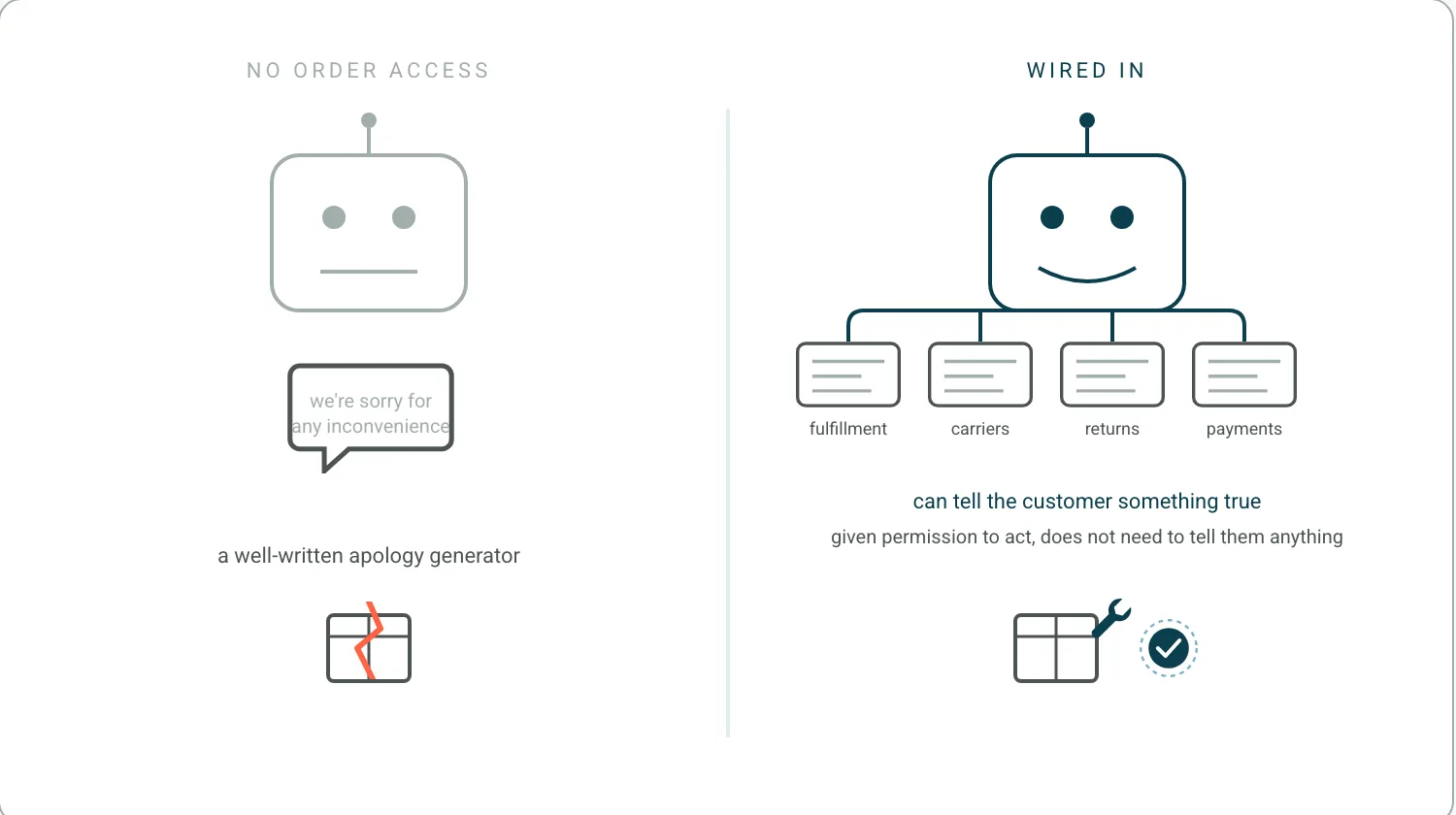
What the bot can see decides what it can say
A bot's usefulness is bounded by its data access. The connections that matter are the storefront for order and customer records, the fulfillment system or third-party logistics provider for dispatch state, carriers for tracking events, the returns platform, and the payment provider for refund status. Carrier data arrives as scans rather than as answers, which the USPS Track and Confirm API shows plainly, and joining all five is third-party integrations work. Without them the bot can answer policy questions but not order questions, which is the volume. Two behaviors are worth testing directly during evaluation: how the bot identifies which order a customer means without asking, and what it says about an order in an unusual state, such as a partial shipment or a parcel that has not moved.
Most people picture AI in ecommerce as a chatbot, something that replies to customers, and I have spent a fair amount of time saying otherwise on the record. That is not what keeps an operation alive. Operations AI is not built to talk, it is built to fix, and the difference shows up entirely in what it is connected to. A conversational layer with no order access is a well-written apology generator. The same layer wired into fulfillment, carriers, returns and payments can tell a customer something true. Wired in and given permission to act, it does not need to tell them anything, which is what proactive e-commerce operations means in practice. Deciding what it may do unattended is a scoping question rather than a modelling one, and the NIST AI Risk Management Framework is the standard place to start on it.
Hand-off quality decides whether automation helps or hurts
Hand-off quality determines whether automation improves or degrades the experience. The requirements are that the customer is not asked to repeat what they have already said, that the agent receives the full conversation and the order context, and that the route to a human is visible rather than hidden. Escalation triggers should include explicit customer request, repeated failure to resolve, and objective severity signals such as a breached delivery promise or high order value, rather than sentiment alone. The helpdesk receiving the hand-off has to carry that context or the customer starts again.
Report on the contacts, not the bot
The analytics worth having are about the contacts, not the bot. Intent distribution shows what customers are asking. Unresolved-intent reporting shows what the bot could not handle. Escalation reason reporting shows why humans were needed. Read against order data, these identify the operational failures generating contact, which is a more valuable output than containment rate. The measures that describe those failures are ecommerce KPIs and resolution time. The common gap is that most chatbot reporting is oriented to proving the bot's performance rather than to diagnosing the business's.
The best support is the message before the question
The final capability is outbound rather than inbound: messaging a customer before they ask, triggered by an order event such as a delay, a stalled shipment, or a stock problem. This inverts the model, since the contact never becomes a conversation. It requires the same operational data integrations as the inbound case plus a trigger layer that watches order state continuously. The message set it fires is shipping notifications and the operating model is proactive customer service. It is the capability that most distinguishes vendors in this category, and the one least well covered by chatbot-first tools, because it depends on operations data rather than conversational ability.
This section is the one worth reading twice, and it is where I would spend the evaluation time. Watching order state continuously is a different engineering problem from answering a message, and it is why the tools that started as conversation are weakest here. The best support is the call the customer never has to make. A bot that answers a delay question perfectly has still let the customer find out about the delay on their own, and the same integrations that let it answer would have let something act four days earlier. Every order is a promise, and a bot that explains a broken one beautifully has still let it break. That is post-purchase operations rather than a better conversation.
Frequently Asked Questions
Which AI chatbot is best for ecommerce?
This page does not rank vendors, and the criteria matter more than the shortlist anyway. Judge on what the bot can see and what it can do: whether it reads live order, fulfillment, carrier and returns data, whether it can identify the order a message refers to without asking, and whether it can change something or only reply.
What are the four types of chatbots?
Usefully split by capability rather than by technique. Rule-based bots follow a script. Retrieval bots answer from a knowledge base. Generative bots compose an answer. Connected bots read the order and, with write access, act on it. Only the last of the four is any use on a post-purchase question, because policy is rarely what the customer is asking about.
References
- Publications Office of the European Union. EU AI Act. The disclosure obligation a brand selling into Europe inherits.
- United States Postal Service. USPS Track and Confirm API. Carrier data arriving as scans rather than as answers.
- US National Institute of Standards and Technology. NIST AI Risk Management Framework. Scoping what a connected assistant may do unattended.
Ready to Stop Reacting?
The fastest way to see how Keeyu prevents complaints is to see it in action.
In one call, we’ll map your current operations, show how our AI Agent fits in, and walk through real examples of issues fixed before customers notice.
Most teams go live within 48 hours. We never share your data.

