
Customer self service
 Verified & Reviewed


 Copy Link
Customer self service is any path that lets a customer resolve their own question or request without contacting a person: an order lookup, a tracking page, a returns portal, a help center, or an automated assistant. In ecommerce its value is concentrated in the post-purchase window, where the volume is repetitive and the answers are deterministic. Self service resolves questions whose answer already exists in a system. It does not resolve situations where the underlying order is in a state nobody wants to report. The capability catalogue is self-service options and the evidence base is customer self-service statistics.
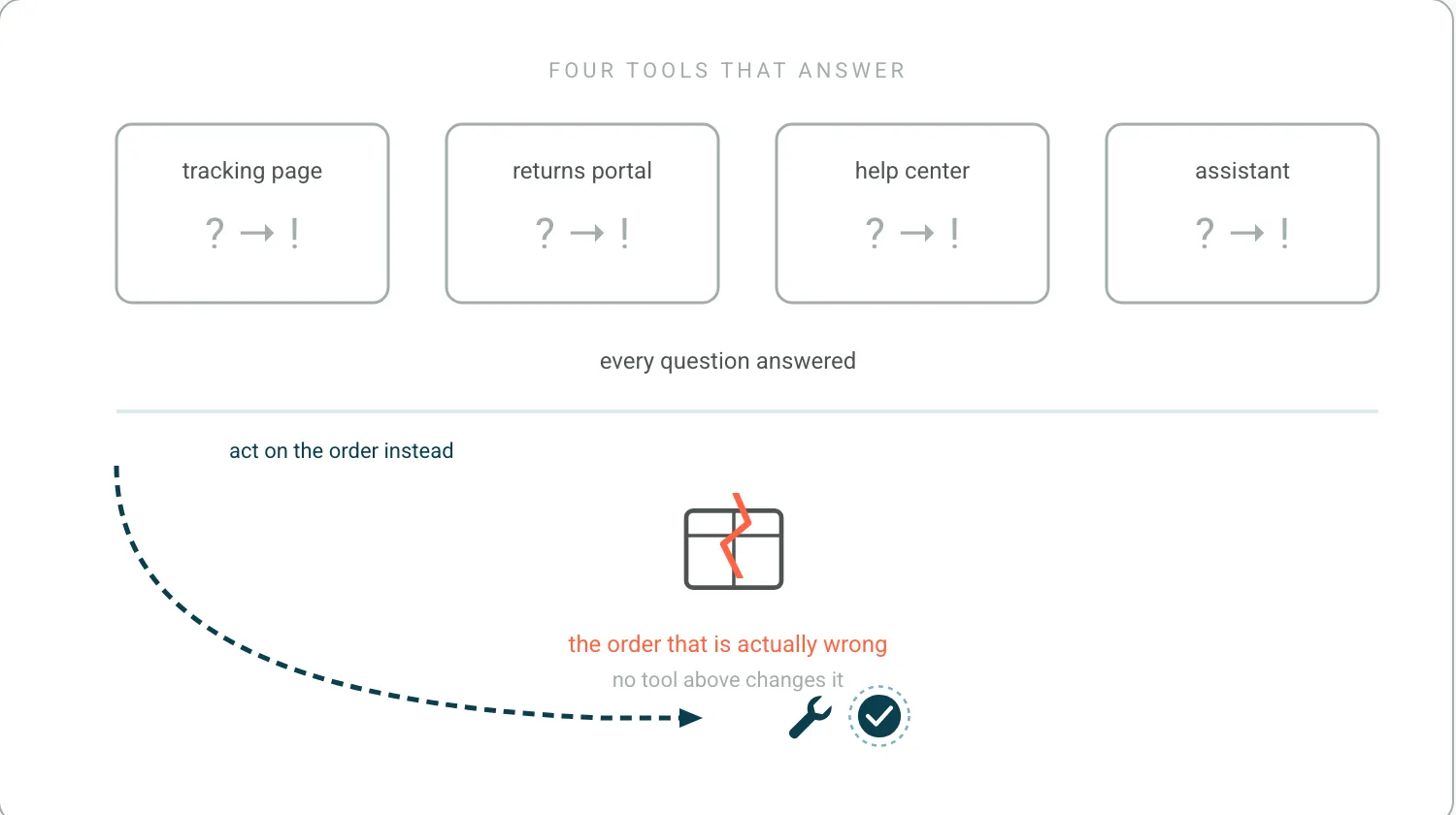
Four tool types, and all four answer rather than act
The category divides into four tool types. Order lookup and branded tracking answer where is my order from carrier and fulfillment data, which arrive as scan events rather than as answers, as the USPS Track and Confirm API makes clear. Returns and exchange portals let a customer initiate a return, print a label, and follow its progress. Knowledge bases and help centers answer policy questions: delivery windows, return eligibility, refund timing. Some of those answers are set by law rather than by the merchant, which 16 CFR Part 435 governs for US sellers, and a help center that contradicts it is a liability rather than a deflection. Conversational assistants sit across the others, routing a typed question to whichever of them holds the answer. Most implementations run several, and coverage gaps between them are where customers give up and open a ticket instead.
Every one of those four tool types answers a question. None of them changes an order. That is not a criticism of the category, it is what the category is for, and it is the reason a team can run all four well and still have a support queue. The questions that reach a person are the ones where the honest answer is that something has gone wrong and nobody has fixed it yet, and no interface improvement reaches those. Acting on them instead is the automated ticketing system argument, and preventing them is proactive customer service.
The dataset says the same thing in numbers. Across the 786 pain points we mined from 270 customer call transcripts between May 2025 and May 2026, returns were the highest-volume category after WISMO. One brand took 400 'how do I return this' tickets a month with a returns portal live on the site, and brands running a dedicated returns platform still logged tickets the portal could not self-serve, most often a label that failed to generate. The portal was answering the question it was built to answer. The tickets were about the cases where the answer did not work.
Deflection rate counts the people who stopped asking
The headline metric is deflection rate: contacts avoided as a share of contacts that would otherwise have arrived. It is harder to measure honestly than it looks, because the denominator is counterfactual. More reliable measures are self-service sessions per hundred orders, ticket volume per hundred orders tracked over time, and the share of tickets whose subject is order status. Two supporting metrics matter: containment, meaning the share of self-service sessions that end without a follow-up contact, and escalation quality, meaning whether escalated cases genuinely required a human. The reason both belong next to the deflection rate is the Harvard Business Review finding on customer effort: a customer who was deflected and then had to come back has been made to work twice. Definitions for the rest sit with ecommerce KPIs and resolution time. A deflection rate that climbs while total tickets stay flat usually means self service is absorbing easy contacts while the hard ones grow.
The reason deflection is so hard to measure honestly is more uncomfortable than the counterfactual problem. For most brands, the CX team has exactly the same visibility into an order as the customer does, which is none. They are reading the same tracking page and guessing from the same scan. When that is true, a deflection number tells you how many people stopped asking, not how many problems stopped happening, and those are very different results with the same shape on a chart.
Sequence by volume, and keep the exit visible
Common practice is to sequence by volume: instrument the top contact reasons first, then build self service against the largest deterministic categories, typically order status and returns. Entry points matter as much as content, so the self-service path is linked from order confirmation and dispatch emails rather than only from a help-center menu. Where the entry point sits and how much work it asks of a customer is exactly the kind of question Baymard Institute tests empirically rather than by opinion. Authentication should be as light as the data sensitivity allows, since an order lookup requiring a full account login deflects less than one requiring an order number and email. The escalation path should stay visible throughout, because a hidden contact route converts a deflected contact into an angry one.
It is a data problem before it is an interface problem
Self service is a data problem before it is an interface problem. The portal needs live order records, fulfillment and dispatch status, carrier tracking events, returns state, and refund or payment status, which is a third-party integrations problem rather than a design one. Anything not connected becomes a question the customer cannot self-serve. Two integration behaviors are worth testing explicitly: how the interface renders an order in an unusual state, such as a partial shipment or a stalled parcel, and how quickly it reflects a change made in an upstream system. Stale or blank states are the most common cause of a self-service session ending in a ticket.
This is the part I would spend the budget on. A portal built on live order, fulfillment, carrier and returns data can answer almost anything a customer asks, and the same portal built on storefront data alone is a nicer-looking way of saying the order was placed. What makes the connected version worth the work is not the answering. It is that once every system touching an order is joined up, the business can see the orders going wrong before anybody looks them up, and proactive e-commerce operations is what you do with that.
The residual is where the cost sits
The business case compares the cost of building and running self service against the fully loaded cost of the contacts it removes, which includes agent time, tooling, and the cost of resolution actions such as refunds or reships. Published per-ticket labor benchmarks for order-status enquiries vary widely by region and staffing model, so an internal figure derived from handle time and loaded hourly cost is more defensible than a cited one. The second half of the case, usually omitted, is the residual: the contacts self service cannot deflect because the order genuinely needs fixing. Those carry a higher cost per contact than the ones removed, so average handling cost typically rises after a successful self-service rollout even as total cost falls.
Most brands are paying a tax they do not know exists, and I call it the reactive tax. It is what a business spends every time a customer has to chase their own order: the agent time, the refunds and reships, the discount to keep them, and the ones who quietly do not come back. Self service takes a real bite out of the first line of that and almost none out of the last one, which is the argument on the reactive tax. That is why the residual matters more than the deflection rate. Every order is a promise, and the contacts left behind are the ones where a promise is already broken. They are the expensive ones, and the only way the total comes down is if fewer orders break in the first place. What that is worth in retained revenue is customer lifetime value, and the operating model is post-purchase operations.
Frequently Asked Questions
What is customer self-service?
Any path that lets a customer resolve their own question or request without contacting a person: an order lookup, a tracking page, a returns portal, a help center, or an automated assistant. In ecommerce its value is concentrated in the post-purchase window, where the volume is repetitive and the answers are deterministic.
What are examples of self-service?
Order lookup and branded tracking, which answer where an order is. Returns and exchange portals, which let a customer start a return and follow it. Knowledge bases, which answer policy questions. Conversational assistants, which route a typed question to whichever of the others holds the answer. The option-by-option version is self-service options.
What is a customer self-service portal?
A single place a customer signs into or looks up an order in, collecting tracking, returns and account history. It is worth judging on its data rather than its design: a portal built on live order, fulfillment, carrier and returns data can answer almost anything asked of it, and the same portal built on storefront data alone is a nicer-looking way of saying the order was placed.
References
- United States Postal Service. USPS Track and Confirm API. Tracking arriving as scans, which bounds what a lookup can answer.
- US Electronic Code of Federal Regulations. 16 CFR Part 435. The policy answers a help center is not free to invent.
- Harvard Business Review. Harvard Business Review finding on customer effort. Why containment belongs beside the deflection rate.
- Baymard Institute. Baymard Institute. Entry points and authentication friction, tested rather than asserted.
Ready to Stop Reacting?
The fastest way to see how Keeyu prevents complaints is to see it in action.
In one call, we’ll map your current operations, show how our AI Agent fits in, and walk through real examples of issues fixed before customers notice.
Most teams go live within 48 hours. We never share your data.

