
Customer service strategy
 Verified & Reviewed


 Copy Link
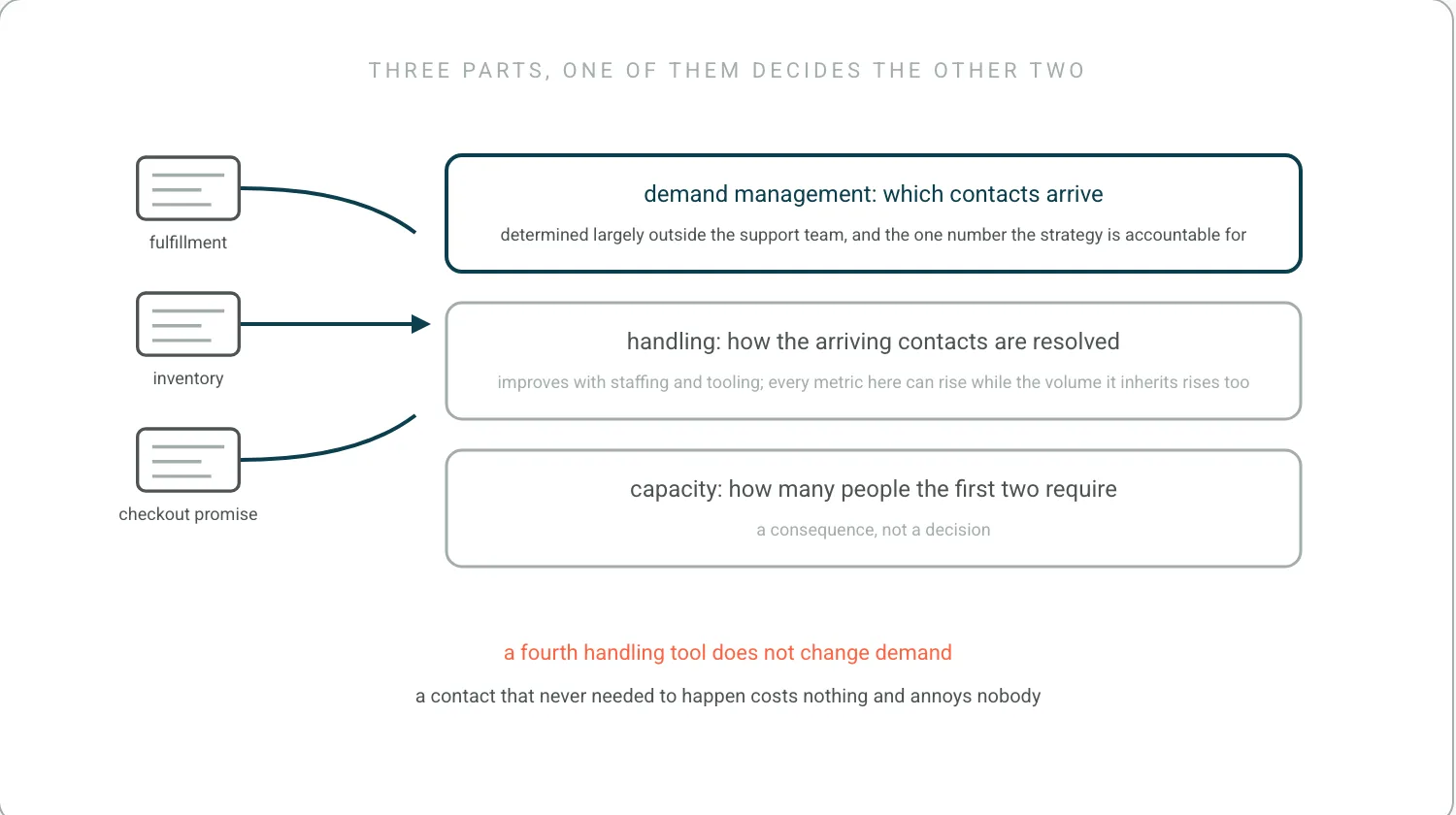
A customer service strategy in ecommerce states what the function is accountable for, which contacts it should be receiving, and what it does with the ones it should not. It has three parts that are usually collapsed into one. Demand management decides which contacts arrive, and is largely determined outside the support team by fulfillment, inventory, and the promise made at checkout. Handling decides how the arriving contacts are resolved. Capacity decides how many people and what tooling the first two require. A strategy that addresses only handling can improve every metric it measures while the volume it inherits keeps rising. The discipline underneath the complaints half of that volume is customer complaint management, and the documented sequence is the complaint resolution process. What a well-run sequence looks like end to end is an ecommerce experience example.
Only exception communication produces the reduction
Proactive communication means sending the customer the information before they request it, and it splits by what is being communicated. Expectation setting happens at purchase and shapes every later contact, since a delivery date given as a range the operation can hit generates far less contact than an optimistic single date. Status communication follows the order through its normal path. Exception communication handles the orders that leave that path, and it is the category that produces the reduction, because a customer who is told about a delay before they notice it usually does not open a ticket. The message set is shipping notifications and the operating model is proactive customer service. The three have different data requirements, and only the third needs a way to detect an order that has stopped without generating an event, which is a carrier integration problem before it is a messaging one.
Contact rate per order is the only strategy metric on the list
The working set is contact rate per order, first response time, resolution time, and a satisfaction measure, and only the first is a strategy metric. The other three describe how well contacts are handled once they arrive, and improve with staffing and tooling. Contact rate per order describes how many contacts the operation generates per unit of business, which is the number a strategy is accountable for. Benchmarks for all four vary by category and by volume tier enough that an external figure is weak evidence, so the usable baseline is the operation's own rate by reason code over time. Building that baseline is ecommerce benchmark and the definitions are ecommerce KPIs. Reason code volume is the diagnostic layer underneath, since a rising contact rate is only actionable once it is attributed to a cause.
A fourth handling tool does not change demand
The tooling divides into four categories with different jobs. A helpdesk holds the conversation and routes it. A post-purchase or tracking platform owns the customer-facing status experience. A returns platform owns the reverse flow and its policy rules. An operations layer sits upstream of all three and works on the order rather than on the conversation. Most stacks in this space hold the first three, which together improve handling and the customer's access to information. The strategic question when adding tooling is which of the three parts of the strategy the tool serves, because a fourth handling tool does not change demand, and demand is what determines how much handling capacity the function needs. The capability catalogue for the self-service layer is self-service options, and what has to be connected for any of it to work on the order is third-party integrations.
Change the composition of returns, not the volume
Returns strategy balances two costs that move in opposite directions. Friction for the customer suppresses returns and also suppresses repurchase, since a customer who could not return something easily is often lost rather than retained. The research on how visible policy affects buying behavior comes from groups that publish their method with the number, such as Baymard Institute, and the obligations that are not a matter of policy at all are in 16 CFR Part 435. Cost to serve rises with every convenience added. The levers that improve both at once are the ones that change the composition of returns rather than the volume: converting a return into an exchange or store credit keeps the revenue, and reducing the returns caused by the operation itself, such as wrong items and damage in transit, removes the return and the complaint together. The wider process is returns management. Levers that only make returning harder move the cost onto the customer relationship, where it is not measured.
The trade only exists at a fixed level of demand
The two are usually presented as a trade and behave as one only within a fixed level of demand. Deflection at fixed demand does trade against experience, since a customer who needed help and was routed to an article has been deflected and not served. That is the same finding Harvard Business Review reported on customer effort, where the work the customer is made to do is what damages loyalty. What good deflection looks like is customer self-service. Reducing demand does not, because a contact that never needed to happen costs nothing and annoys nobody. That distinction is what separates a cost program that holds satisfaction from one that does not, and it is measurable: deflection shows up as a falling contact rate with a flat or falling follow-on contact rate, while suppression shows up as a falling contact rate with follow-on contact and satisfaction both moving the wrong way.
The trade is real within a fixed level of demand and it dissolves the moment demand itself is on the table, which is the whole strategic argument and the reason we think proactive e-commerce operations turns customer service from a cost center into a competitive advantage rather than into a cheaper cost center. The same team, given a queue of prevented problems rather than absorbed ones, is doing a different job: retaining customers and building relationships with the best of them, which is revenue work valued through customer lifetime value. That position is a company one rather than a personal opinion, and it is the one Capital Brief reported when we raised. Every order is a promise, and a strategy accountable only for how well broken promises are handled has accepted the breakage as fixed. The alternative is post-purchase operations.
How far most functions are from it is in the 786 pain points we mined from 270 customer call transcripts between May 2025 and May 2026. The most repeated theme was CX teams running fully reactive, discovering a system problem only when a customer raised a ticket. A strategy document that names demand management as the first of its three parts is, for most of those teams, the first time anyone has written down that the arriving volume is theirs to change.
Frequently Asked Questions
What are the 5 goals in customer service?
Stated as a strategy rather than as service values, the goals divide three ways: which contacts arrive, how the arriving ones are resolved, and what capacity the first two require. Most published goal lists cover only the second. A strategy accountable only for handling can improve every metric it measures while the volume it inherits keeps rising.
What are the 7 steps of customer service?
Step lists in this category describe handling a single interaction well, which is useful and is not a strategy. The strategic question sits one level up: which of those interactions should have happened at all. Contact rate per order is the measure that answers it, and it is the only one on this page a strategy is genuinely accountable for.
What are the best customer service practices?
For an ecommerce operation the practices that move the number are upstream of the conversation: an accurate delivery promise at checkout, dispatch performance measured against it, exception detection early enough to message first, and a resolution path that does not require the customer to chase. Politeness is table stakes and it does not change contact volume.
References
- Harvard Business Review. Harvard Business Review reported on customer effort. Deflecting a contact somebody needed as a loyalty cost.
- Baymard Institute. Baymard Institute. Published-method research on returns visibility and buying behavior.
- US Electronic Code of Federal Regulations. 16 CFR Part 435. The returns obligations that are not a policy choice.
Ready to Stop Reacting?
The fastest way to see how Keeyu prevents complaints is to see it in action.
In one call, we’ll map your current operations, show how our AI Agent fits in, and walk through real examples of issues fixed before customers notice.
Most teams go live within 48 hours. We never share your data.

