
Customer complaint management
 Verified & Reviewed


 Copy Link
Customer complaint management is the process a business uses to receive, record, resolve, and learn from customer complaints. It is distinct from general support in that a complaint asserts something went wrong, which means it carries both a resolution obligation and a diagnostic signal. In ecommerce the majority of complaints trace to an operational event, most often a delivery, stock, or returns failure, so complaint management is as much an operations discipline as a customer-service one. The documented sequence that runs it is the complaint resolution process, the software is a customer complaint management system, and the function all three sit inside is set out on customer service strategy.
The step everybody skips is the only one that changes next month
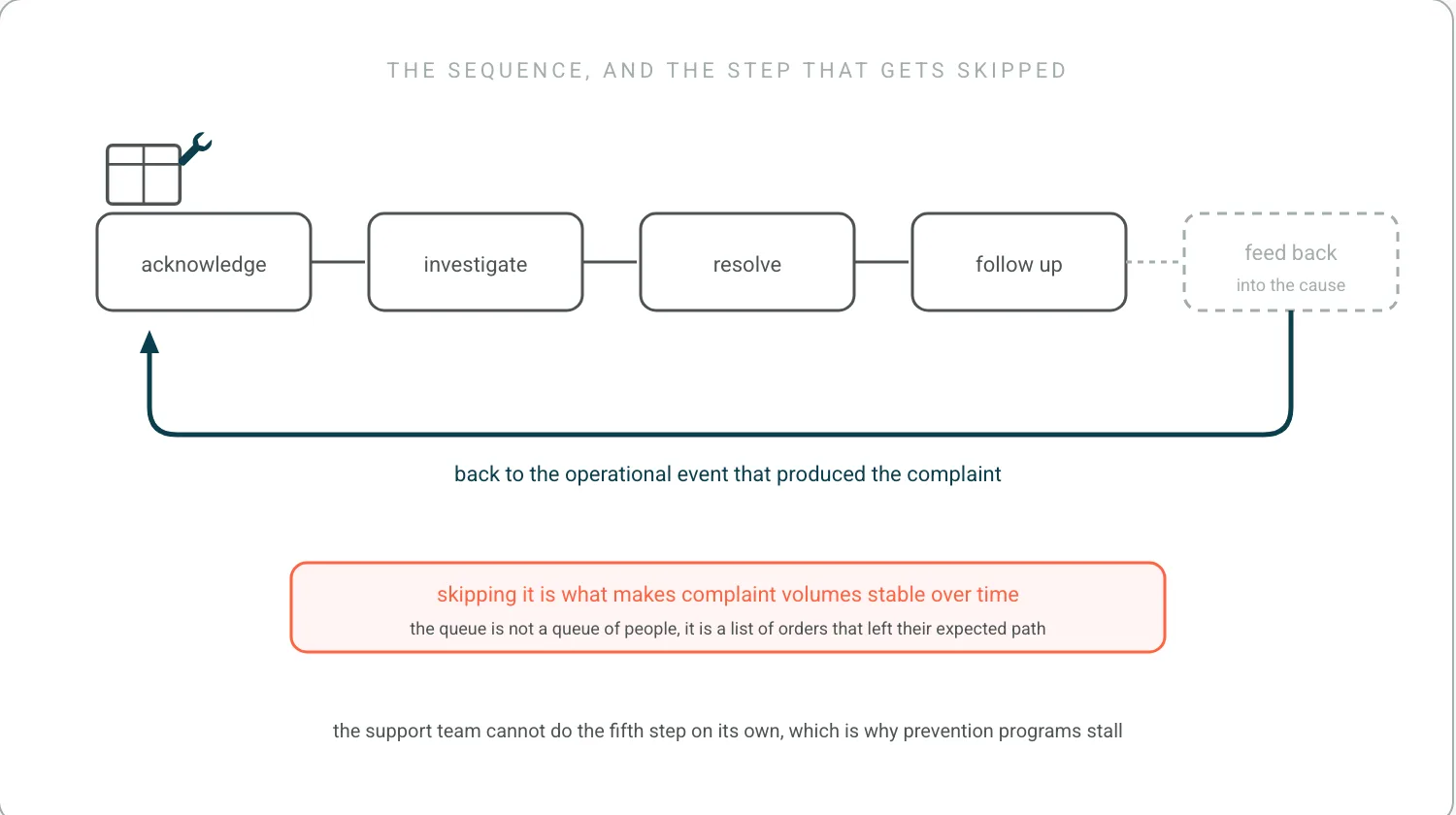
Most working frameworks share the same sequence: acknowledge, investigate, resolve, follow up, and feed back into the process that caused the complaint. Acknowledgement is time-sensitive and largely determines the tone of what follows. Investigation requires access to the order's full history across systems, which is a third-party integration problem before it is a helpdesk one. Resolution should be bounded by a policy that agents can apply without escalation for common cases, with defined authority limits. The final step, feedback into root cause, is the one most often skipped, and skipping it is what makes complaint volumes stable over time. Formal standards exist for complaint handling, most notably ISO 10002, which is worth knowing about for regulated or enterprise contexts. For the categories complaints actually fall into, the FTC's Consumer Sentinel Network Data Book is public and coded, which a coding scheme invented in-house usually is not.
I ran ecommerce brands before I built software for them, and the sequence above is right in a way that is easy to read past. The step everybody skips, feeding back into the cause, is the only one that changes next month's volume. What changed it for my teams, the ones Founders in Motion covered, was reframing the whole function: customer experience stops being ticket-handling and becomes exception management. The queue is not a queue of people, it is a list of orders that left their expected path, and once you see it that way the work is to catch the exception rather than to answer the person.
How far most teams are from that framing showed up in the 786 pain points we mined from 270 customer call transcripts between May 2025 and May 2026. The most repeated theme was CX teams running fully reactive, discovering a system problem only when a customer raised a ticket, and every brand described the period after the warehouse as a black hole. Exception management is not a maturity stage those teams had skipped. It is one they had never been shown.
Reactive automation inherits the limit of the thing it automates
Automation in complaint handling covers intake across channels, classification by type and severity, routing to the right team, and suggested or automated resolutions for well-defined cases. The severity signal is where ecommerce implementations differ from generic ones: useful inputs include the value of the order, whether a delivery promise was breached, how many times the customer has already contacted about it, and whether the customer is a repeat buyer with lifetime value attached. Sentiment alone is an unreliable severity proxy, since it systematically deprioritizes calmly stated serious problems.
The automation being sold into this problem is mostly reactive, and reactive automation inherits the limitation of the thing it automates. Chatbots are a fair example and not a straw one: they are good at conversation and they have no visibility into operations, so they triage, they escalate, and the customer ends up explaining the same broken order to a person anyway. That is a scoping failure rather than a model failure, and it is the kind of context-of-use question the NIST AI Risk Management Framework asks first: what the system can observe bounds what it can be trusted to decide. Zendesk and Gorgias are genuinely good at what they were built for, which is managing and triaging a complaint that already exists. The distinction worth holding onto is that triage is what you do about a complaint, and it is a different activity from removing the operational reason it was made. The tooling half of that argument is the automated ticketing system.
Reason mix converts complaints into a ranked list of defects
The measures that matter are complaint volume per hundred orders, complaint reason mix, time to first response, time to resolution, reopen rate, and the share resolved without escalation. Reason mix is the operationally valuable one because it converts complaints into a ranked list of process defects. Definitions for the rest sit with ecommerce KPIs, and the metric this page deliberately leaves to its sibling, the complaint prevention rate, is on complaint resolution process. Reopen rate indicates whether resolutions are holding. Volume alone is a poor measure in isolation, since it moves with order volume, seasonality, and how easy the business makes it to complain, and a fall can indicate discouragement rather than improvement.
The work starts at the order, not at the complaint
Prevention means acting on the reason mix rather than on the complaints. The sequence is to rank complaint reasons by volume and cost, trace each to the operational event that produces it, and fix or monitor that event. Common examples are stock accuracy problems producing oversell and split shipment complaints, carrier performance on specific lanes producing delivery complaints, and returns processing delays producing refund complaints. Where the refund stops being a service decision and becomes an obligation is 16 CFR Part 435. The measurable objective is a reduction in complaints per hundred orders rather than faster handling of the same volume, and it requires operations rather than support to own the fix.
This is the section the whole page is for, and it is a bigger flip than it sounds. For decades the pattern has been the same: wait for the customer to complain, then firefight. Helpdesks wait until customers complain, and every metric the industry uses assumes that is where the work starts. Prevention means the work starts at the order instead. Every order is a promise, and a complaint is just the customer telling you a promise broke some time ago and nobody noticed. Rank the reason mix, trace each reason to the operational event behind it, and fix the event. The support team cannot do that on its own, which is the real reason prevention programs stall. What the causes are worth once ranked is reasons for customer churn, and the operating model that gives the work an owner is post-purchase operations.
What we know, what we are doing, when you will hear from us next
Templates standardize the parts of a response that should not vary: acknowledgement, the statement of what happened, the remedy offered, and the commitment to a next update. Good practice is to keep the structure fixed and the specifics genuinely specific, since a template that reads as a template amplifies the complaint. The core structure for an operational failure is: what we know, what we are doing, when you will hear from us next. Scripts for phone contact follow the same shape with an explicit ownership statement. Any template offering a remedy should be paired with the authority limits that let an agent actually deliver it.
Frequently Asked Questions
What are the 5 steps to handling a customer complaint?
Acknowledge, investigate, resolve, follow up, and feed back into the process that caused it. The fifth is the one most often skipped, and skipping it is what makes complaint volumes stable over time. The documented version of the sequence, with decision rights attached, is the complaint resolution process.
What are the four types of complaints?
Useful groupings in ecommerce are by cause rather than by tone. Product complaints, where the item disappointed. Delivery complaints, where the order was late, incomplete or lost. Returns and refund complaints, where the reverse path failed. And service complaints, where the customer was made to chase. Only the middle two are addressable by post-purchase operations, and together they are most of the volume.
What is a CRM complaint?
A complaint recorded inside a customer relationship management system rather than in a dedicated helpdesk or complaints tool. It is a storage question rather than a handling one, and the thing worth checking is not where the record sits but whether it carries a structured reference to the order, since a complaint that cannot be joined to its order can be reported on and not diagnosed.
References
- US Federal Trade Commission. FTC's Consumer Sentinel Network Data Book. A public, coded complaint taxonomy against an in-house one.
- US National Institute of Standards and Technology. NIST AI Risk Management Framework. What a system can observe bounding what it can be trusted to decide.
- US Electronic Code of Federal Regulations. 16 CFR Part 435. Where a refund stops being a service decision.
Ready to Stop Reacting?
The fastest way to see how Keeyu prevents complaints is to see it in action.
In one call, we’ll map your current operations, show how our AI Agent fits in, and walk through real examples of issues fixed before customers notice.
Most teams go live within 48 hours. We never share your data.

