
Customer complaint management system
 Verified & Reviewed


 Copy Link
A customer complaint management system is software that records complaints, tracks them to resolution, and reports on their causes. In ecommerce the distinguishing requirement is that most complaints concern an order, so the system's usefulness depends on its connection to order, fulfillment, and carrier data rather than on its case-handling features alone. The discipline it serves is customer complaint management and the sequence it runs is the complaint resolution process. Without those connections it records complaints accurately and cannot help resolve them.
A complaint about an order is a question about a physical object
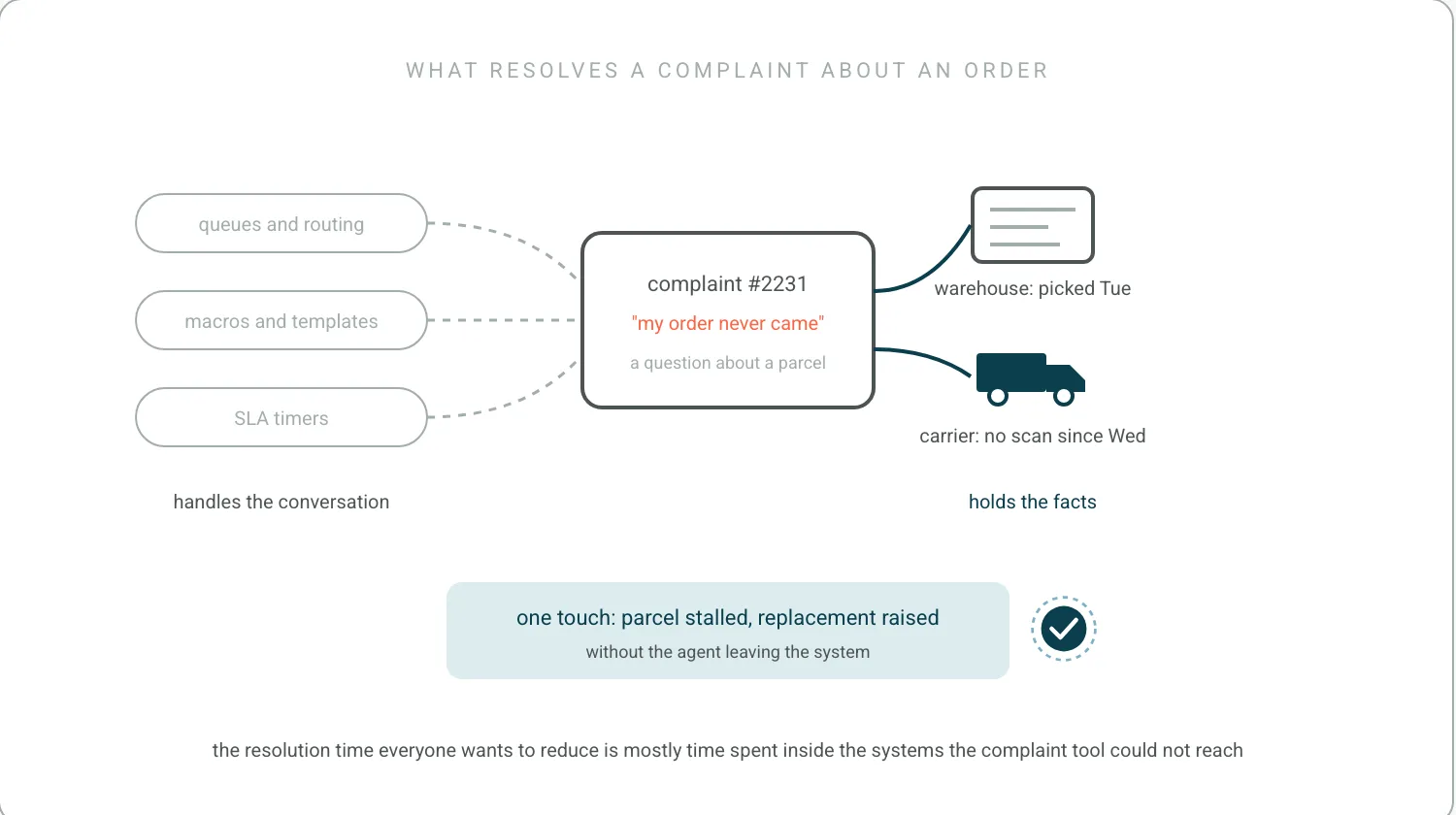
The two integrations that determine whether a complaint can be resolved in one touch are the warehouse management system and the carriers. The warehouse connection shows whether an order was picked, packed, and dispatched, and when. The carrier connection shows what happened after dispatch, including the scan history that establishes whether a parcel moved at all. Together they answer the majority of complaints without an agent leaving the system. Scan histories are not interchangeable between carriers without work, which is what the GS1 EPCIS standard exists to normalize and what third-party integrations has to deliver. Where they are missing, agents work from the customer's account of events plus whatever the storefront shows, which is why the helpdesk ends up holding the conversation and none of the facts.
Putting this first is right, and it decides everything downstream. A complaint about an order is a question about a physical object, and buying criteria in this category are almost always written around case handling instead. Case handling is the part that matters least. The resolution time everyone is trying to reduce is mostly the time an agent spends inside the three systems the complaint system could not reach.
Execute the remedy, not a request for it
Automated workflows execute the remedy rather than routing a request for it. Four cases are typical. Issuing a replacement for a parcel confirmed lost, which for US domestic mail means the point a USPS Missing Mail search can be opened rather than the point the customer gives up. Processing a refund where policy is unambiguous, bounded by 16 CFR Part 435. Reshipping a missing item from a partial shipment. Correcting an undeliverable address before dispatch. The design questions are which actions run unattended, which require approval, what the approval interface is, and what audit record each produces. Systems that stop at drafting a reply leave the resolution work in the systems the workflow was supposed to reach.
The gap between drafting a reply and executing the remedy is where I would put the whole evaluation. But the honest version of my position goes further than that, and it is that customer service has been built the wrong way around. If you can identify the operational problem in real time and fix it before the customer knows there is a delay, the complaint does not need a workflow, because it never happens. Every order is a promise. A workflow that resolves a broken promise efficiently is a good thing to own and it is second best, which is the argument I made on Spotlight Fridays and the distinction on proactive versus reactive customer service.
Handling speed without moving three numbers is automated paperwork
Deflection here has two layers. Pre-complaint deflection answers the order-status question through self-service before a complaint is filed, and the capability catalogue for it is self-service options. Escalation deflection resolves a filed complaint at first contact rather than passing it to a specialist queue, which depends on agents having both the data and the authority to act. The measures are complaints per hundred orders, first-contact resolution, and escalation rate by reason, all defined on ecommerce KPIs. A system that improves handling speed without moving those three has automated the paperwork rather than the problem.
Attribute every complaint to the operational event that produced it
Root-cause analytics attribute complaints to the operational event that produced them: a carrier lane, a warehouse, a product, a fulfillment method, a channel, or a promise type. This is the reporting that turns a complaint log into an operations backlog. It requires complaint records to carry structured references to the order and its fulfillment path, rather than free-text categories chosen by agents, which is the most common reason this capability is nominally present and practically unusable. The output worth producing is a ranked list of causes by volume and cost.
This is the section that would change how the software in this category is bought, and structured references to the order are exactly the requirement. We ran this analysis across 270 customer call transcripts between May 2025 and May 2026, coded into a 786-row pain-point dataset, and the ranking was not close: order status and delivery delays are the single biggest customer-driven category, and teams were spending fifteen to nineteen hours a month on manual outreach for fulfilled-but-not-delivered orders alone. That last one is worth sitting with. It is not a complaint category. It is the work a team does chasing orders that the system already knows have stopped moving. What that work costs across a year is waiting for complaints costs, and the ranked version of the causes is reasons for customer churn.
Consolidate for measurement, not for agent convenience
A unified inbox consolidates complaints arriving by email, chat, phone, social, marketplace messaging, and review platforms into one queue with one history per customer. The ecommerce-specific requirements are marketplace channel support, which carries its own response-time obligations and message templates, and review-platform monitoring, since a public review is a complaint that has skipped the private channel. Consolidation matters less for agent convenience than for accurate volume measurement, because complaints counted per channel understate how many customers are affected. Running several channels against one record is omnichannel order management, and the operating model that owns the causes is post-purchase operations.
Frequently Asked Questions
What are the 5 steps to handle customer complaints?
Acknowledge, investigate, resolve, follow up, and feed the finding back upstream. The discipline behind those steps is customer complaint management and the documented sequence is the complaint resolution process. What this page adds is what the software has to reach for step two to be possible at all.
What are the four most common types of customer complaints?
In ecommerce the recurring four are order status, delivery failure, returns and refund friction, and support that required chasing. Each maps to an operational event rather than to a communication failure, which is why a system that records complaints accurately and cannot see the warehouse or the carrier can report them and not resolve them.
What is a CRM complaint?
A complaint held in a customer relationship management system rather than a dedicated complaints tool. The label matters less than the join: unless the record carries a structured reference to the order and its fulfillment path, root-cause reporting is not possible from it, whichever system the record lives in.
References
- GS1. GS1 EPCIS standard. Making scan histories comparable across carriers.
- United States Postal Service. USPS Missing Mail search. When a parcel is confirmed lost, as a threshold rather than a judgement.
- US Electronic Code of Federal Regulations. 16 CFR Part 435. The bound on an unattended refund workflow.
Ready to Stop Reacting?
The fastest way to see how Keeyu prevents complaints is to see it in action.
In one call, we’ll map your current operations, show how our AI Agent fits in, and walk through real examples of issues fixed before customers notice.
Most teams go live within 48 hours. We never share your data.

