
Complaint resolution process
 Verified & Reviewed


 Copy Link
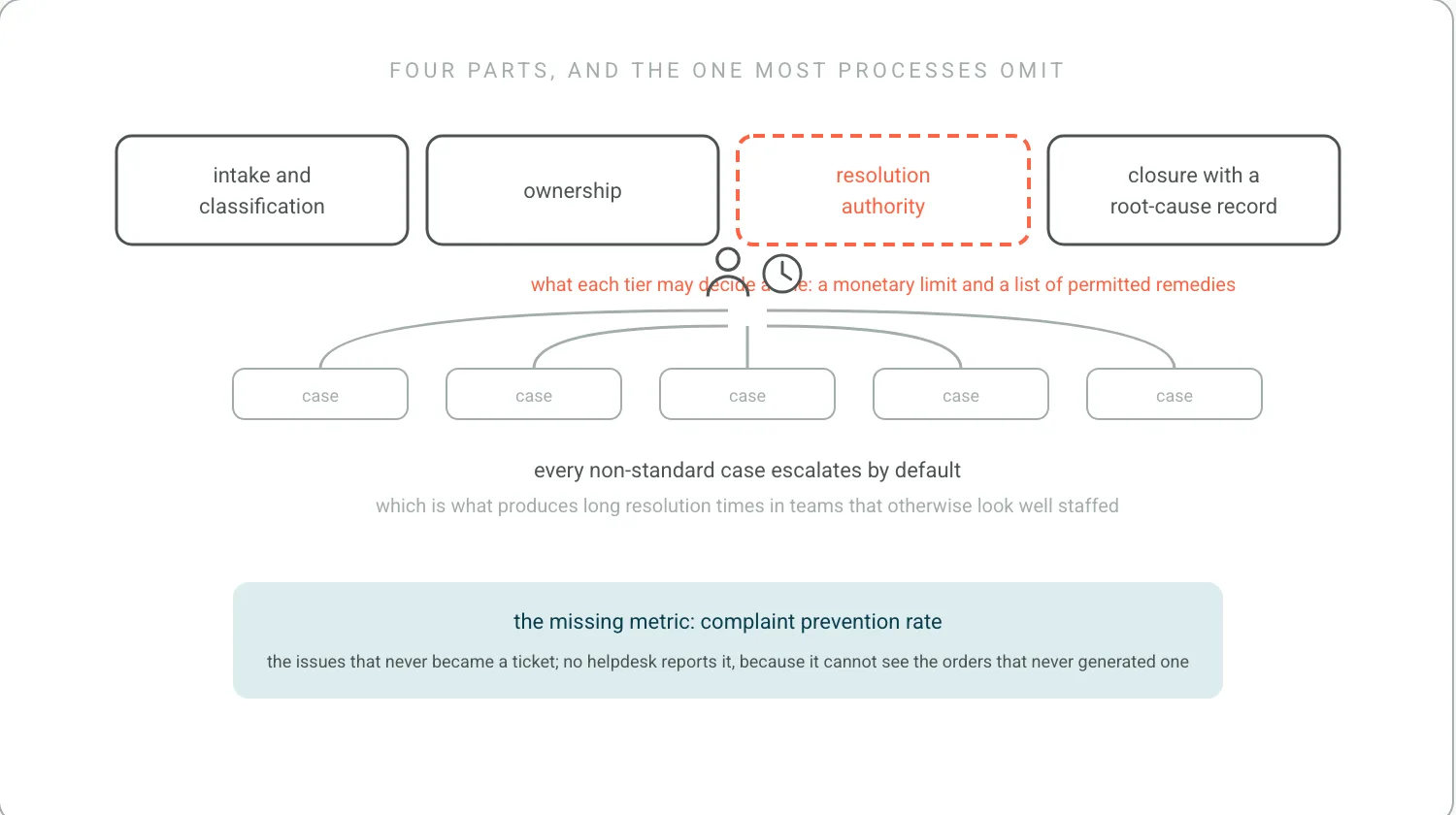
A complaint resolution process is the documented sequence a team follows from receiving a complaint to closing it, with the decision rights at each step named. It has four parts: intake and classification, ownership, resolution authority, and closure with a root-cause record. The part most processes omit is the third. Where a process does not state what each tier can decide without approval, every non-standard case escalates by default, which is what produces long resolution times in teams that otherwise look well staffed. The discipline this process sits inside is customer complaint management, and the software that runs it is a customer complaint management system.
A standard operating procedure template
A usable SOP fits on one page and answers five questions in order. What counts as a complaint, as distinct from a question, since the two need different queues and different targets. How it is classified, using a reason code taken from a fixed list rather than free text, because free text cannot be counted later. Public complaint data is coded the same way and for the same reason, which is visible in the FTC's Consumer Sentinel Network Data Book. Who owns it, named as a role and a queue rather than a person. What the owner may decide alone, expressed as a monetary limit and a list of permitted remedies. Some of those remedies are not discretionary in the US: the FTC's Mail, Internet, or Telephone Order Merchandise Rule sets what a seller owes when an order cannot ship as promised, and an authority limit written below that line will be breached by the law rather than by the agent. And what closure requires, which is the customer being told the outcome and the reason code being recorded. Anything beyond those five belongs in the decision tree rather than in the procedure.
Workflow diagrams or decision trees
The decision tree makes the escalation path explicit so that it does not have to be judged case by case. Three branches carry most of the volume. The first sorts by whether the fact is established or disputed, since a tracked delivery that is late is a known fact and a parcel marked delivered that the customer says never arrived is not. The second sorts by remedy value against the tier's authority limit. The third sorts by whether the case is inside policy, outside policy but within the discretion granted, or requires an exception approval. A tree that routes on emotion rather than on these three produces inconsistent outcomes, because two agents will read the same message differently and the customer discovers that escalation works.
At every brand I have worked with, complaints arrived like a wave that never broke. The thing that changed it was not a better tree. It was collecting every complaint in one place, across email, chat, the helpdesk and the internal notes where half of them actually lived, and then filtering for the ones that happened often and hurt most. Once the signals sat in one list the patterns were obvious, and most of the volume traced back to a handful of operational causes rather than to a hundred different customers having a hundred different problems. The recurring shortlist is the top post-purchase issues. A decision tree routes the wave. It does not tell you why the wave keeps arriving.
Automation and ticketing integration strategies
Automation applies to three of the four parts of the process. Classification can assign a reason code and a queue on arrival. Enrichment can attach the order, the shipment state, and the customer history so the agent does not switch systems, which is a third-party integration problem rather than a helpdesk one. The research reason it matters is Harvard Business Review's finding on customer effort, where the work a customer is made to do predicts disloyalty better than the tone of the reply, and switching systems is how that work gets created. Communication can acknowledge receipt and send status updates without an agent composing them. The part that resists automation is resolution authority, because it is a decision about money and policy. The distinction that matters for tooling is between automating the handling of a complaint and removing the condition that caused it, since the first improves the response and the second reduces arrivals, and only one of them requires the ticketing system at all.
Helpdesks were built for a world where the customer had to raise their hand first. For twenty years the whole category has optimized the same thing, which is answering faster. Handle the ticket, apologize sooner, close the loop. A faster apology does not change the fact that something went wrong. That is the reason we treat this as proactive e-commerce operations rather than as better service, a case I have put on Give it a Nudge: the work is detecting the failed payment, the stockout or the delivery that has slipped, and resolving it at the source, so the complaint never has to be handled at all. The distinction is proactive versus reactive customer service. Every order is a promise, and a process that only manages the aftermath of a broken promise is not managing the promise.
Metrics and KPIs that matter
The working set is first response time, resolution time, contacts per resolution, cost per resolution, and a satisfaction measure taken after closure. Definitions for the wider set sit with ecommerce KPIs. Each needs its scope stated. First response time is honest only when it excludes automated acknowledgements, which otherwise report a few seconds and mean nothing. Resolution time should be measured to the customer's outcome, not to the ticket being closed, since a ticket closed while a replacement is still in transit is not a resolved complaint. Contacts per resolution catches the case a single-touch measure hides, which is the complaint resolved after the customer chased it four times. Reason code volume is the sixth measure and the only one that points upstream.
Every metric on that list measures a complaint that already exists, which is the problem with the whole set. I call the one that is missing the complaint prevention rate, and it counts the issues that never became a ticket or a where-is-my-order message at all. It is the only number that tells you whether the operation is actually working, and no helpdesk reports it, because a helpdesk cannot see the orders that never generated a conversation. Every measure a support team is judged on starts its clock at the moment the operation had already failed.
The size of what those clocks never see is in the 786 pain points we mined from 270 customer call transcripts between May 2025 and May 2026: WISMO and delivery delays were the single largest customer-driven category, and the CX teams behind them were spending 15 to 19 hours a month on manual outreach for orders marked fulfilled that had never arrived. None of that outreach was a complaint being resolved. It was a team finding the failures the process was waiting to be told about.
One of our customers went from four hundred daily tickets to forty on the same team. The reason was not more people. Fulfillment errors were caught the moment they happened, failed payments were retried before the shopper noticed, and courier delays were rebooked and updated automatically. Most leaders assume more complaints mean more staff, and adding people only adds cost, onboarding and complexity to the same underlying problem. What that assumption costs over a year is waiting for complaints costs.
De-escalation scripts and templates
A template's job is to make a difficult message consistent, not to make it warm. The elements that reliably reduce escalation are acknowledging the specific failure rather than the emotion, stating what is known and what is not, giving a next action with a date attached, and naming the remedy directly rather than inviting the customer to propose one. The last of those is what controls concession cost, because an open question about how to make it right sets the customer's expectation above what the policy would have offered. Templates should be written per reason code rather than per emotional register, since the information a customer needs about a lost parcel is different from what they need about a damaged item.
Root-cause analysis frameworks
Root-cause work turns complaint volume into upstream change. Pareto analysis on reason codes identifies the small number of causes producing most of the volume, and a structured why-chain on one of those traces the failure back to a system or a process rather than to a person. The output has to be an owner and a change outside the support team, because the causes of post-purchase complaints usually sit in the warehouse, the carrier arrangement, the inventory position, or the promise made at checkout. Ranking those causes by what they cost is reasons for customer churn. A root-cause program run inside support produces better handling of the same failures indefinitely, and the loop only closes when the finding reaches whoever controls the cause.
The reason root-cause analysis stalls in most teams is not analytical, it is structural. The support team can see the complaint and cannot see the order. Nobody has upstream visibility into the operational failure that produced the enquiry, so the analysis ends at a reason code and a recommendation that another department is free to ignore. What changes it is connecting the systems that touch an order, storefront through to warehouse, carrier and returns, so the failure is visible as it happens rather than reconstructed from what the customer said about it afterwards. Do that and the analysis stops being a monthly report and becomes the thing that fires the fix. The goal is not fewer complaints handled well. It is orders arriving on time, as promised, which is what post-purchase operations is for.
Frequently Asked Questions
What is a complaint resolution process?
The documented sequence a team follows from receiving a complaint to closing it, with the decision rights at each step named. It has four parts: intake and classification, ownership, resolution authority, and closure with a root-cause record. The part most processes omit is the third, and omitting it is what produces long resolution times in teams that otherwise look well staffed.
What is the first step in the complaint resolution process?
Deciding what counts as a complaint, as distinct from a question, because the two need different queues and different targets. Classification comes with it: a reason code from a fixed list rather than free text, since free text cannot be counted later and the count is what eventually points upstream at the cause.
What are the 5 stages of complaint handling?
Published versions of this list vary in length, which is a fair sign that the number is not the useful part. The four that decide whether a process works are intake and classification, a named owner, a stated limit on what that owner can decide alone, and closure that records both the outcome and the reason code.
References
- US Federal Trade Commission. FTC's Consumer Sentinel Network Data Book. Coded reason categories, and why free text cannot be counted.
- US Federal Trade Commission. FTC's Mail, Internet, or Telephone Order Merchandise Rule. The remedies that are owed rather than granted, which bound the authority limit.
- Harvard Business Review. Harvard Business Review's finding on customer effort. Why system-switching is the expensive part of a resolution.
Ready to Stop Reacting?
The fastest way to see how Keeyu prevents complaints is to see it in action.
In one call, we’ll map your current operations, show how our AI Agent fits in, and walk through real examples of issues fixed before customers notice.
Most teams go live within 48 hours. We never share your data.

