
Best marketing automation for ecommerce
 Verified & Reviewed


 Copy Link
Choosing marketing automation for an ecommerce operations team is a selection problem, not a features problem. The tools that win a marketing evaluation are ranked on segmentation, campaign building, and deliverability, while an operations team is buying the ability to trigger a message from a fulfillment event and to reduce the support volume that follows a broken order. The evaluation question that separates the categories is which system holds the order state the automation depends on. The category itself is defined on marketing automation for ecommerce and the channel layer on ecommerce email marketing automation.
Ask which event source the vendor listens to, not which templates ship
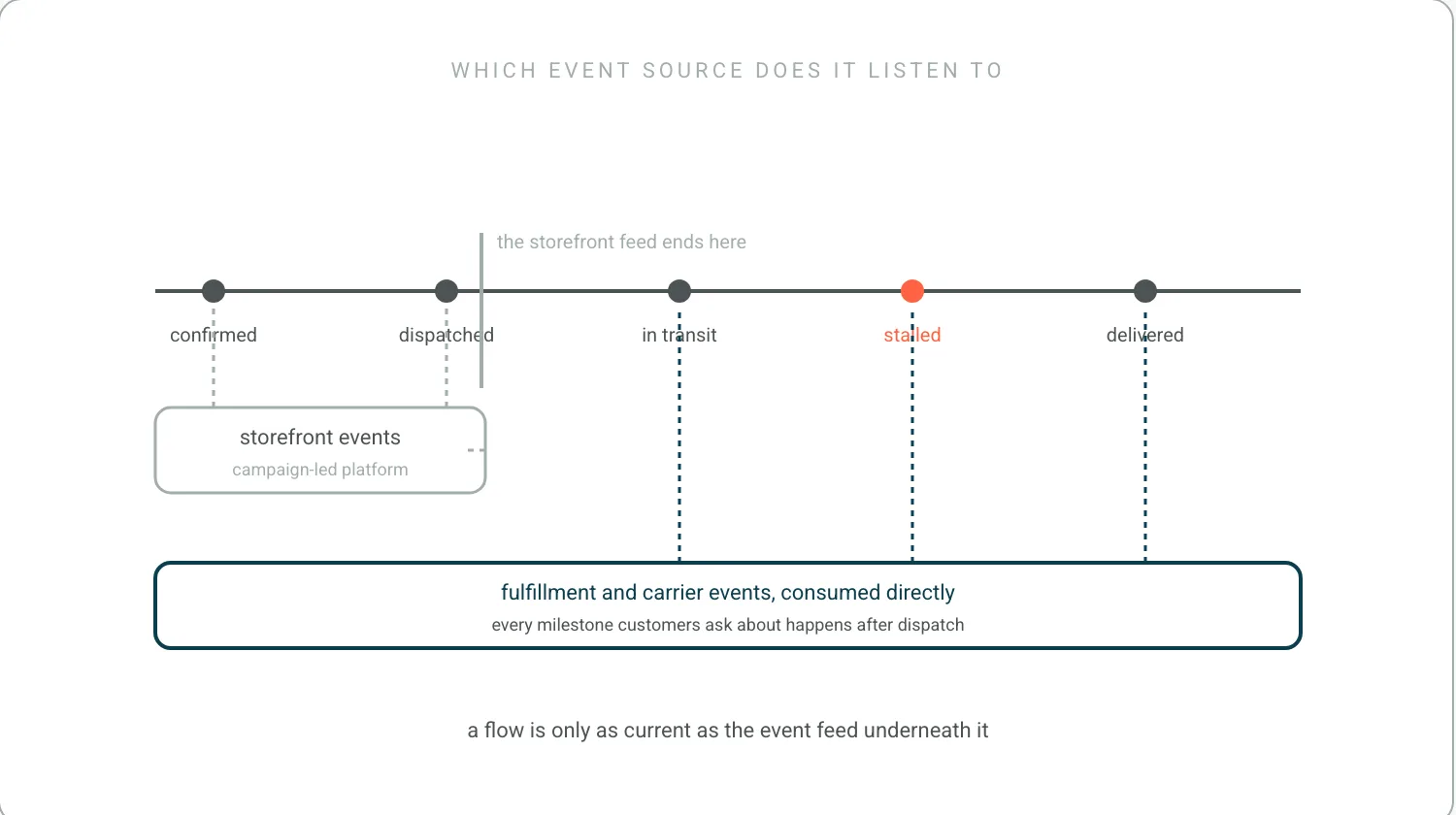
Post-purchase lifecycle automation covers every message a customer receives between the order confirmation and the delivered scan, plus the returns window that follows. The standard set is order confirmation, dispatch, in transit, out for delivery, delivered, and a branded tracking page the customer can return to without opening a ticket. A tool qualifies for this work only if it consumes carrier and fulfillment events directly, since a storefront event stream ends at dispatch and every milestone customers actually ask about happens after it. Those milestones are carrier scans, published as such: the USPS Track and Confirm API is one feed of them, and reconciling several is carrier integration. The message set they drive is shipping notifications and the surface they land on is order tracking software. The practical test during an evaluation is to ask which event source the vendor listens to, and at what latency, rather than which templates ship in the box.
Messages move one number, write-back moves the other
Deflection is the measure of how many customer contacts never happen because the answer arrived first or the customer could resolve the case themselves. It is counted as contacts per hundred orders, split by reason code, and read before and after a flow goes live, which is one of the measures defined on ecommerce KPIs. Most of the volume in question is WISMO. Two mechanisms produce it. Proactive messaging removes the reason to ask, and self-service actions such as a return request, an address correction, or an order cancellation remove the need for an agent to act. A tool that only sends messages can move the first number. Moving the second requires the tool to write back to the order, which is a different integration and a different class of product. The self-service side of it is customer self-service.
Order-triggered flows fail on data access, not features
Order-triggered workflows fire from the state of stock and fulfillment rather than from a customer action. Common examples are a back-in-stock notification when inventory is received, a delay alert when an item cannot be allocated, a split-shipment notice when one line ships without the other, and an internal alert when a high-value order stalls at a carrier. Expressing those states so several systems agree on them is what the GS1 EPCIS standard is for, and watching them continuously is parcel software. These flows depend on inventory and warehouse data that a marketing platform does not normally hold, which is why they are the section of an evaluation most likely to fail on data access rather than on features. The question to ask a vendor is whether the trigger reads live allocation state or a nightly export, which is a question about the order management system as much as about the tool.
Test with a deliberately broken order
The integration surface for this category is wider than a storefront connector. A working deployment reaches the order management or ERP system, the warehouse management system or third-party logistics provider, the carriers, the returns platform, and the helpdesk, so that a message about an order reflects the order's true current state and an agent sees the same state the customer does. What that connection work involves is third-party integrations, and the wider picture is company tech stack. Two failure modes recur in evaluations. Partial coverage leaves one sales channel or one warehouse unconnected, and its orders silently receive no messages at all. Latency leaves the message describing a state the order has already left. Both are testable before purchase by running a deliberately broken order through the stack.
The two failure modes named above are the ones to test, and there is a third that only shows up after purchase. Automating a message is straightforward. Automating the work is not: canceling the order, recreating it, issuing the shipping label, finding the customer's details, writing to them and updating every system that needs to know. That whole sequence is what an operations team actually does when an order breaks, and a tool that integrates well enough to describe it while a person still performs it has passed every integration test on the evaluation sheet and changed nothing. I have made that argument on the eCommerce Australia podcast, and the operating model it points at is proactive customer service.
The sequence is also where order context goes missing. In the 786 pain points we mined from 270 customer call transcripts between May 2025 and May 2026, moving between systems stripped the order context the operations team needed and broke the workflow, and resolving a single ticket routinely meant toggling between three and ten or more systems. A tool that sends the message from inside one of those systems has not shortened that sequence, it has added a tab to it.
Judge the shortlist on the exceptions it handles unattended
Returns automation spans the customer-facing sequence from return request through label issue, carrier scan, receipt at the warehouse, inspection, and refund or exchange. Automating the happy path is the easy half and most tools do it. The half that decides the evaluation is exception handling: a return that never arrives, an item received in the wrong condition, a refund stalled in a payment provider, or an exchange whose replacement is out of stock. The refund leg carries a legal clock as well as a service target, in 16 CFR Part 435, and the process in full is returns management. Exceptions are a small share of returns and a large share of the resulting contact volume, so a tool that leaves them to manual discovery concentrates the remaining support load into the most expensive cases.
Which is the right note to end an evaluation on. The best post-purchase experience is the one the customer does not notice, because nothing went wrong and they are already thinking about their next order. Every order is a promise, and no returns automation, however good, is as valuable as the return that was never triggered. Judge the shortlist on the exceptions it handles unattended, and remember that the tool doing the most visible work is not necessarily the one keeping the most promises. The operating model behind that test is post-purchase operations.
Frequently Asked Questions
What are the top 10 marketing automation platforms?
This page does not publish a ranked list, because the ranking that wins a marketing evaluation is not the one an operations team needs. The question that separates the categories is which system holds the order state the automation depends on, and it is answerable of any product on any shortlist.
What are the best ecommerce marketing platforms?
Judge by class rather than by name. Campaign-led platforms are strongest at segmentation and delivery and weakest at operational event data. Post-purchase platforms are the reverse. Operations layers sit upstream of both and work on the order rather than the message. Which one a business needs follows from which of those three jobs is currently unowned.
What are effective automation tools for ecommerce?
The effective ones are defined by what they can change rather than by what they can send. A tool that only sends messages can reduce the contacts caused by not knowing. Removing the contacts caused by something being wrong needs both a detection path and write access to the order, which is a different integration and a different class of product.
References
- United States Postal Service. USPS Track and Confirm API. What a post-dispatch event source actually is.
- GS1. GS1 EPCIS standard. Stating inventory and shipment states so several systems agree.
- US Electronic Code of Federal Regulations. 16 CFR Part 435. The refund clock inside the exception test.
Ready to Stop Reacting?
The fastest way to see how Keeyu prevents complaints is to see it in action.
In one call, we’ll map your current operations, show how our AI Agent fits in, and walk through real examples of issues fixed before customers notice.
Most teams go live within 48 hours. We never share your data.

