
Marketing automation for ecommerce
 Verified & Reviewed


 Copy Link
Marketing automation in ecommerce is software that triggers customer messages and workflows automatically from data events rather than from someone pressing send. In a post-purchase context the triggering events are operational: an order ships, a shipment stalls, an item fails to allocate, a return is received, a subscription payment fails. The distinction that matters is between campaign automation, which is scheduled around a marketing calendar, and lifecycle or transactional automation, which fires off the state of an individual order. It is a legal distinction as well as an operational one, since the FTC's CAN-SPAM guidance treats a message carrying an offer differently from a genuine order update. How to choose the criteria is best marketing automation for ecommerce and the channel layer is ecommerce email marketing automation.
The efficiency that matters is the human acting as the integration layer
The efficiency case rests on removing repetitive manual contact. Where a support agent would otherwise look up an order, determine its status, and write an update, an automated flow sends that update the moment the status changes. The measurable effect is a reduction in inbound "where is my order" contact, because the answer arrives before the question. Practically this requires the automation platform to receive fulfillment and carrier events, not just storefront events, since the milestones customers care about happen after dispatch, and those arrive as scans rather than as statements, as the USPS Track and Confirm API shows. Joining several carriers into one story is carrier integration. Teams generally track this as WISMO contacts per hundred orders before and after the flows go live, one of the measures defined on ecommerce KPIs.
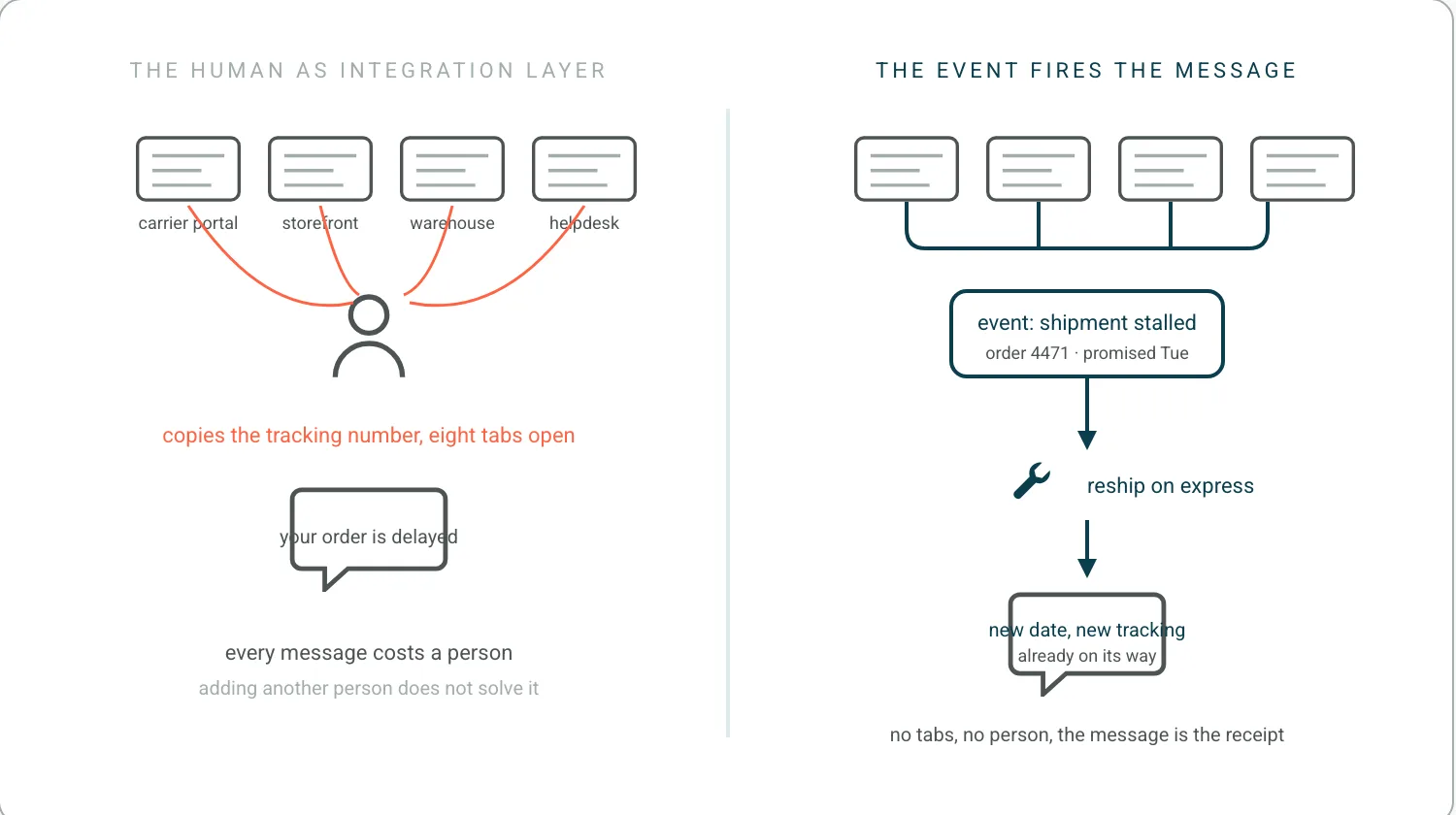
The version of efficiency being sold in this category is usually about sending faster. The version that matters is about the human being who is currently acting as the integration layer between the systems. That is what is really happening when an ops person has eight tabs open and is copying a tracking number out of a carrier portal into a helpdesk reply. It is why those teams burn out while the underlying cause never gets fixed, and it is why adding another person does not solve it. The answer is not more people. It is connected systems, which is third-party integrations rather than another seat licence, and I made the same case on Add To Cart.
Timing accuracy is the failure point
Post-purchase automation is also where repeat-purchase behavior is influenced. Common flows include replenishment reminders timed to a consumable's expected run-out, review and feedback requests timed to arrival rather than to dispatch, and win-back sequences for lapsed buyers. Recovery flows are the adjacent case: a failed subscription payment, an abandoned return, or a canceled order each have an automated path that attempts to save the relationship. Timing accuracy is the common failure point, because a review request that arrives before the parcel does reliably produces a negative response. Review requests carrying an incentive also sit under the FTC's Endorsement Guides, which is a separate question from when to send them. The retention argument in full is post-purchase marketing.
A message can describe a stalled refund, it cannot retry the payment
Returns automation covers the customer-facing sequence from return request through label issue, carrier scan, receipt at the warehouse, inspection, and refund or exchange. The full process is returns management. Each step has a status the customer can be told about, and the automation's job is to keep them informed without an agent. Exceptions are the harder half: a return that never arrives, an item that arrives in the wrong condition, or a refund that stalls in a payment provider. Automating the happy path while leaving exceptions to manual discovery is the usual gap, and it concentrates the remaining support volume into the cases that are most expensive to handle.
Exception messaging is where the two readings of this keyword separate completely. A marketing platform can tell a customer their refund is delayed. It cannot retry the payment, rebook the courier, or find the item. What a stalled shipment actually needs is an action, and the refund half of it has a legal clock in 16 CFR Part 435 that a message does not stop. Behind the scenes this is where operations get messy fastest, because every exception is a promise that has already been broken and the message is only an acknowledgement of it. Fixing in the moment is not a nice-to-have in ecommerce, it is the whole job, and a flow that describes the breakage while it is happening is doing the easier half of the work.
The automation is only as accurate as the data reaching it
The automation layer is only as accurate as the data reaching it. A working stack connects the storefront, the order management or ERP system, the warehouse or third-party logistics provider, the carriers, and the returns platform, so that a message about an order reflects the order's true current state. What that stack looks like as a whole is company tech stack. Two integration failures recur: latency, where the message reflects a state the order has already left, and partial coverage, where one channel or warehouse is not connected and its orders silently receive no messages. Both are worth testing deliberately before launch, using a deliberately broken order rather than a clean one.
When I talk to ecommerce operations teams, they are not short on tools. They are drowning in browser tabs, bouncing between dashboards, and manually fixing issues across systems that do not talk to each other. Two decades of software gave those teams more visibility and more control, and it did not give them less work. That is the honest state of the stack this automation has to sit on top of, and it is why proactive e-commerce operations starts with connecting the systems that touch an order rather than with the message at the end of them. The messaging layer is the last step, not the product, which is also the argument on automated ecommerce store.
Can the tool act on the order, or only describe it
Buyers in this category are usually comparing three classes of tool. Campaign-led platforms are strongest at segmentation and email or SMS delivery, weakest at operational event data. Post-purchase and tracking platforms are strongest at shipment events and branded tracking, weakest at broader lifecycle marketing. Operations platforms sit upstream of both, detecting the order-level problem and deciding what should happen, then messaging. The evaluation question that separates them is whether the tool can act on the order, or only describe it. The tooling comparison for the support side of that is automated ticketing system.
There is a specific failure that runs through the whole comparison and it shows up the moment a team needs to contact everyone affected by one operational problem. The campaign tools can send at scale and cannot see the order, so the message goes out generic, with no order number, no item and no reason. The helpdesk can see the order and cannot send at scale, so somebody composes them one at a time. Every ops person I have met has done that job manually at least once. As founders we lived it ourselves, and the thing that finally made sense of it was this: the tools showed us the red lights, and none of them cleared the traffic. That is the line I would evaluate on. Every order is a promise. Does the tool show you a broken one, or does it get the order to the customer on time, as promised. The operating model behind the second answer is post-purchase operations.
The bulk-contact failure has numbers behind it. In the 786 pain points we mined from 270 customer call transcripts between May 2025 and May 2026, the weeks after Black Friday were the recurring example: teams sending huge volumes of manual outbound emails because nothing in the stack could message everyone affected by one operational problem, and one operator's count of 40 follow-up emails for a single backorder issue running to three hours.
Frequently Asked Questions
What are the top 10 marketing automation platforms?
This page does not rank vendors. The comparison that decides the outcome is by class rather than by name: campaign-led platforms are strongest at segmentation and delivery and weakest at operational event data, post-purchase platforms are the reverse, and operations layers sit upstream of both. The selection criteria are on best marketing automation for ecommerce.
What is the 80/20 rule in ecommerce?
That a small share of causes produces most of the effect. Applied to post-purchase messaging it is a warning as much as a heuristic: most of the volume comes from a handful of operational failures, so a program that automates the messages without touching those causes will keep sending more of them.
References
- US Federal Trade Commission. FTC's CAN-SPAM guidance. Campaign against transactional, as a legal line not only an operational one.
- United States Postal Service. USPS Track and Confirm API. Carrier milestones arriving as scans rather than as statements.
- US Federal Trade Commission. FTC's Endorsement Guides. What changes when a review request carries an incentive.
- US Electronic Code of Federal Regulations. 16 CFR Part 435. The refund clock a message does not stop.
Ready to Stop Reacting?
The fastest way to see how Keeyu prevents complaints is to see it in action.
In one call, we’ll map your current operations, show how our AI Agent fits in, and walk through real examples of issues fixed before customers notice.
Most teams go live within 48 hours. We never share your data.

