
Automated ecommerce store
 Verified & Reviewed


 Copy Link
An automated ecommerce store is an existing business whose repetitive operational work runs without a person performing each step: order processing, inventory updates, customer notifications, returns handling, and the routine decisions between them. The term is also used to market turnkey dropshipping ventures, which is a different subject. For an operator the practical question is not whether the store is automated in general but which specific decisions still require a human, and whether those are the ones that should. The vocabulary here drifts enough that IEEE 2755 exists to pin it down, and the workflow-by-workflow version of this page is automation examples in real life.
The highest-volume automatable work sits after checkout
The highest-volume automatable work sits after checkout. Order-status communication, dispatch and delivery notifications, and self-service order lookup remove the contacts that would otherwise arrive as questions. Automation here is measured on contacts per hundred orders rather than on messages sent, because a business can automate a great deal of messaging without reducing contact if the messages arrive at the wrong time or omit the orders that are actually late. The message set is shipping notifications, the lookup layer is customer self-service, and the contact type is WISMO.
Automate the rules path completely, route the rest with context
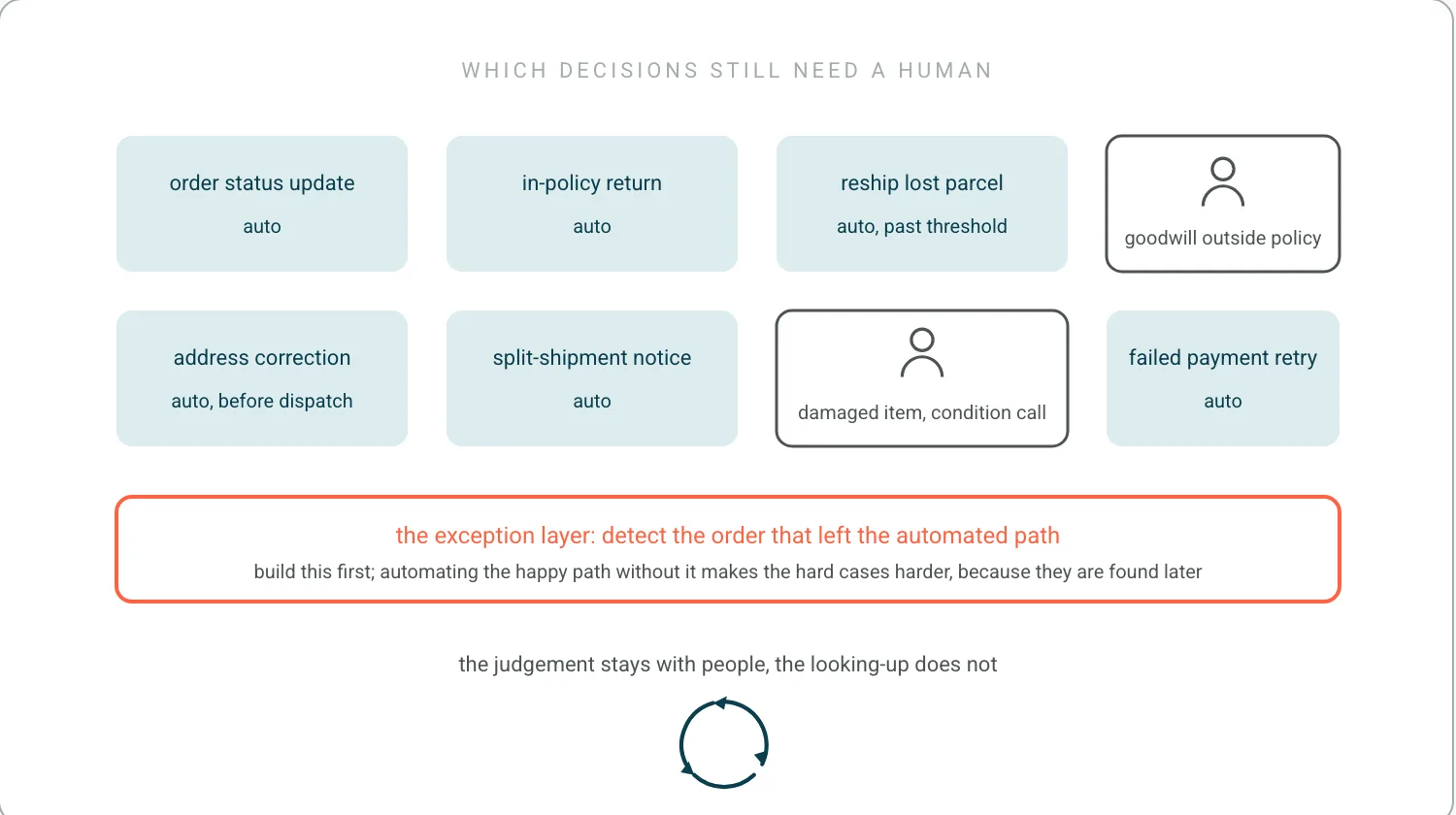
Returns automation covers request intake, policy and eligibility evaluation, label issue, inbound tracking, receipt and inspection at the warehouse, and the refund or exchange decision. Well-defined policies automate cleanly because eligibility is a rules question, though not every rule is the merchant's to write: 16 CFR Part 435 sets refund timing for US sellers whatever the policy engine says. The process in full is returns management. The parts that resist automation are condition assessment, goodwill decisions outside policy, and returns that arrive unlabeled or unexpected. A sound implementation automates the rules-based path completely and routes the exceptions to a person with the context already assembled.
Build the exception layer first
This is the category most often left out of an automation program and the one that determines whether the rest holds up. Exceptions are the orders that do not follow the automated path: stock that fails to allocate, a shipment that stalls, a payment that reverses, a bundle that partially fulfills, an integration that stops syncing. Watching for them across several carriers is carrier integration work. Automating the happy path while leaving exceptions to manual discovery concentrates all remaining work into the hardest cases and makes them harder, because they are now found later. Detection has to be automated even where resolution is not.
This section is the one I would build first, and I can say that because we built it in the wrong order ourselves. The first version of Keeyu made it easy to detect operations issues in real time, and we were pleased with it. Startmate wrote up what we were building at the time. Then we talked to the people using it and saw the actual pain: the same problems, found faster, and still fixed by hand. Detection turns out to be the easy half. Every order is a promise, and knowing sooner that a promise is about to break only helps if something acts on it, which is why automating the resolution rather than the alert is the whole difference between an automated store and a well-instrumented one. That is proactive customer service stated as an engineering choice.
An oversell is discovered by a customer, not by the system
Synchronization keeps stock accurate across channels and locations, and drives allocation and routing decisions without human input. The automation-relevant properties are sync frequency, conflict behavior when two channels sell the last unit simultaneously, and how bundles, kits, and pre-orders are modeled. Describing the same physical event consistently across warehouse, carrier and store is what the GS1 EPCIS standard is for, and running one stock pool across channels is multichannel retailing. Failure here is expensive because it surfaces as an oversell, which is discovered by a customer rather than by the system, and cannot be resolved without disappointing someone. The system that is supposed to prevent it is the order management system, and the application layer around it is ecommerce application.
Silent failure is the mode to specify against
Every automation above depends on data crossing system boundaries: storefront, order management, warehouse or third-party logistics, carriers, returns, helpdesk, and finance. Integration quality determines whether automation is reliable or merely fast. The properties worth specifying are coverage per channel and location, latency, and failure behavior, meaning whether a broken connection alerts, retries, or silently stops. Silent failure is the most damaging mode because automated systems continue to operate confidently on stale data. What has to be connected, and how each connection fails, is third-party integrations.
Worth being specific about what is still manual in most operations today, because the list is short and repetitive. Order status enquiries, out-of-stock delays, lost in transit, incorrect shipping addresses, fraud holds and chargebacks. Every one of those is handled reactively, by a person, after somebody noticed, and every one of them is knowable from data that already exists in systems the business already pays for. The automation question is not whether the data exists. It is whether anything is joining it up while there is still time to act. The department-by-department version of the same list is examples of automation in the workplace, the marketing-side version is marketing automation for ecommerce, and the operating model is post-purchase operations.
What still-manual looks like in hours, from the 786 pain points we mined from 270 customer call transcripts between May 2025 and May 2026: one operator put 40 follow-up emails for a single backorder issue at three hours, and 200 oversold orders from a 90-minute sale meant a week of one-by-one email triage. Those are the jobs the narrow sense of automation removes.
Frequently Asked Questions
What is an automated ecommerce business?
An existing business whose repetitive operational work runs without a person performing each step: order processing, inventory updates, customer notifications, returns handling, and the routine decisions between them. The term is also used to market turnkey dropshipping ventures, which is a different subject and not this one.
What is ecommerce automation?
Replacing a repeated human decision with a rule that reads system state. The practical question for an operator is not whether the store is automated in general but which specific decisions still require a human, and whether those are the ones that should. The rule-by-rule version is automation examples in real life.
What is the 80/20 rule in ecommerce?
The observation that a small share of causes produces most of the effect, applied here to contact volume rather than to revenue. Reason codes are how you find your own version of it, and in post-purchase the concentration is usually stark: a handful of operational causes generate most of the queue, which is what makes the automation worth ordering by cause rather than by ease.
References
- IEEE. IEEE 2755. Pinning down what automated means before evaluating it.
- US Electronic Code of Federal Regulations. 16 CFR Part 435. The returns rules a policy engine does not get to write.
- GS1. GS1 EPCIS standard. Describing the same physical event consistently across systems.
Ready to Stop Reacting?
The fastest way to see how Keeyu prevents complaints is to see it in action.
In one call, we’ll map your current operations, show how our AI Agent fits in, and walk through real examples of issues fixed before customers notice.
Most teams go live within 48 hours. We never share your data.

