
Multichannel retailing
 Verified & Reviewed


 Copy Link
Multichannel retailing is selling through more than one channel: an owned online store, marketplaces, physical retail, wholesale, and social commerce. It describes the commercial model rather than the integration between channels, which is the distinction from omnichannel, where the channels share stock, customer records, and fulfillment. The two terms are often used interchangeably in vendor copy and they are not interchangeable, a point Verhoef, Kannan and Inman set out in the Journal of Retailing and one the multichannel and omnichannel comparison page works through in detail. A business can be multichannel with entirely separate systems per channel, and many are, which is where the operational cost sits.
One order layer under every channel
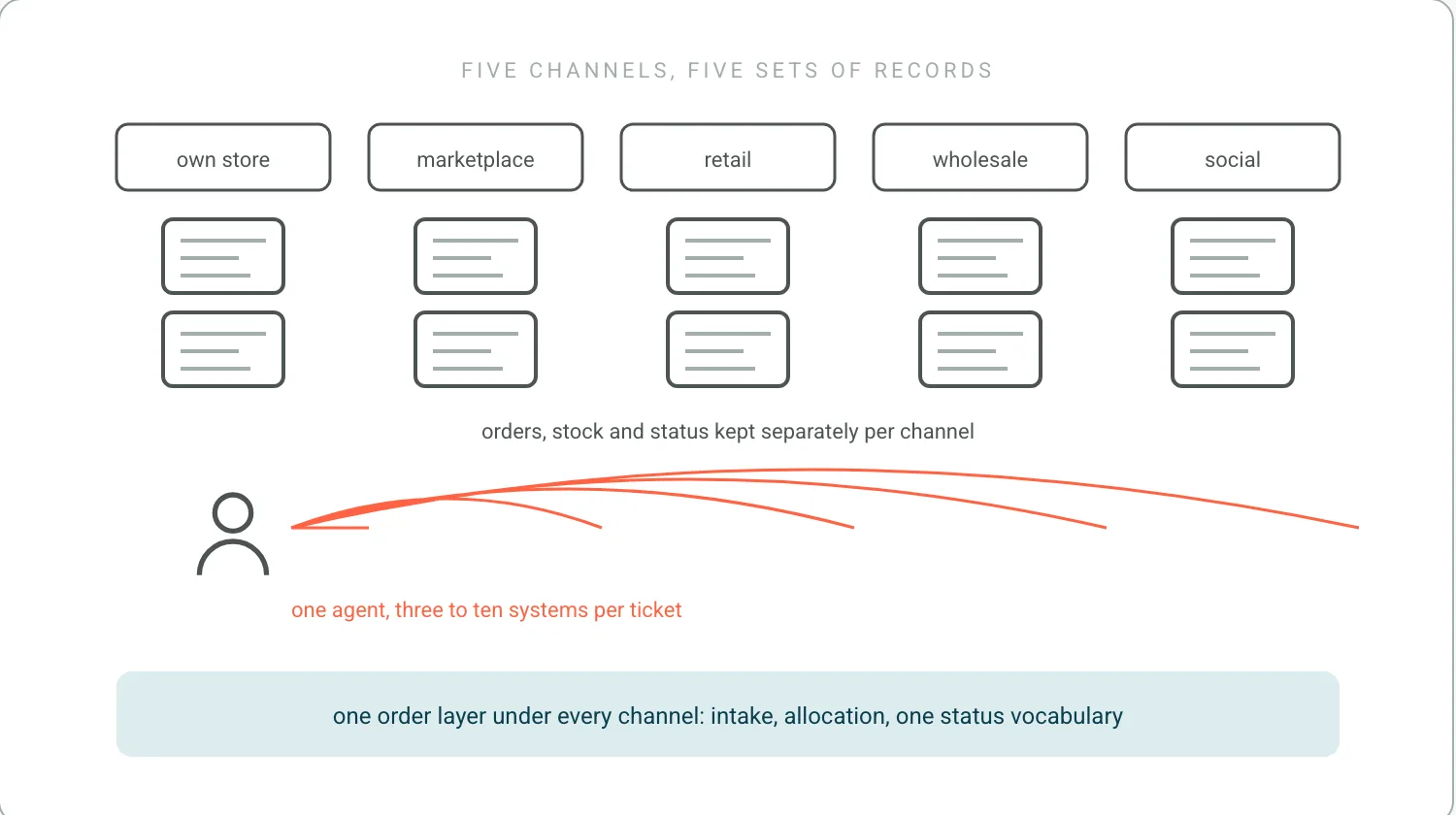
An order management system is the layer that accepts orders from every channel and holds them in one place, deciding where each is fulfilled and tracking its state. Without it, each channel keeps its own order records, and questions that span channels cannot be answered without opening several systems. The capabilities that matter for multichannel specifically are channel-agnostic order intake, allocation rules that account for stock committed to other channels, and a single order status vocabulary, since marketplaces and storefronts define statuses differently and unreconciled definitions produce contradictory customer-facing information. Allocation in particular has settled definitions worth borrowing rather than inventing, in the CSCMP supply chain glossary, and the status vocabulary problem is visible the moment two systems disagree about what fulfilled means, which the Shopify Fulfillment object defines for one of them and a marketplace defines differently for another. What the layer itself is doing is order management.
Worth holding onto while everyone argues about the next big shift in commerce: a new channel is just a new channel. When Google and Shopify launched the Universal Commerce Protocol, most of the industry called it a revolution. I read it as another sales channel, sitting alongside owned storefronts, marketplaces and everything else, and inheriting exactly the same problem as all of them. Every channel you add is another order source that has to land in one place, be allocated against the same stock, and be answerable in one status vocabulary. That is the argument I made on The Ecommerce Edge and it is why omnichannel order management is the part worth investing in rather than the channel. The channel is the easy part. The order management layer underneath is what decides whether adding it costs you anything.
One process that satisfies the strictest channel
Each channel imposes its own post-purchase rules. Marketplaces frequently mandate messaging templates, dispatch windows, and tracking upload deadlines, with seller-performance consequences for missing them. Owned channels allow branded tracking and free-form communication. The operational requirement is one process that satisfies the strictest channel's obligations while giving the owned channel the branded treatment, driven from one set of order events rather than a per-channel implementation that drifts. What those branded events look like on the owned channel is shipping notifications, and the connection work that feeds them is carrier integration.
Overselling is two channels working from a figure nobody owned
Inventory synchronization is the defining technical problem of multichannel. One pool of stock is exposed to several channels that each sell independently, so the risk is overselling, and its severity rises with channel count and sales velocity. Mitigations include a single source of truth with short sync intervals, buffer stock per channel, and reservation at the point of order rather than at dispatch. Bundles, pre-orders, and kits are the standard failure cases, because they consume stock in ways simple per-SKU counters model badly. All of it assumes the same physical unit carries the same identifier in every channel, which is what the GS1 GTIN exists to guarantee and what a business running two SKU schemes has already given up.
Here is the thing that surprises people, and it has happened with more than one retailer. They tell us their order volume, we connect the systems, and the real number is double or triple what they said. Not because anyone was being careless. Because nobody had ever seen every channel in one place at the same time. If a business cannot count its own orders across channels, the stock position underneath those orders is not a number either, and that is what overselling actually is. It is not a synchronization bug so much as the moment two channels find out they were both working from a figure nobody owned. The version of that failure the customer sees is split shipments.
The visible cost lands on the person answering the email
A customer who bought on a marketplace and contacts through the brand's own channel is a routine case that fragmented systems handle badly. Centralized context means an agent can see the order, its channel, its fulfillment state, and prior contact, regardless of where the sale occurred. Where this is missing, the observable symptom is agents working across several systems per enquiry, which raises handle time and produces inconsistent answers. The system that is supposed to hold that context is the helpdesk, and it usually holds the conversation rather than the order. Marketplace privacy rules complicate it, since some channels withhold customer contact details, so the design has to work from order identifiers rather than assuming a unified customer record.
The visible cost of multichannel lands here, and it lands on the person answering the email. Teams routinely toggle between three and ten systems to resolve a single ticket, and on the worst setups it is more. Every one of those switches is a place where the order context gets dropped and the agent starts again. Operational complexity is the silent growth killer, because it never appears as a line item. It appears as handle time, as inconsistent answers, and as a support team that grows in proportion to the channel count rather than to the revenue. Every order is a promise regardless of which channel it came through, and a customer does not care that their order was placed somewhere your support tooling cannot see. What the connected version is worth is omnichannel benefits, and the operating model it belongs to is post-purchase operations.
That range is not a guess. It is what operators told us across the 786 pain points we mined from 270 customer call transcripts between May 2025 and May 2026, where toggling between three and ten or more systems to resolve one ticket was among the most repeated entries, and a single 'where is my order' investigation could open more than 40 tabs.
Returns multiply the channel problem
Returns multiply the channel problem, because the return path may differ from the sale path and each channel sets its own policy and refund timing. The operational questions are where a returned item physically goes, which stock pool it re-enters and when, who funds the return, and how refunds reconcile against a marketplace's own settlement process. Cross-channel returns, such as buy online return in store, add a further requirement: the returning location must be able to see and accept an order it did not sell. The wider process, including where the item physically re-enters stock, is returns management.
Frequently Asked Questions
What is multichannel retailing?
Selling through more than one channel: an owned online store, marketplaces, physical retail, wholesale, and social commerce. It describes the commercial model rather than the integration between channels, which is the distinction from omnichannel. A business can be multichannel with entirely separate systems per channel, and many are, which is where the operational cost sits.
What is the difference between omnichannel and multichannel retailing?
Integration, not channel count. Multichannel means selling in several places. Omnichannel means those places operate as one system, sharing stock, customer records and fulfillment. The difference shows up after the sale rather than before it, which is why omnichannel versus multichannel works the comparison through from the agent's side.
What are some examples of multichannel retailing?
A brand selling on its own storefront, on a marketplace, and through a physical counter, with each keeping its own order records and its own stock count. That is the common shape and it works until a question spans two of them. The integrated versions are on omnichannel retailing examples.
References
- Journal of Retailing. Verhoef, Kannan and Inman set out in the Journal of Retailing. Multichannel and omnichannel as different things, from the research.
- Council of Supply Chain Management Professionals. CSCMP supply chain glossary. Settled definitions for allocation and order management.
- Shopify. Shopify Fulfillment object. One channel's definition of fulfilled, against a marketplace's different one.
- GS1. GS1 GTIN. The same physical unit carrying one identifier across channels.
Ready to Stop Reacting?
The fastest way to see how Keeyu prevents complaints is to see it in action.
In one call, we’ll map your current operations, show how our AI Agent fits in, and walk through real examples of issues fixed before customers notice.
Most teams go live within 48 hours. We never share your data.

