
Omnichannel retailing examples
 Verified & Reviewed


 Copy Link
Omnichannel retailing examples are the specific scenarios in which channels operate as one system rather than side by side: an online order collected in store, a store return of an online purchase, an online order fulfilled from store stock, an exchange processed in a channel other than the one that sold the item. Each is a concrete capability that either works or does not, which makes them the practical vocabulary for assessing whether an omnichannel claim is real. The definition underneath them is what omnichannel retailing is, and the marketing-side version of this list is omnichannel marketing examples.
Four models, and one failure they share
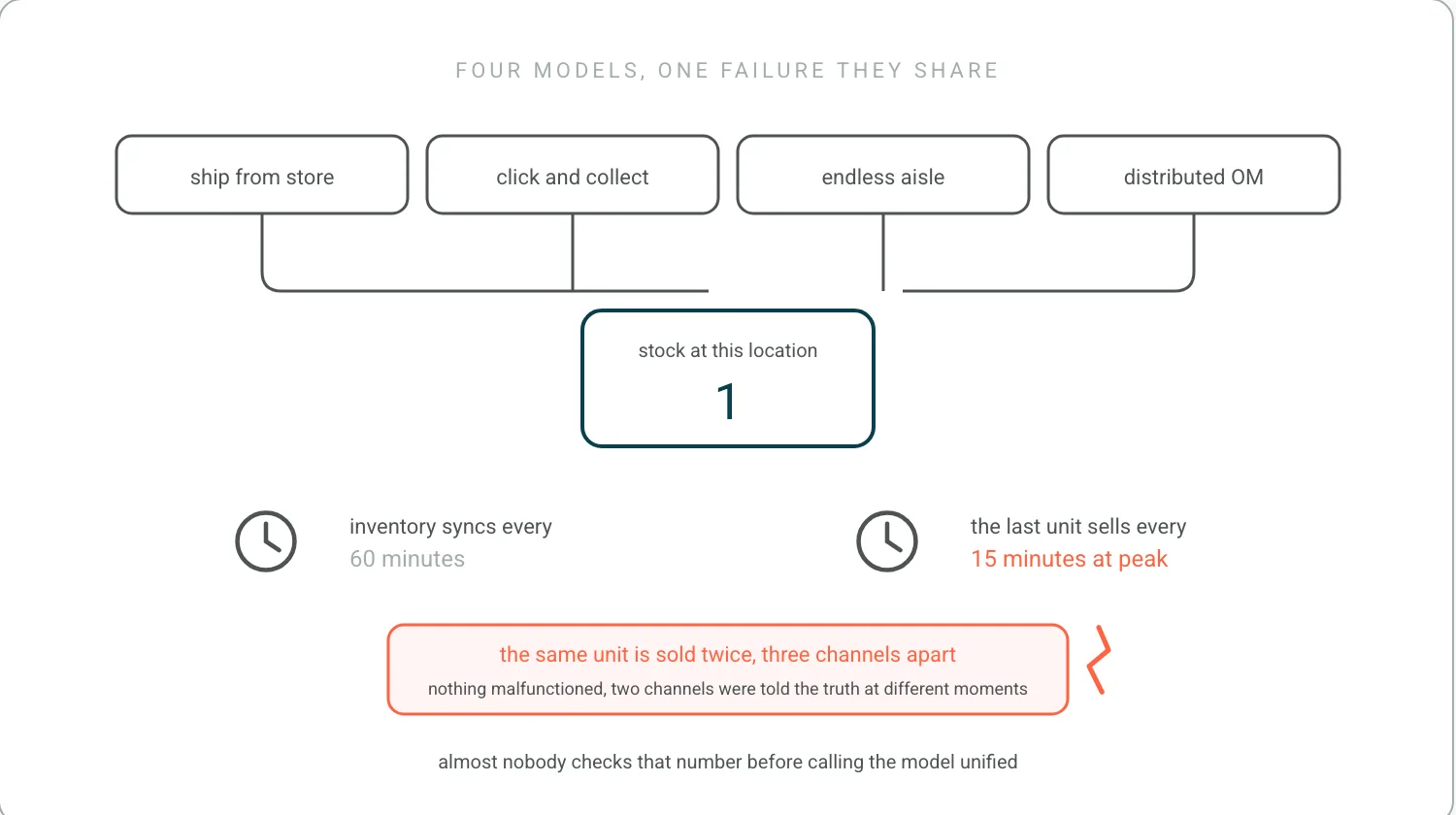
Four models turn up in practice. Ship-from-store, where store stock fulfills online demand. Click-and-collect, where an online order is picked and held for collection. Endless aisle, where a store sells an item it does not hold, from warehouse stock. Distributed order management, where an allocation engine chooses among locations by stock, distance, cost, and cut-off. Those four are settled terms rather than vendor coinages, and the CSCMP supply chain glossary is where to check what each one actually commits you to. Each requires stock visibility at location level and a picking process the location can execute, which in platform terms means fulfillment is modelled per location rather than per order, as the Shopify Fulfillment object does. The system layer above all of it is omnichannel order management. The observable failure mode is a location committing to stock it does not physically hold, which converts an omnichannel promise into a cancellation, or into split shipments when the order is only partly rescued.
The example everyone reaches for is stock shared across stores and warehouses, and the failure inside it is worth naming because we see it constantly. Storefronts sell stock the business does not have, because the inventory system behind them updates on a delay or does not reflect what is physically on the shelf. Nothing in that sentence is a broken integration. Every system is doing what it was asked. The unified model only works if the update interval is shorter than the time it takes to sell the last unit, and almost nobody checks that number before calling the model unified. What running several channels costs when that number is wrong is multichannel retailing.
Two entries from the 786 pain points we mined from 270 customer call transcripts between May 2025 and May 2026 show what the number looks like when it is wrong. Warehouse spot-checks turned up dozens of exceptions where stock was marked non-pickable, a hidden discrepancy no channel could see. And a business ingesting purchase orders across four channels with no central 'stock landed' signal found accurate invoice timing impossible, because nobody could say when the unit had actually arrived.
Identify the customer by order where identity is unavailable
The example that tests this is a customer who buys online, contacts through social, and walks into a store. A single customer record means each touchpoint sees the same history. In practice most implementations achieve this partially, with the order record unified and the marketing profile separate, or with marketplace purchases excluded because the channel withholds customer identity. The workable design identifies the customer by order where identity is unavailable, rather than assuming a complete profile exists. Getting the record to that state is third-party integration work, and how the customer meets it is customer order tracking.
Test each scenario from the least-integrated channel
The scenarios here are the ones customers actually encounter: tracking an order regardless of purchase channel, initiating a return without contacting anyone, exchanging an item bought online at a counter, and receiving proactive notice of a delay. Each depends on cross-channel order visibility rather than on interface design. A useful diagnostic is to attempt each scenario as a customer, using an order placed in the least-integrated channel, since that is where the gaps are and where the marketing screenshots never come from. Running a scenario end to end rather than reading a spec is how Baymard Institute produces its ecommerce findings, and it is the only method that catches a step that technically exists and practically does not.
My co-founders and I were retailers before we built software, a background The SaaS News set out when we raised, and this is the conclusion we came to running these operations rather than selling into them. You do not have to wait for the ticket. The operational pain points are visible upstream, before the customer knows anything is wrong, and you can either fix them quietly or reach out with options while the customer still has choices. That is the difference between a frictionless workflow and a fast one. Every order is a promise, and the workflows worth copying are the ones that act on the promise rather than apologize for it, which is proactive customer service stated as a workflow instead of as a philosophy.
Split handle time by purchase channel and the gap shows
The support consequence of fragmentation is that agents cannot resolve cross-channel enquiries without switching systems, which raises handle time and produces inconsistent answers. The measurable version is handle time and first-contact resolution split by purchase channel: a marked gap between the owned channel and marketplace or store purchases indicates the unification is incomplete. Contact volume also rises where customers must ask a question the systems should have answered, such as where to return an item bought in another channel, which is buy online return in store failing quietly. The measures behind both halves are ecommerce KPIs and resolution time.
Benchmark by capability, not by product list
Benchmarking an omnichannel stack is best done by capability rather than by product list. The questions are which channels write into one order record, whether stock is visible at location level in real time, whether returns can be accepted at any location, whether support sees all channels in one view, and what happens when an integration fails. Assessed this way, most stacks show a clear boundary between the channels that are genuinely unified and those that are nominally supported, and that boundary is the honest scope of the business's omnichannel capability. What that scope is worth is omnichannel benefits, and the operating model it belongs to is post-purchase operations.
Frequently Asked Questions
What is an example of omnichannel retail?
Ship-from-store, where store stock fulfills online demand. Click-and-collect, where an online order is picked and held for collection. Endless aisle, where a store sells an item it does not hold. Distributed order management, where an allocation engine chooses among locations. Each requires stock visibility at location level and a picking process the location can execute.
What does omnichannel retailing mean?
Selling across channels that share the same stock, customer records and fulfillment capability, so an order placed in one can be seen, fulfilled, serviced and returned through another. The definition in full, and the five-scenario test behind it, is on what omnichannel retailing is.
Can you give me an example of an omnichannel brand?
This page describes patterns rather than naming brands, deliberately. A named example tells you what a business says it does, and the four models above tell you what to check. Run one real order through the least-integrated channel and see which of them actually completes, which is worth more than any case study.
References
- Council of Supply Chain Management Professionals. CSCMP supply chain glossary. Settled definitions for ship-from-store, click-and-collect and distributed order management.
- Shopify. Shopify Fulfillment object. Fulfillment modelled per location rather than per order.
- Baymard Institute. Baymard Institute. Running a scenario end to end as the only method that catches a step that exists on paper.
Ready to Stop Reacting?
The fastest way to see how Keeyu prevents complaints is to see it in action.
In one call, we’ll map your current operations, show how our AI Agent fits in, and walk through real examples of issues fixed before customers notice.
Most teams go live within 48 hours. We never share your data.

