
Omnichannel marketing examples
 Verified & Reviewed


 Copy Link
The omnichannel marketing examples worth studying are post-purchase rather than promotional. A campaign that reaches a customer in three channels is table stakes. The examples below are the ones where the channels have to share an order: a return accepted somewhere it was not sold, one tracking story across every purchase channel and carrier, a support conversation that can move a parcel, and an offer that knows to stay quiet while the order is in trouble. Each is a test of whether the channels can see each other, which is the whole of omnichannel versus multichannel, and each is judged after checkout rather than before it.
Buy online, return in store: judge it on the refund step
Buy-online-return-in-store is the most cited omnichannel example and the most demanding to implement, because the returning location must retrieve an order it did not sell, accept the item, trigger a refund through the original payment path, and return the unit to the correct stock pool. Done well it converts a return into a store visit with a demonstrable attachment rate. Done partially, which is common, the store can accept the item but not refund it, so the customer leaves without resolution and contacts support anyway. The capability is worth assessing on the refund step rather than the acceptance step, not least because the refund leg carries a legal clock in the US under the FTC's Mail, Internet, or Telephone Order Merchandise Rule while the acceptance leg carries none. The process behind it is buy online return in store, and the stock leg is returns management.
One tracking story across every channel and carrier
The example here is one tracking experience covering every purchase channel, with proactive messages triggered by order events rather than by campaign schedules. What makes it an omnichannel example rather than a notification feature is that the customer receives consistent information regardless of where they bought and regardless of which carrier is delivering. Every carrier publishes its own status vocabulary and its own interface, the USPS Track and Confirm API being one of them, and reconciling those into one customer-facing story is carrier integration work rather than design work. The message layer on top is shipping notifications. Exception handling extends it: when an order stalls, the same unified layer detects it and initiates the message and the remedy, rather than each channel handling its own failures differently or not at all.
Worth making concrete, because the example most people give here is a nicer tracking page. Take a stockout where the system believes there is inventory in one location and the unit is not actually there. Most brands cancel the order, refund it, and send an apology. The version worth copying scans every other location, finds the unit, updates the systems that were wrong, and reships, and the customer's first message about it is the one saying it is on its way from somewhere else. That is the same capability as the tracking page pointed at the problem instead of at the status. When the unit is found in two places rather than one, the customer sees it as split shipments.
Support that can produce a physical outcome
This covers the cases where a digital interaction must produce a physical outcome: a support agent redirecting a parcel in transit, arranging a collection, releasing an order held at a depot, or authorizing a replacement from store stock. These are the interactions where the gap between systems is most visible to the customer, because the agent either can act or must refer the customer elsewhere. The capability depends on the support view carrying not just order data but the ability to write back into fulfillment and carrier systems, which is a question about third-party integrations rather than about the helpdesk itself.
The gap this section describes is usually an org-chart problem wearing a systems-problem costume. In a previous life running large ecommerce brands, the arc SmartCompany covered when Keeyu launched, I restructured customer support to report directly to me and merged operations and support into one department, and the change that produced was visibility upstream: the team answering customers could finally see the operational causes generating the questions. Once support is involved upstream they stop reacting and start front-footing, because they know an order is in trouble before the customer does, which is the whole difference between proactive and reactive customer service. No integration delivers that on its own if the two teams still report to different people with different targets.
An upsell that knows when to stay quiet
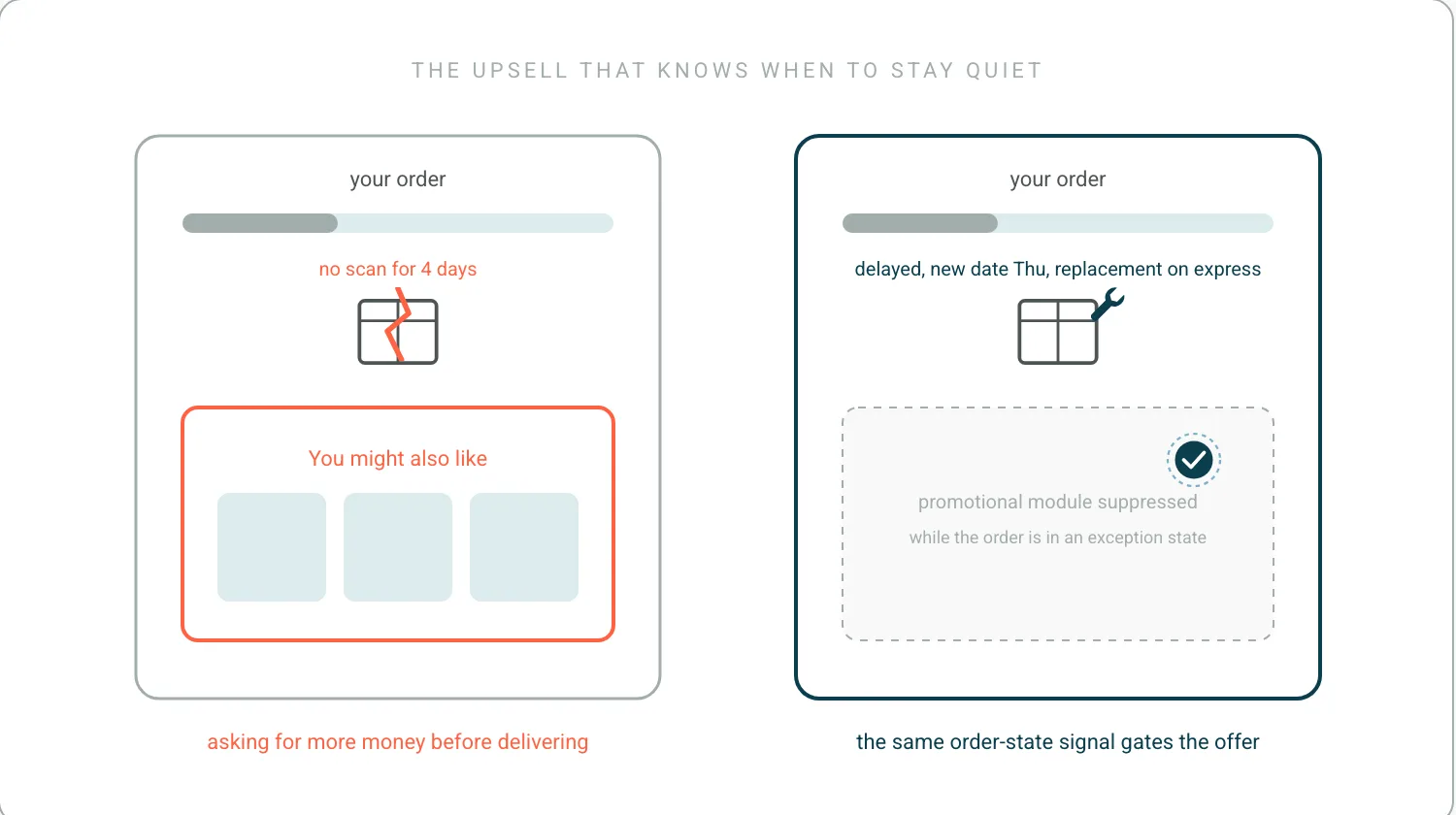
The example is a relevant offer presented during the waiting period or at delivery, on the tracking page, in a shipment notification, or at the point of a return being converted to an exchange. The operational condition, frequently ignored, is that the offer should be suppressed when the order is in trouble. An upsell attached to a delayed or lost shipment reliably produces a complaint, so the same order-state signal that drives exception handling should gate promotional content. The distinction is not only editorial: US email law separates commercial messages from transactional ones, and the FTC's CAN-SPAM guidance sets out what changes when an offer is added to a shipping update. The wider version of this argument is post-purchase marketing. That gating is the difference between an example worth copying and one worth avoiding.
This is where I would disagree with most omnichannel marketing advice. Every order is a promise, and a promotion arriving while a promise is broken is the business asking for more money before it has delivered what it already took. Almost no stack is wired to prevent that, because the marketing platform and the operations data have never been connected, and the two teams are usually measured on numbers that pull in opposite directions during exactly the week it matters. An example that upsells on the tracking page is only worth copying if it also knows when to stay quiet.
The proof is in cross-channel measures, not the channel list
The measures that demonstrate these examples are working are cross-channel return rate and its attachment rate, contact rate split by purchase channel, on-time performance across channels, and the share of support interactions resolved without a system switch. The stack proof points are order records unified across channels, location-level stock visibility, a support view with write access to fulfillment, and an event layer that all customer messaging reads from. Claims about omnichannel capability should be tested against these rather than against the channel list, and the measure definitions sit with ecommerce KPIs. For the retail-operations version of the same examples see omnichannel retailing examples, for the definition what omnichannel retailing is, for the comparison omnichannel versus multichannel, for the strategy the whole list is meant to serve what an omni-channel marketing strategy is, for a full worked sequence an ecommerce experience example, and for the operating model behind all of it post-purchase operations.
Frequently Asked Questions
What is omnichannel in marketing?
Coordinating every channel a customer can encounter so that what one channel promises the others can deliver. Read operationally, that is a data requirement rather than a creative one, and the translation is on what an omni-channel marketing strategy is.
Can you give me an example of omnichannel retailing?
The retail-operations examples, ship-from-store and click-and-collect among them, are on omnichannel retailing examples. The examples this page covers are the marketing-side ones: one tracking experience across every purchase channel, exception messages triggered by order events, and an upsell that knows to stay quiet when the order is in trouble.
Can you give me an example of an omnichannel goal?
A useful one is measurable and cross-channel rather than per-channel: contact rate per order measured across every inbox rather than one, so a reduction in one channel is not read as an improvement when the contact simply moved. The rest of that measure set is on ecommerce KPIs.
References
- US Federal Trade Commission. FTC's Mail, Internet, or Telephone Order Merchandise Rule. Why the refund step, not the acceptance step, is the real BORIS test.
- United States Postal Service. USPS Track and Confirm API. One carrier's status vocabulary, and why reconciling several is integration work.
- US Federal Trade Commission. FTC's CAN-SPAM guidance. What changes when an offer is added to a shipping update.
Ready to Stop Reacting?
The fastest way to see how Keeyu prevents complaints is to see it in action.
In one call, we’ll map your current operations, show how our AI Agent fits in, and walk through real examples of issues fixed before customers notice.
Most teams go live within 48 hours. We never share your data.

