
What is an omni-channel marketing strategy?
 Verified & Reviewed


 Copy Link
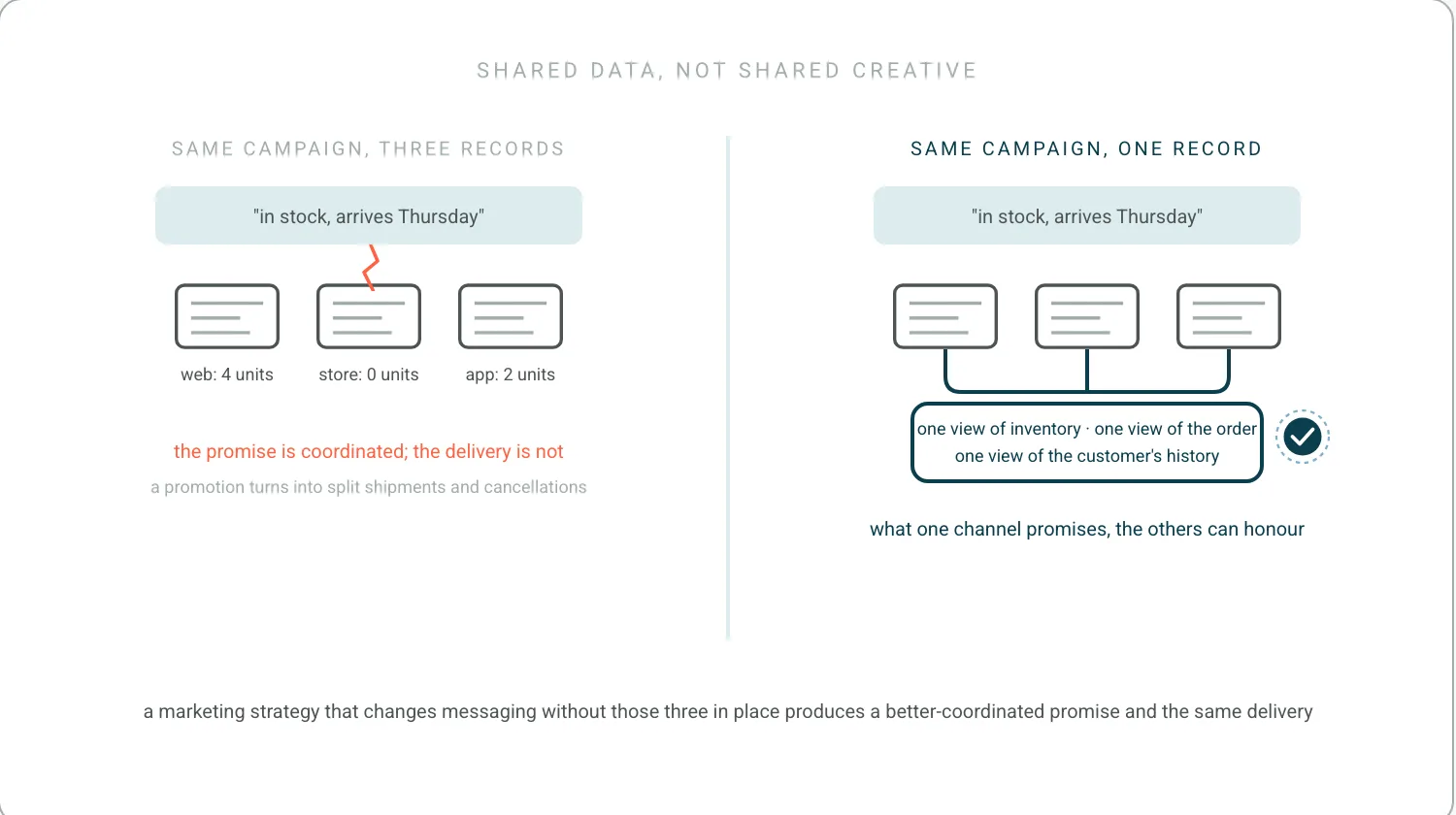
An omni-channel marketing strategy coordinates every channel a customer can encounter, so that what one channel promises the others can honour. Operationally that is a data requirement rather than a creative one: the channels have to share the same view of inventory, the same view of the order, and the same view of the customer's history. The distinction that matters is that a multi-channel operation runs several channels well in parallel, while an omni-channel operation runs them against one shared record, and the promise made in a campaign is only deliverable if that record is the one fulfillment reads. That distinction was drawn in the research before it was borrowed by vendors, by Verhoef, Kannan and Inman in the Journal of Retailing, and the retail-operations version of it is what omnichannel retailing is.
Three requirements, and none of them are marketing systems
Translated into operations, an omni-channel strategy has three requirements and none of them are marketing systems. Inventory has to be visible at the location level across every channel, or a campaign can sell stock that a specific store or warehouse cannot supply, which is how a promotion turns into split shipments and cancellations. Orders have to be routed on that same view, so that the fulfillment decision reflects what was actually promised, which is the job of omnichannel order management. And customer records have to be unified enough that a person who bought through one channel is recognizable in another. A marketing strategy that changes messaging without those three in place produces a better-coordinated promise and the same delivery. What the connected version is actually worth, measured rather than asserted, is omnichannel benefits.
A shared identifier, or the customer explains it again
Unified context means an agent can see the whole relationship rather than the channel they happen to be answering in. The realistic case is a customer who bought in one channel, raised the issue in another, started a return in a third, and is now asking about the refund in a fourth. Without a shared identifier tying those together, each channel holds a fragment and the agent asks the customer to supply the rest, which is the experience customers describe as having to explain it again. The comparison page omnichannel versus multichannel works that scenario through from the agent's side, and the system that is supposed to hold it is the helpdesk. The technical requirement is a stable customer and order identifier that every system carries, and identity resolution across channels is usually the harder half, since the same person can appear as several records under different contact details.
The break happens at the handoff from marketing systems to logistics systems
Continuity after the buy button means the experience does not change character once the order is placed. In practice the break happens at a predictable point, which is the handoff from the systems marketing controls to the systems logistics controls. The customer sees it as a shift from a branded, responsive experience to a carrier tracking page and a template email. The carrier's page is doing its own job perfectly well, and it is a different job: the USPS Track and Confirm API reports scan events, not the promise the campaign made. Carrying the brand across that handoff is shipping notifications and carrier integration, and choosing which channel each message goes to is communication preferences. Closing that gap requires the post-purchase messages to be driven by the same order record and delivered under the same brand, and it requires exception handling to exist at all, since continuity that holds while everything goes well and disappears when an order breaks is not continuity from the customer's position. Which channel an offer or an update is even permitted to use is a separate constraint again, set by the FTC's CAN-SPAM guidance for US email.
Unification removes one kind of contact, and only one
Connecting the channels reduces support load through two distinct mechanisms that are worth separating. The first is that a unified record removes the contacts caused by inconsistency, where a customer was told different things in different places and writes in to resolve the contradiction. Most of those arrive as where is my order questions. The second is that a shared view lets an issue be detected once and acted on once rather than being noticed separately in each channel. Only the first follows automatically from unification. The second requires something in the stack to act on the unified record, which is a capability rather than an architecture, and a business can complete the integration work and see the second reduction never arrive.
The distinction between the two mechanisms is where an omnichannel program succeeds or quietly does not, and the short version is one I gave on the eCommerce Australia podcast: help desks manage tickets, and preventing them is a different activity. That difference is the whole of proactive versus reactive customer service. Unifying the channels removes the contacts caused by inconsistency, which is real and immediate. It does not remove the contacts caused by orders going wrong, because unification is a property of the record rather than an action on the order. A business can finish the integration work, report beautifully on it, and see the second reduction never arrive. Every order is a promise, and unifying the record of a promise is not the same as keeping it, which is the argument post-purchase operations is built on.
The contacts that survive unification look the same everywhere in the 786 pain points we mined from 270 customer call transcripts between May 2025 and May 2026: navigating between systems still strips the order context the operations team needs, and resolving one ticket still means toggling between three and ten or more of them, because the channels agreeing on the record does not put anyone in front of the order when it stalls.
Cross-channel measures, or the contact simply moves
The measures that reflect this strategy are cross-channel rather than per-channel, which is what makes them awkward to report in most stacks. Contact rate per order, measured across all channels rather than per inbox, prevents a reduction in one channel being read as an improvement when the contact simply moved. End-to-end resolution time, measured to the customer's outcome rather than to a ticket closing in one system, catches the case where each channel closes its own record and the customer is still waiting. Repeat purchase rate split by whether the customer used more than one channel is the retention measure, and it needs the identity resolution described above before it can be calculated at all. Definitions for all three are on ecommerce KPIs.
Frequently Asked Questions
What does omnichannel marketing mean?
Coordinating every channel a customer can encounter so that what one channel promises the others can honour. Operationally that is a data requirement rather than a creative one: the channels have to share the same view of inventory, of the order, and of the customer's history, or the strategy produces a better-coordinated promise and the same delivery.
What is an example of omni channel marketing?
A campaign that can be delivered as promised, which sounds trivial and is the whole test. Promoting an item that a specific store cannot supply, or promising a delivery date the operation cannot hit, is omnichannel marketing failing at the only point a customer notices. Worked examples are on omnichannel marketing examples.
What are the four C's of omnichannel?
The phrase circulates in incompatible versions, so it is a mnemonic rather than a framework. The three requirements this page names are testable instead: inventory visible at location level, orders routed on that same view, and customer records unified enough that a person who bought through one channel is recognisable in another.
References
- Journal of Retailing. Verhoef, Kannan and Inman in the Journal of Retailing. The multi-channel and omni-channel distinction the definition rests on.
- United States Postal Service. USPS Track and Confirm API. What a carrier page reports, and what it does not.
- US Federal Trade Commission. FTC's CAN-SPAM guidance. Which messages a channel is permitted to carry.
Ready to Stop Reacting?
The fastest way to see how Keeyu prevents complaints is to see it in action.
In one call, we’ll map your current operations, show how our AI Agent fits in, and walk through real examples of issues fixed before customers notice.
Most teams go live within 48 hours. We never share your data.

