
Omnichannel vs multichannel
 Verified & Reviewed


 Copy Link
Multichannel means selling through several channels that operate independently. Omnichannel means selling through several channels that operate as one system, sharing stock, customer records, order history, and fulfillment. The difference is not how many places a business sells but whether those places can see each other. Most businesses describing themselves as omnichannel are multichannel with a shared brand, and the gap between the two shows up in operations rather than in marketing. What omnichannel retailing is carries the full definition and the five-scenario test, and multichannel retailing carries what each extra channel costs to run.
Silos cost continuously and never appear as a line item
A siloed operation keeps a separate order record, stock count, and customer history per channel. The observable symptoms are stock discrepancies between channels, agents opening several systems to answer one question, and reporting that cannot be reconciled at a total level. A unified operation places a single system of record between the channels and the fulfillment layer, so each channel writes into and reads from the same order and inventory truth. Getting there is third-party integration work, and the vocabulary for the events being shared is standardized: GS1 EPCIS exists precisely so a warehouse, a carrier and a store can describe the same event the same way. The cost of silos is paid continuously in manual reconciliation rather than visibly in a single line item, which is why it persists.
The reason silos persist is that nothing about them looks like a cost. I have watched customer experience teams burn half their day hunting for orders across five to eight different systems, copy-pasting tracking numbers between them, and apologizing for problems they did not cause and could not see coming. That is what one agent opens to answer one question. The business behind them is typically running twelve or more, counting the commerce platform, the payment gateway, the ERP, the warehouse system, the carrier connections, the helpdesk and the returns tool, each one doing its own job properly. Nobody signed off on that as a design. It accumulated, one application at a time, and the bill arrives as somebody's afternoon rather than as a line in a budget.
The five-to-eight figure matches what we heard across the 786 pain points we mined from 270 customer call transcripts between May 2025 and May 2026: operators toggling between three and ten or more systems to resolve a single ticket, and one 'where is my order' investigation opening more than 40 tabs before one customer collapsed it to a single screen.
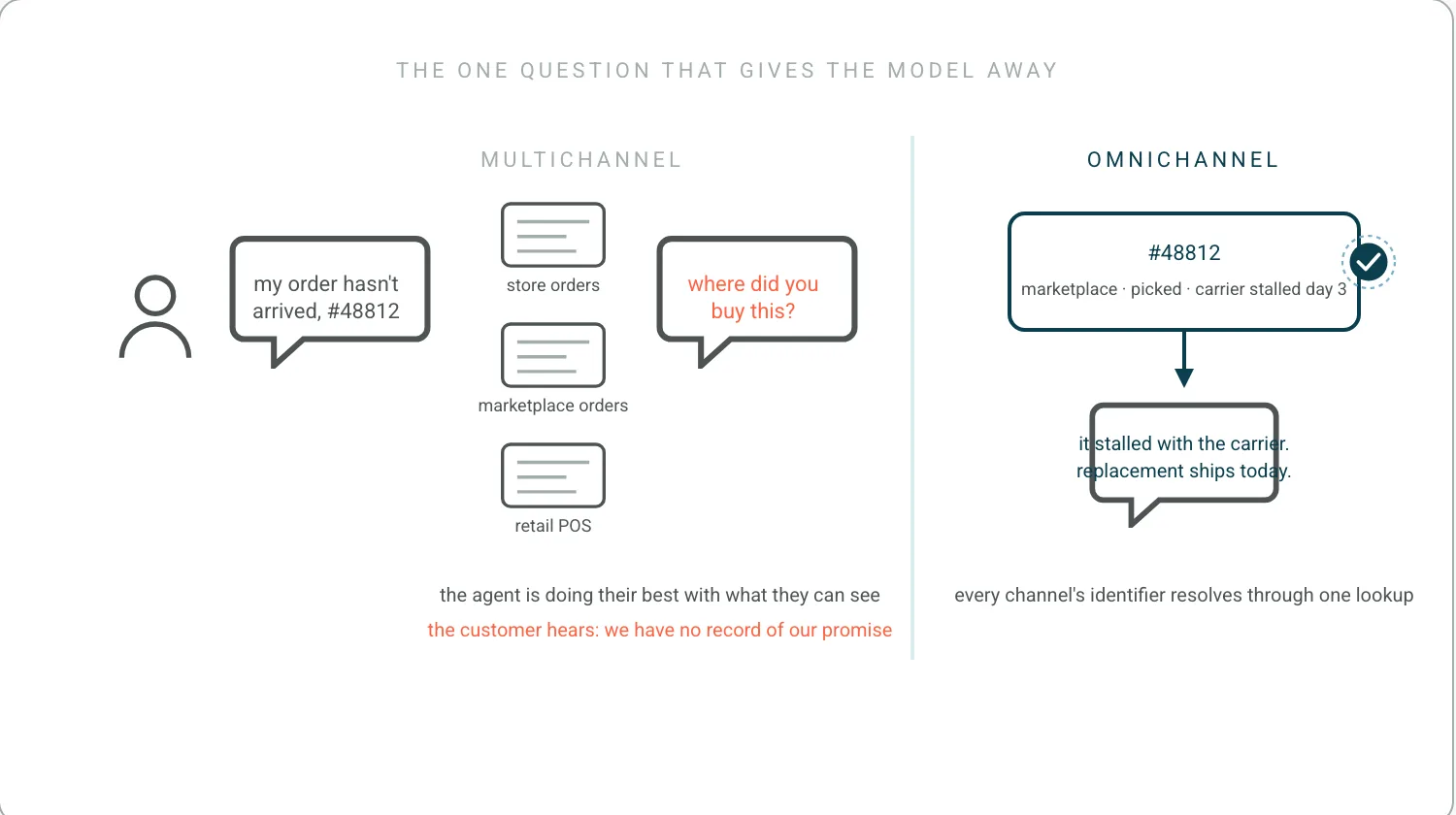
The one question that gives the model away
The diagnostic scenario is a customer contacting about an order the agent cannot find, because it was placed in a different channel. In a siloed operation the agent must ask the customer where they bought it, then open the corresponding system, and often cannot act on the order from there. In a unified operation the order is retrieved from any channel by identifier. That is a mechanical requirement rather than an aspiration: an order carries an id and a set of line items in whichever system holds it, as the Shopify Order resource shows for one channel, and a unified operation is one where every channel's identifier resolves through the same lookup. The customer-facing version is order tracking. This single interaction is the clearest practical test of the difference between the two models, and it is the one customers judge, because being asked to explain your own purchase reads as a business that does not know its own records.
This is the whole comparison in one question, and it is worth being blunt about what the customer hears. Every order is a promise the business made, and asking a customer to tell you where they bought something is telling them you have no record of making it. That is not a support failure. The agent is doing their best with what they can see. It is a channel-model failure arriving at the one moment the customer is paying attention, which is why the customer order tracking experience is a channel-model question rather than a design one.
Cross-channel returns and fulfillment are where the models diverge
Cross-channel fulfillment and returns are where the models diverge irreversibly. Returning an online order to a store requires the store to look up an order it did not sell, accept it, trigger a refund through the original payment path, and return the item to the correct stock pool. The refund leg is not only an operational choice in the US, since the FTC's Mail, Internet, or Telephone Order Merchandise Rule governs the timing a seller has to meet, and the stock leg is returns management. Fulfilling an online order from store stock requires visibility of that stock and a picking process the store can execute. Neither is possible without a shared inventory and order layer, which is omnichannel order management, and it is why these capabilities are the standard proof that an omnichannel claim is real.
One order lookup, or several that silently omit a channel
The customer-facing consequence is whether a single tracking or self-service experience covers every order, or whether each channel sends the customer somewhere different. Unified operations expose one order lookup and one returns portal regardless of where the purchase happened, within the constraints marketplaces impose on customer contact. Siloed operations either expose several, or expose one that silently omits some channels, which is worse because it presents as a missing order rather than an unsupported one. The self-service layer that sits on top of a unified record is customer self-service.
The cost that never appears in the case
The investment case for moving from multichannel to omnichannel is usually built on three components: reduced manual reconciliation labor, reduced support handling time from single-view access, and revenue effects from cross-channel capabilities such as store fulfillment and cross-channel returns. The component most often omitted is the avoided cost of oversell and misfulfillment, which siloed inventory produces continuously and which is rarely attributed to the channel model. Building the case requires a baseline for each, taken before the migration.
One cost belongs in this case that almost never appears in it. What I found running these operations, and I have talked about that period on Founders in Motion, is that when customer service sits disconnected from the ecommerce team, the ecommerce team is out driving revenue and bringing customers in while operations quietly fails behind them, and nobody connects the two numbers. The acquisition spend is measured to the cent. The orders that broke after checkout are somebody else's report. Until both sit in the same view, the return on unifying the stack will keep being argued on labor savings, which is the smallest part of it. Omnichannel benefits carries the measures that case should actually be built on, and post-purchase operations is the operating model behind it.
Frequently Asked Questions
What is multi-channel marketing?
Reaching customers through several channels that are planned and measured separately. The omnichannel version runs the same channels against one shared record, so what one channel promises the others can honour. The operational cost of the first is on multichannel retailing.
Can you give me an example of multichannel marketing?
A brand running email, paid social and a marketplace listing, each with its own audience, its own calendar and its own reporting. Nothing about that is wrong, and it becomes a problem at the moment a customer who bought through one channel asks about their order through another, which is the scenario this page is built around.
What are the four C's of omnichannel?
Several incompatible versions of the phrase circulate, which is a reason to treat it as a mnemonic rather than a framework. The comparison that does not vary is whether a customer's order can be seen from a channel that did not sell it, and the honest test for that is described on what omnichannel retailing is.
References
- GS1. GS1 EPCIS. One shared vocabulary for events crossing warehouse, carrier and store.
- Shopify. Shopify Order resource. An order as an identifier and a line-item set, resolvable from anywhere.
- US Federal Trade Commission. FTC's Mail, Internet, or Telephone Order Merchandise Rule. The refund timing behind the BORIS payment leg.
Ready to Stop Reacting?
The fastest way to see how Keeyu prevents complaints is to see it in action.
In one call, we’ll map your current operations, show how our AI Agent fits in, and walk through real examples of issues fixed before customers notice.
Most teams go live within 48 hours. We never share your data.

