
Omnichannel benefits
 Verified & Reviewed


 Copy Link
The operational benefit of omnichannel is a single view of inventory and order state across every place a customer can buy, return, or ask. Where that view exists, a support agent, a warehouse, and a customer are looking at the same record, and the work created by reconciling different records disappears. The benefits an operations team can measure follow from that one property, which is why the case is made in ticket volume, return rates, and cost per contact rather than in brand consistency. The definition itself belongs to what omnichannel retailing is, the comparison with running channels separately belongs to omnichannel versus multichannel, and the marketing-side translation of both is what an omni-channel marketing strategy is.
Cost reduction metrics
Four measures carry the operational case and each has a defined denominator. Contacts per hundred orders isolates support load from order growth. Average handle time captures the minutes an agent spends reconciling systems, which is the part unified data removes directly, and resolution time covers what that clock is really measuring. Definitions for all four sit with ecommerce KPIs. Cost per contact converts both into money at a fully loaded agent rate. Return rate is the fourth, and the mechanism there is different from the others: unified inventory reduces the returns caused by an order that should never have been accepted, such as an item that was not actually available or was fulfilled twice. Reading these as rates rather than counts is what makes them comparable across a peak period, when every count rises regardless of the change being measured. The US Census Bureau's quarterly retail ecommerce series is a useful reminder of how large that seasonal swing is before anyone reads a December number as an improvement.
Efficiency and automation
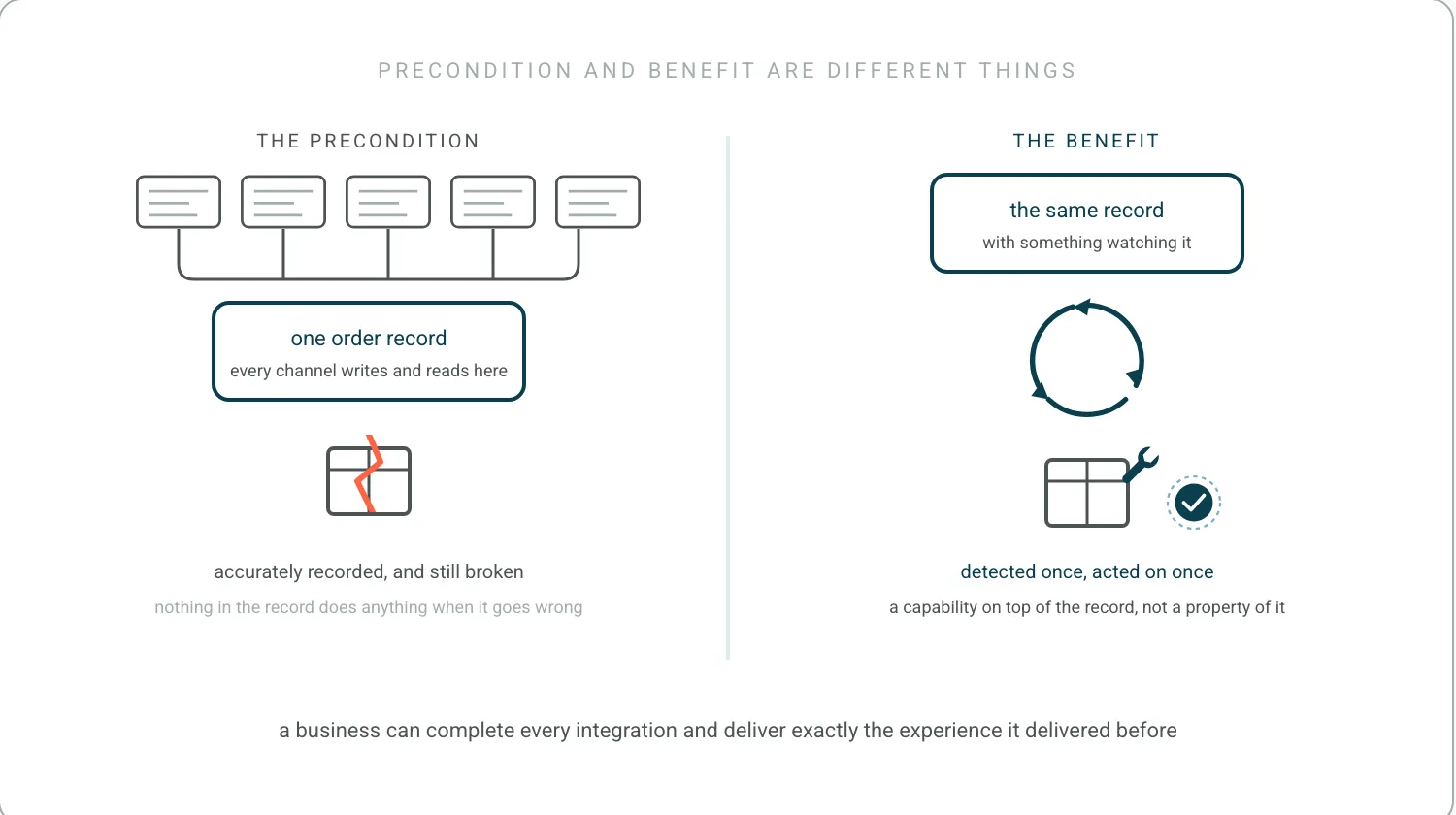
Automation depends on the data being trustworthy, which is why unification comes first in every sequence. With one order record, an exception can be detected once and acted on once, instead of being noticed separately by a marketplace dashboard, a warehouse export, and a customer email. Two categories of manual work disappear first. Re-keying, where a person copies a state from one system into another, and reconciliation, where a person decides which of two conflicting records is correct. Both of those are integration work being done by a human because software is not doing it. The second is the more expensive of the two, because it requires judgment and therefore cannot be delegated to a junior queue, and it scales with the number of connected channels rather than with order volume.
Unification is a precondition and it is not the benefit, which is the distinction this whole page turns on. A business can complete every integration, hold one accurate record of every order, and deliver exactly the experience it delivered before, because nothing in the stack does anything when the record goes wrong. Help desks manage tickets, and I have been saying that long enough that it is on the record, including on Spotlight Fridays. The benefit arrives when something prevents them, and that is a capability sitting on top of the unified record rather than a property of the record itself, which is the whole of proactive versus reactive customer service. Every order is a promise, and one accurate view of a broken promise is still a broken promise.
What the capability on top is worth is in the 786 pain points we mined from 270 customer call transcripts between May 2025 and May 2026. For one customer, the change we measured was discovery time, from 'we find out on Tuesday' to 'we find out within the hour', and the unified record was the precondition rather than the cause. The record told them where to look. Something watching it told them when.
Post-purchase enablement
Omnichannel changes what is possible after the order rather than only how it is tracked. Buying online and returning in store requires the store system and the ecommerce order record to recognize the same purchase, and it converts a shipping cost and a two-week refund wait into an immediate resolution. The wait is not arbitrary either: 16 CFR Part 435 sets the outer bound a US seller has to work inside, and most refund policies are written against it. Flexible fulfillment works the same way in reverse, letting an order route to a store with stock when the warehouse has none. Both depend on inventory accuracy at the location level rather than at the aggregate level. An aggregate stock number that is correct across the business and wrong for the specific store is the failure mode that turns these options into a worse experience than not offering them. Location-level accuracy is an events problem before it is a counting problem, which is what the GS1 EPCIS standard addresses, and the customer-facing symptom when it goes wrong is split shipments.
Real-world operational wins
The wins that recur in published operational accounts fall into three groups. Peak season handling improves because a unified inventory position removes the need to hold separate buffer stock per channel, which frees units that were previously unsellable in the location that needed them. Fulfillment speed improves where routing can choose the nearest location holding stock rather than defaulting to one warehouse. Support load falls where one record means one answer, which removes the class of contact caused by a customer being told different things by different channels. Claimed figures in this category vary widely between sources and by category, so a benefit case is worth building from the operator's own baseline rather than from a published benchmark. How to construct that baseline is ecommerce benchmark, and what the channel cost looks like before any of it is multichannel retailing.
Scalable infrastructure advice
The practical route to a single source of truth is to name which system owns each fact before connecting anything. Inventory ownership usually sits with the warehouse management system or the order management system, order state with the same system, customer contact history with the helpdesk, and the storefront owns none of them despite often being the easiest to read. The CSCMP supply chain glossary is a reasonable place to settle what each of those terms means before anyone argues about which system is which. Integrations then move data toward the owner rather than in both directions, which prevents the two-way sync conflicts that produce contradictory records. The pattern that fails at scale is point-to-point connections between every pair of systems, since the number of connections grows faster than the number of systems and every one of them is a place where state can diverge. Every order is a promise, and each of those connections is somewhere the record of the promise can quietly stop being true. The operating model that puts a name against that risk is post-purchase operations.
Frequently Asked Questions
What does omnichannel mean in simple terms?
Selling in several places that behave as one. A customer can move between them without the business losing the thread, because they share the same stock position, the same order record and the same customer history. The full definition is on what omnichannel retailing is.
What is the main disadvantage of omnichannel?
It is expensive to hold together, and the cost is paid continuously rather than once. Every connection between systems is somewhere state can diverge, and location-level inventory accuracy has to be right rather than approximately right, because an aggregate stock figure that is correct for the business and wrong for one store turns a promise into a cancellation.
What is an example of an omnichannel benefit?
Buying online and returning in store, which converts a shipping cost and a two-week refund wait into an immediate resolution, and gives the store a visit it would not otherwise have had. It only works when the store system and the ecommerce order record recognise the same purchase, which is why the benefit is a property of the integration rather than of the policy.
References
- US Electronic Code of Federal Regulations. 16 CFR Part 435. The refund wait a store return replaces.
- GS1. GS1 EPCIS standard. Location-level accuracy as an events problem.
- Council of Supply Chain Management Professionals. CSCMP supply chain glossary. Settled definitions for the systems of record.
Ready to Stop Reacting?
The fastest way to see how Keeyu prevents complaints is to see it in action.
In one call, we’ll map your current operations, show how our AI Agent fits in, and walk through real examples of issues fixed before customers notice.
Most teams go live within 48 hours. We never share your data.

