
What is omnichannel retailing?
 Verified & Reviewed


 Copy Link
Omnichannel retailing is selling across multiple channels that share the same stock, customer records, and fulfillment capability, so a customer can move between them without the business losing the thread. The distinction from multichannel is integration rather than channel count: multichannel means selling in several places, omnichannel means those places operate as one system. That distinction is not a marketing coinage. It was drawn in the research literature by Verhoef, Kannan and Inman in the Journal of Retailing, whose framing is still the one the field uses. The practical test is whether an order placed in one channel can be seen, fulfilled, serviced, and returned through another.
Straightforward in isolation, demanding in combination
The operational consequences are concrete rather than strategic. Stock becomes a single pool exposed to every channel, which raises both utilization and oversell risk. Fulfillment becomes a routing decision across locations including stores. Support must answer for orders regardless of origin. Returns must be accepted at locations that did not sell the item. Each of these is straightforward in isolation and demanding in combination, because they all depend on the same underlying requirement: one accurate, current view of every order and every unit of stock. A unit is only the same unit across channels if it is identified the same way in all of them, which is the job the GS1 GTIN does and the reason a business running two SKU schemes has already lost this argument.
The combination problem is easy to nod along to and worth making concrete. Running direct-to-consumer with retail fulfillment, the system shows a unit on the shop floor, an order is raised against it, and fifteen minutes later somebody walks in and buys that unit off the shelf. Nothing malfunctioned. Two channels were both told the truth at different moments. That is what a single stock pool actually feels like in operation, and it is why brands routinely sell stock they do not have, which stops being an edge case and becomes the whole day during a flash sale. I ran that operation before I built software for it, on the retail side as well as the online one, which Internet Retailing covered at the time. The version where the shortfall becomes two parcels instead of one is split shipments.
A storefront is not a single source of truth
A single source of truth means one system holds the authoritative version of a given record, and the others reference it rather than keeping their own. In practice that usually means one system of record for inventory, one for orders, and one for customers, with defined ownership per field. The failures are of two kinds. Duplication, where two systems each maintain a version and diverge, produces contradictory answers to the same question. Latency, where one system is authoritative but slow to propagate, produces answers that were true recently. Both present to the customer identically, as a business that appears not to know its own state.
I will say the unpopular version of this. A storefront is not a single source of truth, and treating one as though it were is the most common architectural mistake in this category. It is completely normal for the storefront and the carrier to hold different information about the same order at the same time, and neither is lying. Read the Shopify Order resource and it is clear enough what it is authoritative about, which is the sale, the line items and the money. It is not authoritative about where the parcel is. They are each authoritative about their own part and blind to the rest. The useful move is not to crown one of them, it is to connect enough of them that the disagreement itself becomes visible, because the disagreement is where the customer's problem is.
The five scenarios that expose whether it is real
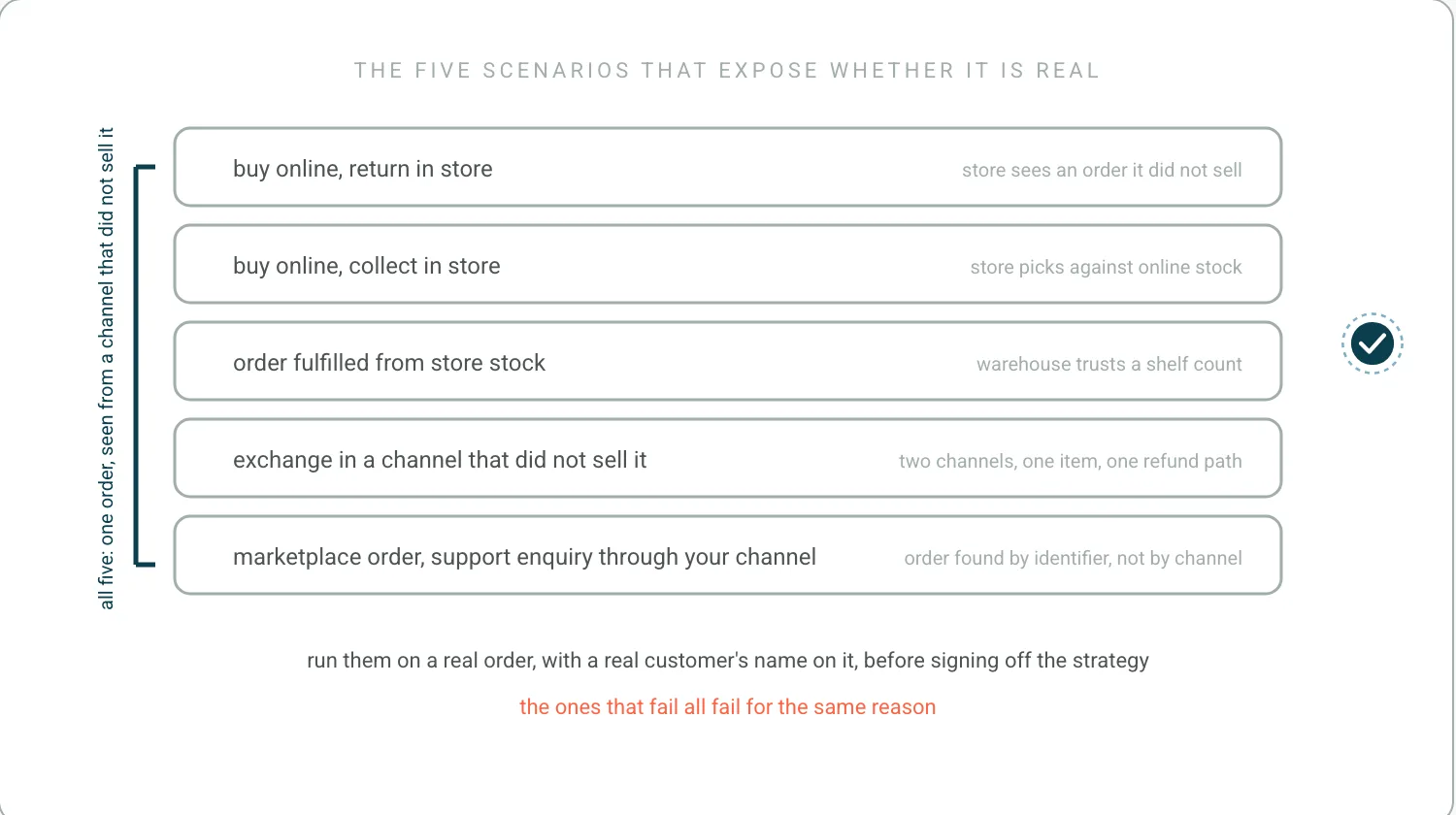
Omnichannel promises are made at the front of the journey and tested after it. The scenarios that expose whether an implementation is real are all post-purchase: buy online and return in store, buy online and collect in store, an order fulfilled from a store's stock, an exchange processed in a channel other than the one that sold the item, and a support enquiry about a marketplace order arriving through the brand's own channel. The system layer those five run through is omnichannel order management. Each requires cross-channel visibility of a single order. A business can present a convincing omnichannel front end and fail every one of these, which is why the post-purchase window is the honest place to assess it.
This is the test, and I would apply it before believing any omnichannel claim including my own. Every order is a promise, and the promise is made at the front of the journey and kept or broken at the back of it. Run the five scenarios on a real order, with a real customer's name on it, before anyone signs off on the strategy. The ones that fail will fail for the same reason every time, which is that the order cannot be seen from anywhere it was not sold.
Omnichannel is a property of the connections, and nobody owns them
The typical stack comprises a storefront, a point-of-sale system, an order management system, an inventory or ERP layer, a warehouse or third-party logistics provider, carriers, a returns platform, and a helpdesk. Omnichannel capability is a property of the connections between them rather than of any one product, which is why it is rarely delivered by a single purchase. What those connections have to carry, and where they break, is third-party integrations. The recurring constraints are integration coverage, meaning which channels and locations are genuinely connected rather than nominally supported, and failure behavior, meaning whether a broken connection alerts someone or simply stops updating.
There is a structural reason the connections stay weak, and it is not technical. Typically nobody owns the whole ecommerce operation. Responsibilities are split along the journey, one person per system, because the stack grew one application at a time and each one arrived with its own owner. So the storefront has an owner, the warehouse has an owner, the helpdesk has an owner, and the space between them has nobody. Proactive e-commerce operations is largely the work of giving that space an owner, which is a question of accountability before it is a question of integration. Post-purchase operations is what that ownership looks like written down, and omnichannel benefits is the case for paying for it.
That gap is a category of its own in the 786 pain points we mined from 270 customer call transcripts between May 2025 and May 2026: schedulers and webhooks between the storefront, the ERP and the warehouse system failing silently and intermittently, with the customer as the alerting system, and a lack of direct 3PL data access that leaves the merchant waiting to be told.
Frequently Asked Questions
Can you give me an example of omnichannel retailing?
The five that test whether an implementation is real are all post-purchase: buy online and return in store, buy online and collect in store, an online order fulfilled from a store's stock, an exchange processed in a channel other than the one that sold the item, and a support enquiry about a marketplace order arriving through the brand's own channel. Worked examples are on omnichannel retailing examples.
What are the four C's of omnichannel?
The phrase circulates in several incompatible versions, with different sources naming different four words, which is a reason to treat it as a mnemonic rather than a framework. The test that does not vary is operational: can an order placed in one channel be seen, fulfilled, serviced and returned through another. A business that passes that is omnichannel whatever it calls the four C's.
What is the main disadvantage of omnichannel?
Cost and failure surface, both of which land in operations rather than in marketing. One stock pool exposed to every channel raises utilization and oversell risk together, fulfillment becomes a routing decision rather than a warehouse task, and every additional connection is somewhere state can quietly stop agreeing. Omnichannel benefits covers the other side of that trade.
References
- Journal of Retailing. Verhoef, Kannan and Inman in the Journal of Retailing. The multichannel-to-omnichannel distinction, from the research that drew it.
- GS1. GS1 GTIN. One unit being the same unit in every channel.
- Shopify. Shopify Order resource. What a storefront is and is not authoritative about.
Ready to Stop Reacting?
The fastest way to see how Keeyu prevents complaints is to see it in action.
In one call, we’ll map your current operations, show how our AI Agent fits in, and walk through real examples of issues fixed before customers notice.
Most teams go live within 48 hours. We never share your data.

