
Automation examples in real life
 Verified & Reviewed


 Copy Link
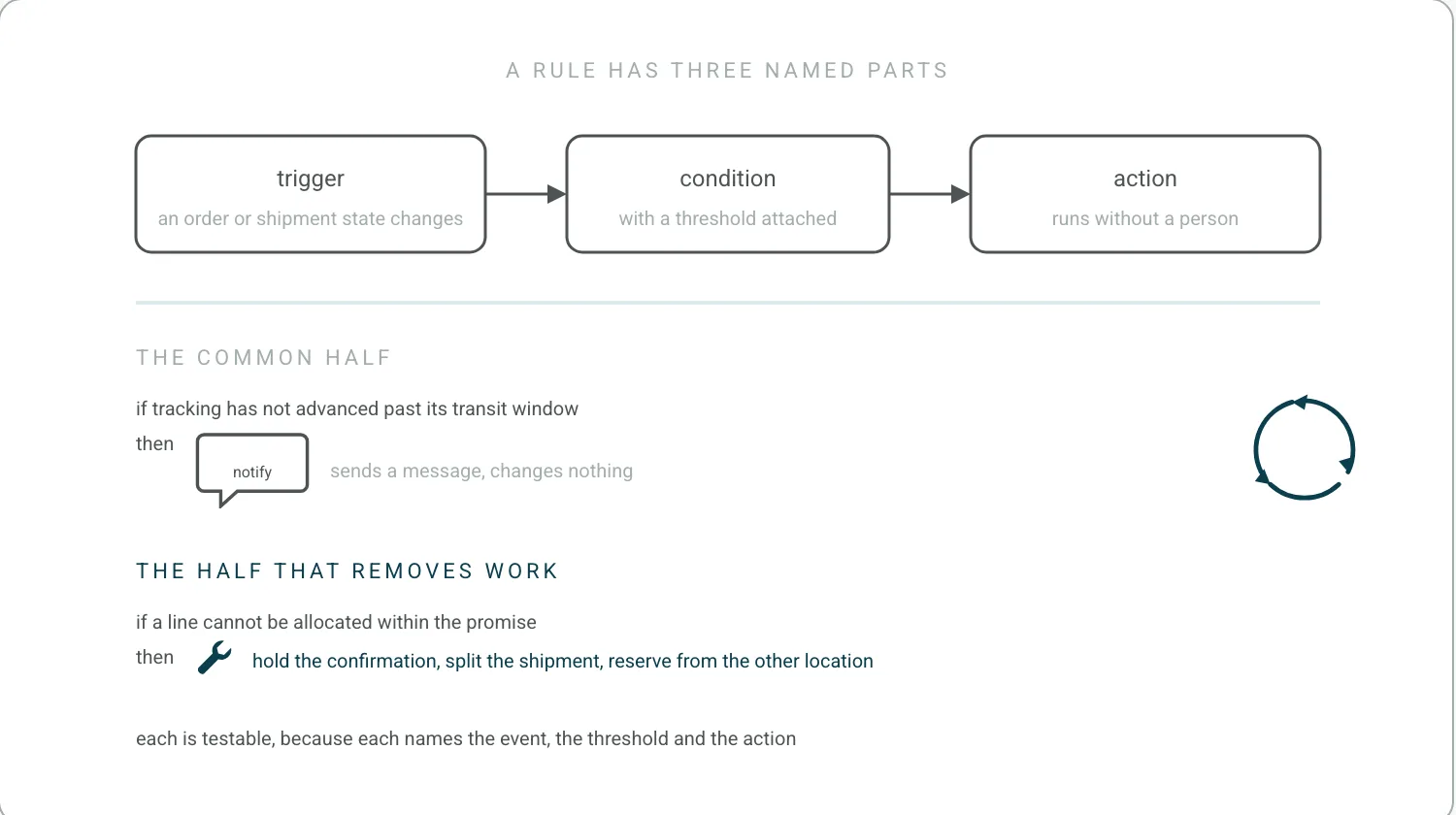
A real-world automation is a rule with three named parts: a trigger event, a condition that qualifies it, and an action that runs without a person. In ecommerce operations the trigger is usually a state change on an order or a shipment, the condition filters for the cases worth acting on, and the action is either a message to the customer or a change to the order itself. Automations that only send messages are the common half. Automations that change the order are the half that removes work. The terminology in this category drifts enough that IEEE 2755 exists to fix it, and the store-wide version of this page is automated ecommerce store.
Real-world workflows, not theory
A usable workflow is written as a specific if-then pair with a threshold attached, not as a category of task. Worked examples in post-purchase operations look like this. If a tracking status has not advanced past its expected transit window, notify the customer with a revised estimate before they ask. That threshold has to be set against something, and a carrier's own published standard is the honest reference: USPS states both its service standards and its performance against them. If a shipment is scanned as a failed delivery attempt, send the address confirmation link rather than waiting for the second attempt to fail. If an order contains a line that cannot be allocated, hold the confirmation email and send a split-shipment notice instead. If a return is scanned into the carrier network, start the refund clock and tell the customer what the clock is. For US sellers that clock has an outer bound in 16 CFR Part 435 rather than in the policy page. Each of those is testable, because each names the event, the threshold, and the action.
The pattern that actually works in real stacks is not to design the automation first. Run the action manually a few times, watch what it touches, then save that sequence as a workflow and let it run on its own. What you get is a rule shaped by the exceptions you already hit rather than by the ones you imagined, and the team trusts it because they watched it do their job before it did their job. The department-by-department catalogue of what to run this on is examples of automation in the workplace.
The manual version of these is what the dataset is full of. Across the 786 pain points we mined from 270 customer call transcripts between May 2025 and May 2026, the same handful of jobs came up again and again: a week of one-by-one email triage for 200 oversold orders, three hours to send 40 follow-up emails on one backorder, and 3PLs that quietly prioritized new orders over the backlog so somebody had to chase the unshipped batches by hand. Each of those is an if-then pair with a threshold, once something is watching the order.
Proof of ROI and time saved
The business case for an automation is built from three numbers, which are the volume of cases it applies to, the handling time per case, and the fully loaded cost of that handling time. Multiplying them gives the recovered hours, and the recovered hours are what a budget approval is actually argued on. Two adjustments make the case honest. The first is that automation rarely removes a queue completely, so the realistic figure is the share of cases that follow the happy path rather than the total. The second is that the exceptions left behind take longer per case than the average did, so the remaining queue does not shrink in proportion to the ticket count. The same adjustment applies to any deflection case, and it is worked through on customer self-service and measured on resolution time. A case built on ticket count alone tends to overstate the saving.
Two things make an ROI case in this category honest, and neither is a percentage. The first is scale: one oversell workflow saving an hour of manual work across five orders is a real, checkable number, and it multiplies transparently. The second is the threshold. My rule of thumb is simple. More than about five hours a week on spreadsheets chasing post-purchase issues is your business case. Under two hours, keep it manual, because the return is not there yet. Most published automation cases skip both and lead with the percentage. Building the baseline they should have started from is ecommerce benchmark.
Specific tool stacks
An automation is only as reliable as the connection between the systems it spans. The systems involved in a post-purchase workflow are typically the storefront, the order management or ERP system, the warehouse management system or third-party logistics provider, the carrier, the returns platform, and the helpdesk. Getting a rule across all six is third-party integrations work. Where the rule lives decides what it can do. A rule inside a helpdesk can tag, route, and reply, and cannot change an order. A rule inside a messaging platform can send, and cannot see whether the parcel moved. A rule with access to the order state can do both, which is why the same workflow described in one sentence can be trivial or impossible depending on which system it is built in.
Worth being precise about what automated means here, because the word is doing a lot of work in this category. It is not fully automated in the wide sense of a system that runs your operation. It is automated in the narrow sense: the system updates, the emails, the status changes and the record-keeping happen without a person, so the team is not doing that work. The judgement stays with people. Any vendor claiming the wide version is either selling something narrower or has not met an exception yet. I have talked about where that line sits in an interview about building this.
Edge-case handling
Edge cases are where automation either earns its place or creates work. The recurring ones in post-purchase operations are an address change requested after dispatch, a partial fulfillment where one line ships and another does not, a parcel marked delivered that the customer says never arrived, a return that is never scanned into the network, and a duplicate order created by a customer who assumed the first one failed. Watching a parcel closely enough to catch the middle three is parcel software. Each needs an explicit path, because the default behavior of an unhandled edge case is silence, and silence is what generates the contact. The design rule that follows is to write the exception branch at the same time as the happy path rather than after launch.
This is where automation projects are won and lost and I have seen both extremes fail. Too much freedom and the system does something confident and wrong. Too many rules and it stalls on the first case nobody anticipated, which is usually week two. The pattern that holds in production is a split: strict deterministic workflows for order validation, where being right matters more than being flexible, agent-driven detection for exceptions, where the shape of the problem varies every time, and a blend for customer communication. Deciding which half a given decision belongs in is the scoping exercise the NIST AI Risk Management Framework puts first, and it is the same line drawn on ecommerce chatbots. Every order is a promise, and the exception branch is where you find out whether your automation can keep one it was not designed for. The operating model that treats the exception as the main event is post-purchase operations.
Frequently Asked Questions
What are some examples of automation?
In post-purchase operations, written as rules with a threshold attached. If a tracking status has not advanced past its expected transit window, notify the customer with a revised estimate before they ask. If a shipment is scanned as a failed delivery attempt, send the address confirmation link. If an order contains a line that cannot be allocated, hold the confirmation and send a split-shipment notice instead.
What are some examples of automation in the workplace?
The department-by-department catalogue, covering order-status deflection, returns workflows, routing, exception management and helpdesk triage, is on examples of automation in the workplace. This page is about the anatomy of a single rule and the case for building it.
What are the top automation tools?
Naming tools is the least useful answer here, because the same workflow described in one sentence is trivial or impossible depending on which system the rule lives in. A rule inside a helpdesk can tag, route and reply, and cannot change an order. A rule with access to the order state can do both. Ask where the rule runs before asking what it is called.
References
- IEEE. IEEE 2755. The terminology the category keeps blurring.
- United States Postal Service. USPS states both its service standards and its performance against them. A published reference for the transit-window threshold.
- US Electronic Code of Federal Regulations. 16 CFR Part 435. The refund clock the returns workflow starts.
- US National Institute of Standards and Technology. NIST AI Risk Management Framework. Which decisions belong to deterministic rules and which to detection.
Ready to Stop Reacting?
The fastest way to see how Keeyu prevents complaints is to see it in action.
In one call, we’ll map your current operations, show how our AI Agent fits in, and walk through real examples of issues fixed before customers notice.
Most teams go live within 48 hours. We never share your data.

