
Parcel software
 Verified & Reviewed


 Copy Link
Parcel software is the tooling a merchant uses to create, dispatch, track, and manage individual shipments. It spans label generation and manifesting at the outbound end, tracking and exception handling in transit, and returns at the inbound end. The category overlaps with shipping platforms and multi-carrier aggregators, and the practical distinction between products is less about features listed than about where each sits: at the point of dispatch, across the journey, or at the point of failure. The connection layer underneath all of them is carrier integration and the wider connector question is third-party integrations.
No manual carrier-portal work between order and label
The automation baseline is that orders become labeled parcels without manual carrier-portal work: service selection by rule, label generation from order data, manifest closure on schedule, and tracking numbers written back to the order and the customer. Beyond the baseline, the differentiators are batch handling for high-volume dispatch, packing verification to catch mis-picks before they ship, and rules that account for the delivery promise rather than only cost. The measures are shipments processed per labor hour and the share requiring manual intervention, alongside the wider set on ecommerce KPIs.
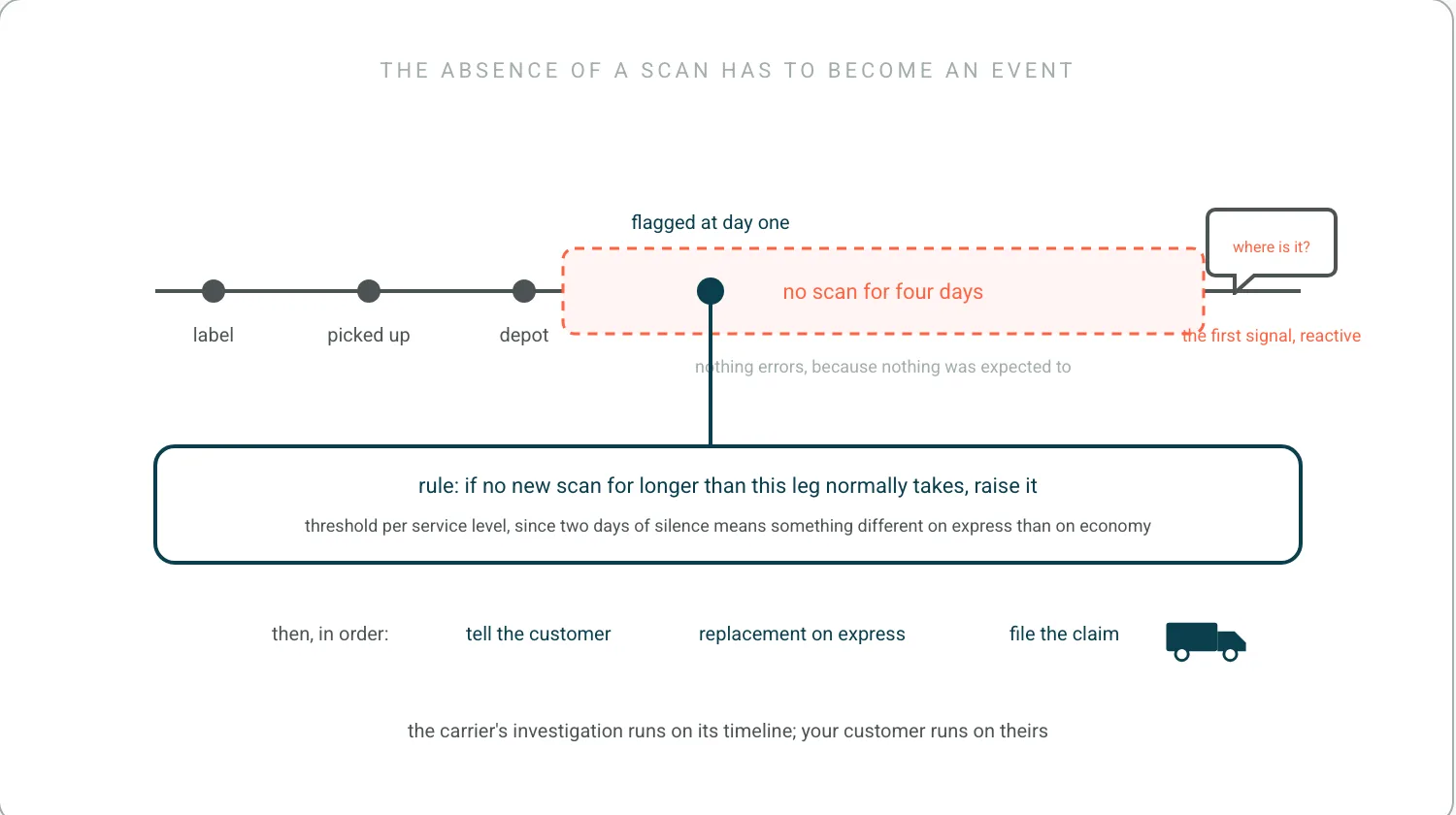
The absence of a scan has to become an event
Exceptions are the shipments that stop behaving: no carrier scan after a label is created, no movement for a defined period, a failed delivery attempt, a customs hold, a return to sender. Those scans come from each carrier's own feed, the USPS Track and Confirm API being one, and a parcel that never resolves eventually becomes a Missing Mail search rather than an answer. Managing them proactively requires a monitor that evaluates every in-flight shipment against expected progress and raises the ones that have stalled, rather than a report someone reads. The design decisions are the thresholds per service level, since a two-day silence means something different on express than on economy, and what happens on trip: an alert, a customer message, or an automated remedy such as a replacement. Setting those thresholds honestly means measuring against a published standard rather than a guess, which is what USPS does with its own service performance, and the merchant-side version is on-time delivery.
This is the section that justifies the category, and the finding underneath it is blunt: once a parcel leaves the warehouse, most brands are flying blind. Our own analysis of 270 customer calls, 786 pain points coded between May 2025 and May 2026, put it in the operators' own words repeatedly, and the phrase that kept coming back was a black hole. Nothing is wrong with the tracking data. The problem is that nobody is reading it until a customer forces the issue, so the first signal that a parcel stopped moving is an email from the person waiting for it. The workable version is a rule rather than a dashboard: watch every outbound parcel across every carrier, and flag any that has not produced a new scan for a set period, so the absence of an event becomes an event. That is proactive customer service expressed as a rule, and it is what stops WISMO volume being the first signal. I made the same argument on the Retail Fest post-purchase panel.
Two failure shapes from that dataset are worth designing the rule around. A carrier picks up a batch and the parcels vanish with no tracking at all, so there is no scan to go stale, only silence. And customs quietly changes an HS code, and a whole market's parcels start bouncing back as return-to-sender exceptions at once. Neither produces an error in any system the merchant owns. Both produce a wave of customer contact about a week later.
A branded page showing a stalled parcel is a well-designed broken promise
Branded tracking replaces the carrier's page with one on the merchant's domain, carrying its design and often product recommendations. Its operational value is that it consolidates a multi-carrier estate into one customer-facing experience, so the customer's journey does not vary by which carrier happened to be selected. Its limit is that it presents status rather than changing it, so a branded page showing a stalled parcel is a well-designed account of a broken promise. The pairing that works is branded presentation over an exception process that acts. The presentation half is order tracking software, customer order tracking and final mile delivery tracking. The notification half is delivery notification software.
Refund on the carrier scan, not days after receipt
The inbound leg needs the same capabilities as the outbound one: label issue, tracking, and status visibility, plus receipt and inspection at the warehouse. Integration between the parcel layer and the returns platform determines whether a merchant can see a return in transit or only learns of it on arrival, which is the difference between proactively refunding on carrier scan and refunding days after receipt. Refund timing is a significant driver of contact volume, so this integration has a measurable support effect, and it has a legal outer bound in 16 CFR Part 435. The process is returns management and the faster version of the refund is instant refunds.
Consolidate for visibility, not just for rate
Most merchants run several carriers, and the operational task is consolidating them behind one process. That means normalizing service levels, tracking event vocabularies, and label formats so that internal workflows do not branch per carrier. The industry vocabulary for the event half of that is the GS1 EPCIS standard. The benefits are resilience, since one carrier's failure does not halt dispatch, and negotiating position. The cost is integration surface, which is why aggregation is common. The evaluation question is whether consolidation extends to exception handling or stops at label generation, because carriers differ most in how they report failure.
Consolidation is usually argued on rate and it should be argued on visibility. A multi-carrier operation needs one view showing how many parcels are in transit, how many are sitting with exceptions, how many are waiting collection and how many are delivered, across all of them at once. Without that, adding a carrier adds a portal, and every portal is a place where a stalled parcel can sit unnoticed. Every order is a promise regardless of which carrier is carrying it, and the customer will not accept that it was the other one's fault. The operating model behind that view is post-purchase operations.
Read carrier performance by lane, never in aggregate
Four reports are worth having. Cost per shipment by carrier, service and lane. On-time performance against the promise. Exception rate by carrier and cause. Claim outcomes. The comparison that changes decisions is carrier performance by lane rather than in aggregate, because a carrier that performs well nationally can be the cause of a concentrated regional failure. Invoice reconciliation against expected charges belongs here too, since carrier adjustments for dimensions and surcharges are a routine and rarely audited cost, and claims are a carrier-defined process rather than a merchant one, as FedEx sets out for its own. Building a baseline to read any of this against is ecommerce benchmark.
Frequently Asked Questions
What is the best parcel tracking software?
This page does not rank products, and the criteria decide the outcome anyway. Judge on where a tool sits rather than on its feature list: at the point of dispatch, across the journey, or at the point of failure. The third is the one that changes the numbers, because it has to notice a shipment that has stopped scanning, which produces no event to react to.
What is the parcel app and what does it do?
In the merchant sense it is the tooling used to create, dispatch, track and manage individual shipments, covering labels and manifesting at the outbound end, tracking and exception handling in transit, and returns at the inbound end. There is also a consumer parcel-tracking app category, which is a different product for a different user.
References
- United States Postal Service. USPS Track and Confirm API. Where the scans an exception monitor reads come from.
- United States Postal Service. Missing Mail search. What an unresolved parcel formally becomes.
- United States Postal Service. USPS does with its own service performance. A published standard to set thresholds against.
- GS1. GS1 EPCIS standard. Normalizing event vocabularies across carriers.
- US Electronic Code of Federal Regulations. 16 CFR Part 435. The refund timing the inbound leg is bounded by.
- FedEx. FedEx sets out for its own. Claims as a carrier-defined process.
Ready to Stop Reacting?
The fastest way to see how Keeyu prevents complaints is to see it in action.
In one call, we’ll map your current operations, show how our AI Agent fits in, and walk through real examples of issues fixed before customers notice.
Most teams go live within 48 hours. We never share your data.

