
Final mile delivery tracking: watching the leg where promises break
 Verified & Reviewed


 Copy Link
Final mile delivery tracking is the monitoring of a shipment's last leg, from the final depot or local courier to the customer's door. It is where an ecommerce operator needs real-time visibility, exception alerts, and carrier performance data, because the final mile is where most delivery promises actually break: failed attempts, misdeliveries, parcels that go quiet a suburb away from the buyer. My view is simple: carriers will drop parcels, and no brand gets to control that. What I can control is who tells the shopper first, because every time a shopper has to go and look something up, friction has already been added. Every order is a promise. Keeyu keeps it, and the final mile is where keeping it gets hard, because the promise is now in a courier's van. Proactive e-commerce operations, the system of action for e-commerce, exists for exactly this gap between what you promised and what you can directly control.
What an ecommerce team needs from final mile tracking
- Real-time visibility with exception alerts. Not a map for its own sake. The signal that matters is a delivery failing, stalling, or drifting past its promise while there is still time to intervene.
- Customer-facing status that stays honest. The delivery-day page and notifications, covered in depth on the order tracking software page.
- Carrier and 3PL performance data. On-time rate, exception rate, and claim outcomes per carrier. This is how you learn which partner is quietly costing you customers, and the metric definitions live on the on-time delivery page.
The same visibility problem runs backwards through reverse logistics, where the parcel is coming to you and nobody is watching either. Honest scope note: if you run your own drivers or a courier fleet, you also need route optimization, dispatching, and proof-of-delivery capture. That is fleet software, a different product class, and not what Keeyu or the merchant-side tools in this space do. This page is for the merchant watching carriers, not the carrier managing drivers.
The final mile at scale is a many-carrier problem
The complexity is not one parcel on one truck. One lifestyle brand we work with runs global operations on a lean CX team, four storefronts, multiple 3PLs, and roughly 100,000 orders a year. One of our strongest advocates has managed multi-geo operations across six warehouses, including Walmart fulfillment. We work with a large retailer processing 1.2 million orders across 22 carriers, who had been told their logistics were too complex for any solution to manage. At that scale "check the tracking" is not an instruction a human can execute, and the maturity ladder on the post-purchase ops maturity page is a fair way to place yourself on it. Final mile tracking has to be aggregated, automated, and watched against each order's specific promise, or it is just a very large pile of tabs. The SLA landscape makes it harder: warehouse dispatch cut-offs, carrier delivery promises of 24 to 48 hours or five business days, marketplace SLAs on top. Each parcel is racing a different clock, and the tracking layer has to know which one.
It is a many-origin problem before it is a many-carrier one. Some of our customers ship a million orders a year from seven warehouses across five storefronts, and one runs a hundred drop shippers he could not see into at all, which I described on The Ecommerce Edge. Every origin brings its own carriers, its own cutoffs and its own version of the truth.
When the final mile fails: the rule we encode
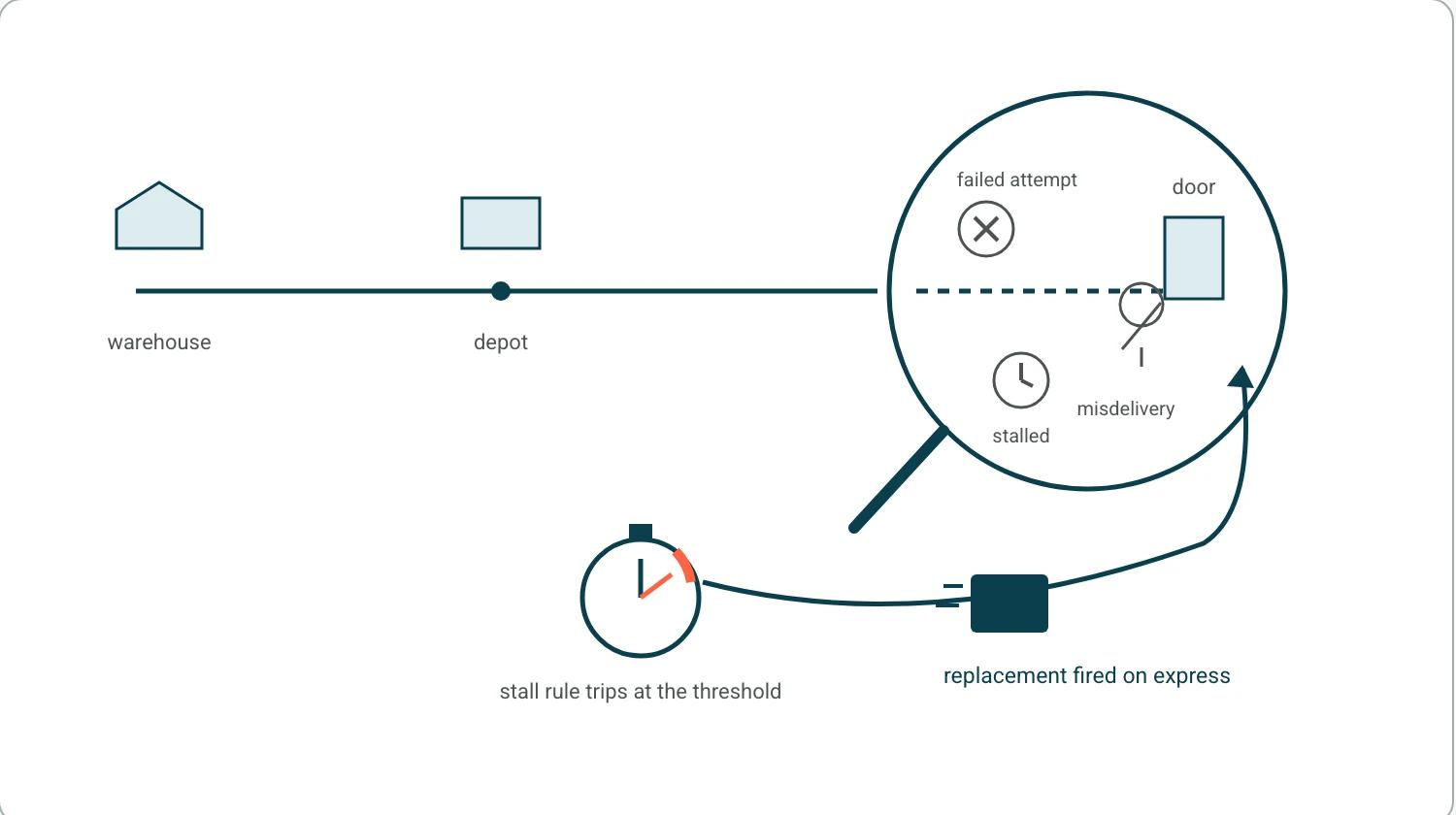
Every operator needs a stall rule, because carriers do not send a "we lost it" event. Ours starts from the order's promise. As a working default, when a parcel has shown no scan movement for 5 days and the promise is still open, we stop calling it slow and treat it as lost, and we tune that threshold per carrier and per leg. When a parcel trips it, act in this order: check for replacement stock across your locations, raise the replacement on express, tell the shopper what has already been done, then lodge the carrier inquiry, all without waiting for the angry email. The failure modes are wilder than the dashboards suggest: one brand described last mile carriers leaving parcels at the bottom of recycling bins, with the status reading delivered, so nothing flagged it until the shopper complained. Most of these exceptions share the same gap, and it is the gap all through the 786 pain points we mined from 270 customer call transcripts between May 2025 and May 2026: no proactive detection and no automated resolution workflow. What each exception type means and how to respond is broken down on the delivery exception page. The team at Budgy Smuggler put the before and after plainly: one dashboard showing whether orders are going out on time and whether any are stuck in transit, where before it was a manual scroll through the Shopify back end. Their ops lead now logs in to see what the team missed, because the view is trimmed down to what is actually a problem. EHP Labs hit the same hidden bottleneck: no unified view, no early warning, and no system to act. The tracking data existed. Nothing was watching it.
The rule is a clock, not a status. When an order has not moved between scans for longer than that leg normally takes, we treat it as lost and start the recovery: alternative stock found, replacement shipped express, new tracking number sent to the shopper, and the carrier claim settled afterwards. I walked through it on Add To Cart. The carrier's investigation runs on its timeline. Your customer runs on theirs.
Tracking the mile versus keeping the promise
Final mile tracking tells you where the parcel is. The customer only cares whether the promise holds. Tracking calms customers. Keeyu fixes the order behind it: detect the stalled or failed delivery in real time, decide the fix, act on it, then tell the customer what has already been done. Keeyu gets shoppers what they want, on time, as promised. The wider discipline this sits inside is mapped on the post-purchase operations hub, and you can see your own final mile exceptions surfaced in a demo. Every order is a promise. Keeyu keeps it, all the way to the door.
The difference shows up in the ticket count rather than the map. EHP Labs cut reactive tickets 55% and saved close to half a million dollars over twelve months, figures I gave on Marketing for SMEs. They still had carrier delays. What changed is that the delays were caught and handled before the shopper opened the tracking page.
Frequently Asked Questions
What is final mile delivery tracking?
Monitoring the last leg of a shipment, from the final depot or local courier to the customer's door. It is the stage with the most exceptions - failed attempts, misdeliveries, parcels that stop moving - and the stage customers judge the brand on.
How is final mile tracking different from regular shipment tracking?
Regular tracking follows the parcel across the whole carrier network. Final mile tracking focuses on the delivery-day leg, where timing promises, failed attempts, and driver handoffs happen, and where most "where is my order" contact is generated.
What should I do when a final mile delivery fails?
Contact the customer before they contact you, with the new plan - redelivery date, pickup point, or replacement. The failure is the carrier's. The silence afterwards is the brand's.
References
- Keeyu customer results (Budgy Smuggler, EHP Labs): keeyu.com/customer-stories
- The Breakout CEO #86, The Pivot This Founder Made After an Investor Called It Impossible - one in five US shoppers not getting orders on time, and the ticket ratios behind it.
- Add To Cart #599, How to Prevent "Where is my Order?" Complaints Before Customers Ask - preventing "where is my order" before the customer asks.
- Marketing for SMEs, Jevon Le Roux on the E-Commerce Mistake Costing Millions - the orchestration layer, and the 55% ticket cut at EHP Labs.
- USPS, USPS Ground Advantage - ground parcel delivery expected in 2 to 5 business days, one of the carrier clocks a final mile order races.
Keep the promise.
See how Keeyu catches and fixes post-purchase issues before customers notice.
In one call, we’ll map your operations and show how Keeyu detects issues, decides what needs to happen, and takes action across your existing systems.
We’ll confirm your integration requirements and rollout plan during the demo.
