
Ecommerce application
 Verified & Reviewed


 Copy Link
An ecommerce application is any software a merchant runs alongside their storefront to operate the business: order management, fulfillment, shipping, returns, support, and the integrations between them. The term is broad enough to be near-meaningless on its own, so in practice it is scoped by the job being solved. For an operations or support team the relevant applications are the ones that handle what happens after checkout, where most operational cost and most customer contact are generated. What the whole set looks like is company tech stack and how to choose between the options is best tech stack for ecommerce.
Three layers that get sold with the same words
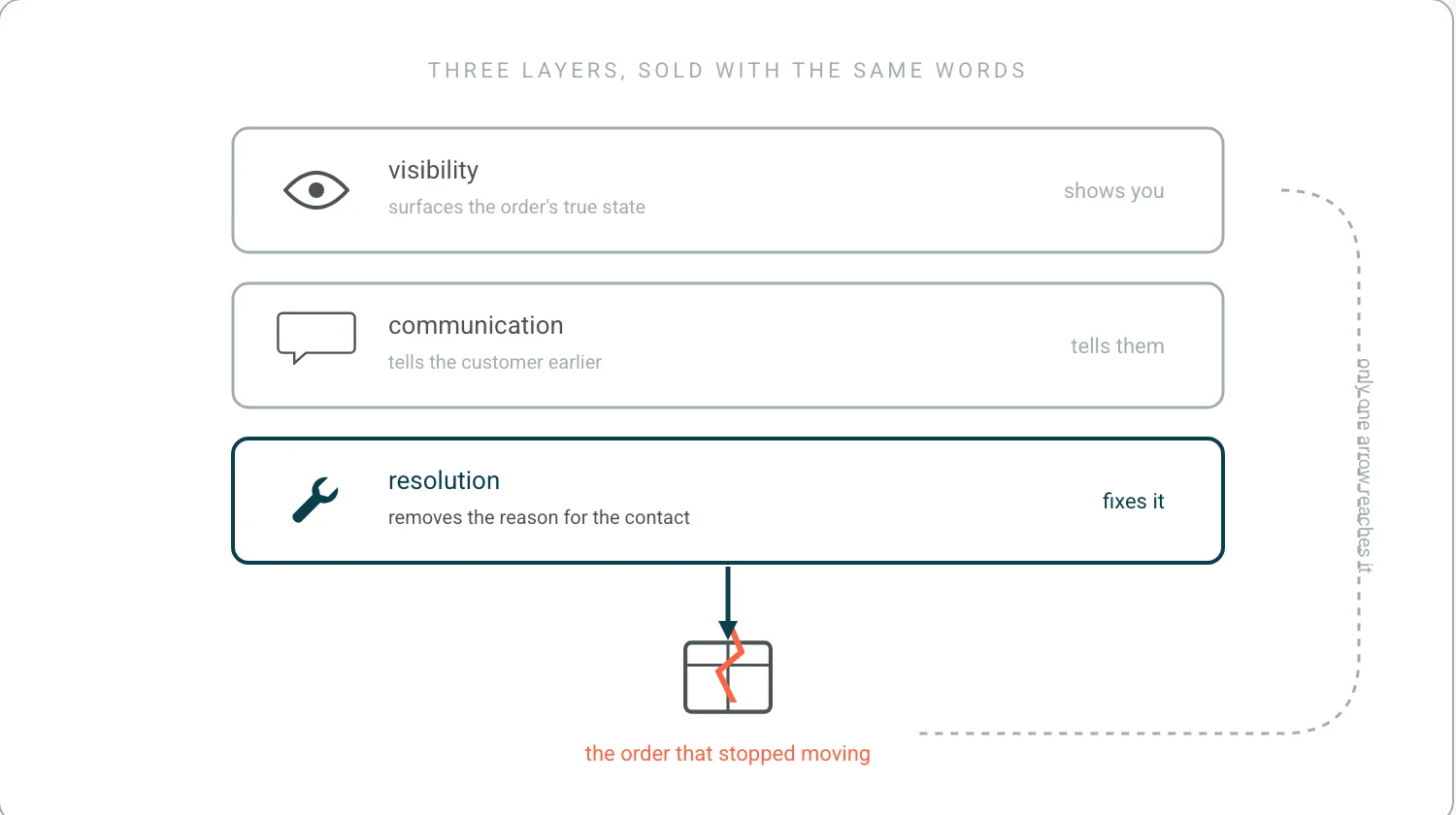
Order-status enquiries are the largest single contact category in most ecommerce support queues. Applications addressing it fall into three layers. Visibility surfaces the order's true state across systems. Communication pushes proactive updates and hosts a branded tracking page. Resolution acts on orders that have gone wrong. The first two reduce contact by answering earlier. The third reduces contact by removing the reason for it. Evaluating this category usefully means asking which of the three layers a given application actually provides, since all three are commonly described with the same language. The contact type itself is WISMO and the tooling that handles what still arrives is the automated ticketing system.
I have run ecommerce brands for twenty years and the pattern never changed: the tools I bought were good at telling me something was wrong. Almost none of them did anything about it. That is the whole reason the three layers above are worth separating before you buy anything, because visibility and communication are cheap to build and resolution is not, and all three get sold with the same words. The honest test is to ask the vendor what happens to an order that has stopped moving. If the answer describes a screen, you are buying layer one. I have made the same point in trade press since Internet Retailing covered the operations side of my career, and the operating model it points at is proactive customer service.
Returns: the policy engine is where the differences are
Returns applications cover request intake, eligibility and policy enforcement, label generation, carrier tracking of the inbound parcel, warehouse receipt and inspection, and the refund or exchange decision. The measurable objectives are cycle time from request to refund, the share of returns converted to exchanges or store credit, and the labor cost per return processed. Policy configuration is where most differentiation sits: eligibility windows, condition rules, fee structures, and the exception paths for items that arrive damaged, unlabeled, or outside policy. Not all of it is configurable, since 16 CFR Part 435 sets refund timing for US sellers. The category is returns management software and the process is returns management.
Overselling is a latency problem
Inventory synchronization keeps a single stock truth across sales channels and fulfillment locations. Its failure mode is overselling, where an item sells after the last unit has gone, and its cause is usually latency or partial coverage between the storefront, the warehouse system, and any marketplace channels. Multi-warehouse operations add an allocation decision: which location should fill a given order, based on stock, proximity, cost, and cut-off times. Those are settled terms, defined in the CSCMP supply chain glossary, and the system that makes the decision is the order management system. Getting the order into it cleanly in the first place is order entry software. Bundles and pre-orders are the standard stress cases, because they consume stock in ways simple counters handle badly.
Multiple fulfillment locations is where this gets genuinely hard, and it gets harder again with ship-from-store and click-and-collect, because the stock a customer is buying is sitting in a shop that is also selling it to somebody standing in front of the counter. Almost every cancellation that follows traces back to the same two root causes, which are system sync and stock integrity. Nobody notices the sync itself failing. They notice the cancellation email three days later, or a split shipment, and by then the decision has already been made for them. Running one stock pool across channels and stores is multichannel retailing and omnichannel order management.
Cut-offs and carrier choice decide what 'ships today' means
This layer covers rate shopping and carrier selection, label generation, manifesting, dispatch, and tracking. The operationally significant capabilities are cut-off handling, which determines what "ships today" actually means, and multi-carrier support, which determines whether a single carrier failure stops dispatch. Cost control usually comes from packaging right-sizing and rate selection, while service performance comes from carrier choice by lane rather than by headline price, measured against a stated standard the way USPS publishes its own. The connection layer is carrier integration and the tooling category is parcel software.
Routing gets automated, exceptions get a person
Routing decides where and how an order is fulfilled. Exception handling decides what happens when that plan fails: stock that will not allocate, a warehouse that misses its cut-off, a carrier that loses the parcel, a payment that reverses. Lost has a formal definition for US domestic mail, which is the point a Missing Mail search can be opened rather than the point the customer gives up. The recurring gap in this category is that routing is usually automated while exception handling is not, so orders that follow the plan are efficient and orders that break it fall to a person to notice. Any application in this space is worth evaluating on what it does when the order does not proceed as routed.
The routing is the part everybody automates and the exceptions are the part that decides your December. One brand went into Black Friday and a sync failure left them with no order visibility at all, hundreds of parcels already picked up and nothing on any screen to say where they were. Flying blind at the highest-volume moment of the year, with a support queue filling up faster than anyone could read it. That is not a routing problem, it is what happens when nothing in the stack is watching whether orders are still moving. Every order is a promise, and an exception is the moment a promise starts to break, which is the moment worth building for rather than the happy path everyone demos.
Silent failure is the expensive kind
Integrations determine whether the applications above operate on the same version of the truth. An ERP connection carries stock, cost, invoicing, and often customer records. A helpdesk connection carries the contact history and lets support see order state without switching systems. The practical criteria are coverage, latency, and failure behavior, meaning what happens when a sync fails: whether it retries, alerts, or fails silently. Judging a connector on those terms is third-party integrations, and whether two systems even describe the same event the same way is what the GS1 EPCIS standard addresses. The system holding the conversation is the helpdesk. Silent failure is the most damaging, because the systems continue to look correct while diverging.
Silent failure is not a theoretical category. One brand had a thousand orders on the storefront and nine hundred in the warehouse system, and no way to find the missing hundred. Nothing errored. Both systems looked correct on their own, and the only signal that anything was wrong was a hundred customers who eventually wrote in. That is the reason we treat this as proactive e-commerce operations rather than as integration work: connecting the systems is the easy half, and the half that matters is something continuously checking that the two ends still agree. That is post-purchase operations rather than an integration project.
It is also the most common kind. When we categorized the 786 pain points we mined from 270 customer call transcripts between May 2025 and May 2026, system sync failures were the largest single category, with 94 separate mentions across prospects and deployed customers, and the pattern repeated: schedulers and webhooks between the storefront, the ERP and the warehouse system failing quietly and intermittently, with a customer ticket as the first signal anyone received. One storefront had stopped syncing on October 22 and nobody knew until the tickets arrived. A warehouse cutover silently stopped the data flow on March 3. Neither showed an error.
Frequently Asked Questions
What is an ecommerce application?
Any software a merchant runs alongside their storefront to operate the business: order management, fulfillment, shipping, returns, support, and the integrations between them. The term is broad enough to be near-meaningless on its own, so in practice it is scoped by the job being solved, and for an operations team that job is what happens after checkout.
What are the four types of ecommerce?
The classical split is by who is transacting with whom: business to consumer, business to business, consumer to consumer, and consumer to business. It matters less here than the operational split, since a B2B order carries account pricing, credit terms and partial-shipment rules that a direct-to-consumer order never has, and those differences land in the same order record.
What are the top ecommerce apps?
This page does not publish a ranked list, because the category is too broad for one to mean anything. The useful sort is by layer: which of visibility, communication and resolution a given application actually provides. All three are commonly described in the same language, and the honest test is to ask a vendor what happens to an order that has stopped moving.
References
- US Electronic Code of Federal Regulations. 16 CFR Part 435. The returns policy that is not configurable.
- Council of Supply Chain Management Professionals. CSCMP supply chain glossary. Settled definitions for allocation and routing.
- United States Postal Service. USPS publishes its own. Carrier performance measured against a stated standard.
- United States Postal Service. Missing Mail search. Lost as a defined state rather than a judgement.
- GS1. GS1 EPCIS standard. Two systems describing the same event the same way.
Ready to Stop Reacting?
The fastest way to see how Keeyu prevents complaints is to see it in action.
In one call, we’ll map your current operations, show how our AI Agent fits in, and walk through real examples of issues fixed before customers notice.
Most teams go live within 48 hours. We never share your data.

