
Best tech stack for ecommerce
 Verified & Reviewed


 Copy Link
An ecommerce operations stack is the set of systems that carry an order from checkout to delivery, return, and resolution. The core categories are the storefront, the order management or ERP system, the warehouse management system or third-party logistics provider, the carriers, the returns platform, and the helpdesk. There is no single best combination, because the right stack is decided by order volume, the number of fulfillment locations, and how many sales channels feed the same inventory. What does generalize is the order in which the categories are chosen, since every layer after the order management system depends on it holding accurate state. What each layer is and how it fails is company tech stack, and the terms themselves are settled in the CSCMP supply chain glossary.
Count systems opened, values re-keyed and records reconciled
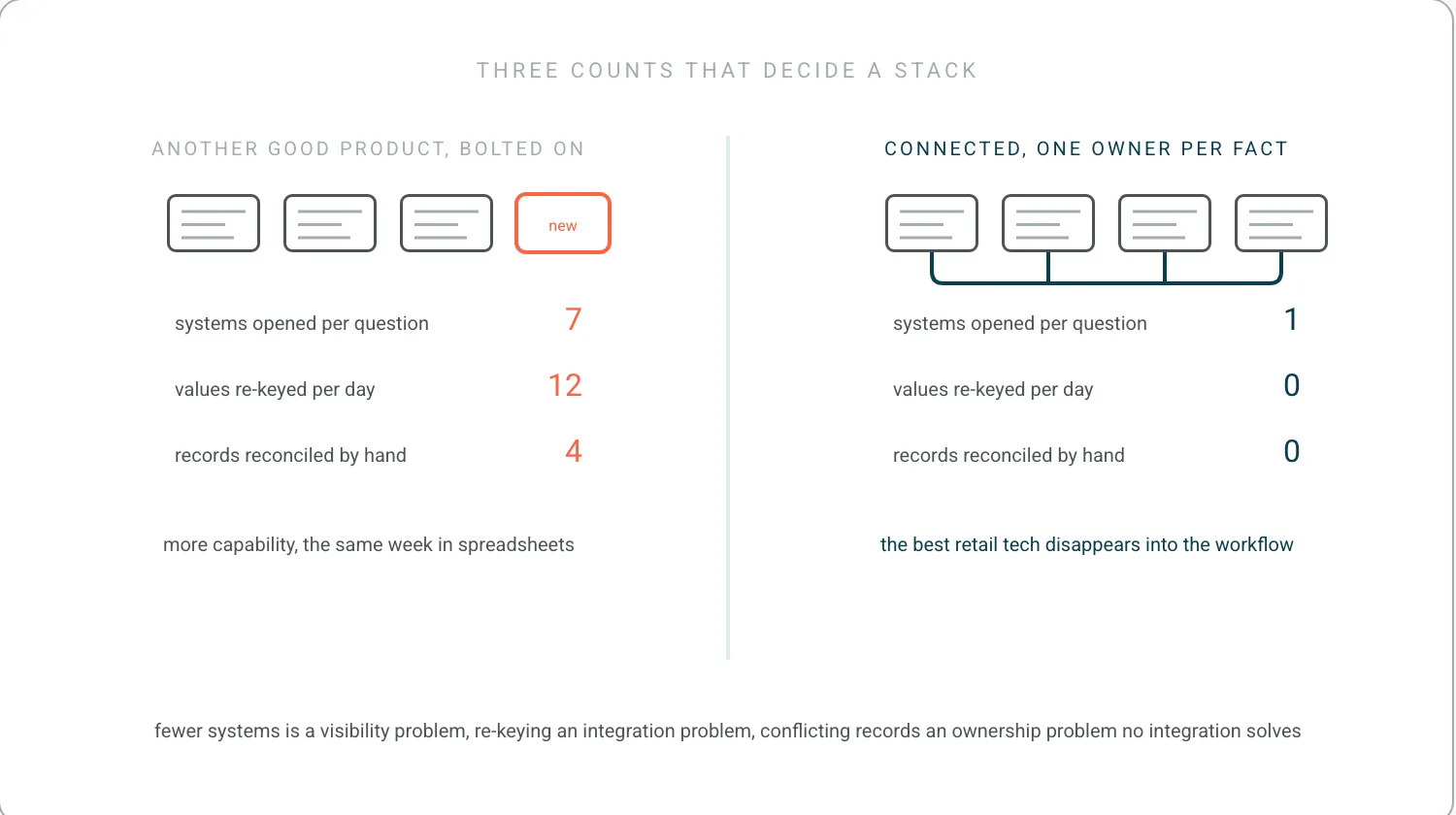
Efficiency in a stack is decided by how much manual reconciliation it requires, not by how many features it has. The work worth counting is the number of systems a person has to open to answer one question, the number of times a value is re-keyed from one system into another, and the number of decisions that require a human to judge which of two records is right. Each of the three has a different fix. Fewer systems to open is a visibility problem, re-keying is an integration problem, and conflicting records is an ownership problem that no integration solves. Evaluating a stack on features rather than on those three counts is the reason well-equipped teams still spend their week in spreadsheets. The application layer where most of that switching happens is ecommerce application, and the cost of it lands on the helpdesk.
There is a test for this that cuts through every feature comparison. The best retail tech disappears into the workflow. When a team stops fighting its tools, the tools have started working, and until then no amount of capability is being realized. That is why the three counts above are the right measures: systems opened per question, values re-keyed, records reconciled. All three go down when the stack recedes, and all three stay flat when a business buys another good product and bolts it on beside the others. The measures that show it are on ecommerce KPIs.
The direction of each connection predicts how it fails
The connections between the systems are the part of a stack that fails, and the question that predicts failure is which direction each connection runs. A read connection displays state elsewhere and is enough for tracking pages and helpdesk context. A write connection changes something and is what allows a return, a cancellation, or an address correction to complete without a person. The distinction is the safe-versus-unsafe method split in RFC 9110, and the criteria for judging either are on third-party integrations. Native connectors are usually easier to deploy and narrower in scope than middleware, and middleware adds a place where a mapping can drift. Whichever route is taken, the practical acceptance test is the same: run a deliberately broken order end to end and see which systems notice. Where a vendor publishes an OpenAPI description, half of that test can be run before anything is installed.
The joins are where this is decided and the ownership question is the one that settles them. What we kept finding is that people had become the integration layer, which is why operations teams burn out while the underlying cause never gets fixed. The answer is not more people and it is not a better dashboard. It is connected systems with one owner per fact, so that when two of them disagree the disagreement surfaces somewhere other than the support inbox. The connection to the layer with the least control is carrier integration, and the operating model is proactive customer service.
The chain that people end up holding together is described the same way by almost everyone in the 786 pain points we mined from 270 customer call transcripts between May 2025 and May 2026: storefront to ERP, NetSuite or SAP in the larger businesses, to the warehouse system, to the carriers and the downstream tools, with the connections between them failing silently and intermittently and orders getting stuck in the gaps. The stack is rarely the problem. The joins are, and nobody was ever asked to buy the joins.
Two audiences, two views, and the exception view decides workload
Visibility divides into two audiences with different requirements. The customer needs the current status of one order, which a tracking page and notifications provide. The operations team needs the exceptions across all open orders, which is a different view and is the one that determines workload. The customer-facing half is customer order tracking and the internal half is parcel software. Inventory visibility carries a further requirement, which is accuracy at the location level rather than the aggregate. An aggregate stock figure that is right for the business and wrong for the specific warehouse produces orders that are accepted and cannot be fulfilled, and that failure surfaces days later as a cancellation or a split shipment rather than immediately as an error. Location-level accuracy is an events problem, which is what the GS1 EPCIS standard addresses.
Judge the returns layer on write-back, not on the portal
The returns layer is usually the last one bought and the one with the clearest operational payback, because returns are labor-intensive at every stage. A returns platform is judged on three things. Policy expressiveness decides how many cases can be approved automatically without a rule that also approves cases it should not. Stock reservation decides whether exchanges are viable, since an exchange offered against stock that is not held is a second disappointment. Write-back decides whether the outcome reaches the order record, the refund, and the inventory position without an agent completing the loop by hand. The third is the one most often assumed rather than tested, and the refund it writes has a legal outer bound in 16 CFR Part 435. The category is returns management software.
A stack scales when volume doubles and headcount does not
Peak exposes different weaknesses than volume alone suggests. Rate limits on integrations bind first, since a connector sized for average daily volume can queue for hours at four times that rate, and a queued update is a customer being told something that is no longer true. Inventory accuracy degrades second, because the interval between stock synchronizations that is harmless at normal velocity is long enough to oversell at peak. Support capacity is third and is the visible one. The way to test the first two before the season is a load rehearsal against real volumes rather than a vendor's stated ceiling, and the number to ask a vendor for is the request limit and the queue behavior when it is reached. How large the swing actually is, if a team needs to argue the case for rehearsing, is in the US Census Bureau's quarterly retail ecommerce series.
Peak is the honest test of a selection decision and the useful question is not whether the stack survives, it is what happens to the team. A stack scales when order volume doubles and headcount does not. If holding it together at four times normal volume requires four times the people watching it, what you bought is capacity rather than leverage, and you will buy it again next November. Every order is a promise, and peak is when a business finds out how many promises it can keep at once. I have made the same argument on The Ecommerce Edge, and the operating model behind it is post-purchase operations.
Frequently Asked Questions
What is the best tech stack for ecommerce?
There is no single best combination, because the right stack is decided by order volume, the number of fulfillment locations, and how many sales channels feed the same inventory. What does generalize is the order in which the categories are chosen, since every layer after the order management system depends on it holding accurate state.
What is an ecommerce tech stack?
The set of systems that carry an order from checkout to delivery, return and resolution: the storefront, the order management or ERP system, the warehouse system or third-party logistics provider, the carriers, the returns platform, and the helpdesk. What each layer is and how it fails is on company tech stack.
Which tech stack is most in demand?
A hiring question rather than an operations one, and the answer differs by role. For an ecommerce operations team the more useful version is which capability is scarcest, and it is consistently the layer that watches orders across systems, because it is the one nobody was asked to buy.
References
- Council of Supply Chain Management Professionals. CSCMP supply chain glossary. Settled definitions for the stack categories.
- IETF. RFC 9110. Read against write, in the terms a vendor's engineers use.
- OpenAPI Initiative. OpenAPI description. Running half the acceptance test before installing anything.
- GS1. GS1 EPCIS standard. Location-level inventory accuracy as an events problem.
- US Electronic Code of Federal Regulations. 16 CFR Part 435. The refund the write-back leg is bounded by.
Ready to Stop Reacting?
The fastest way to see how Keeyu prevents complaints is to see it in action.
In one call, we’ll map your current operations, show how our AI Agent fits in, and walk through real examples of issues fixed before customers notice.
Most teams go live within 48 hours. We never share your data.

