
Online ordering system for small business
 Verified & Reviewed


 Copy Link
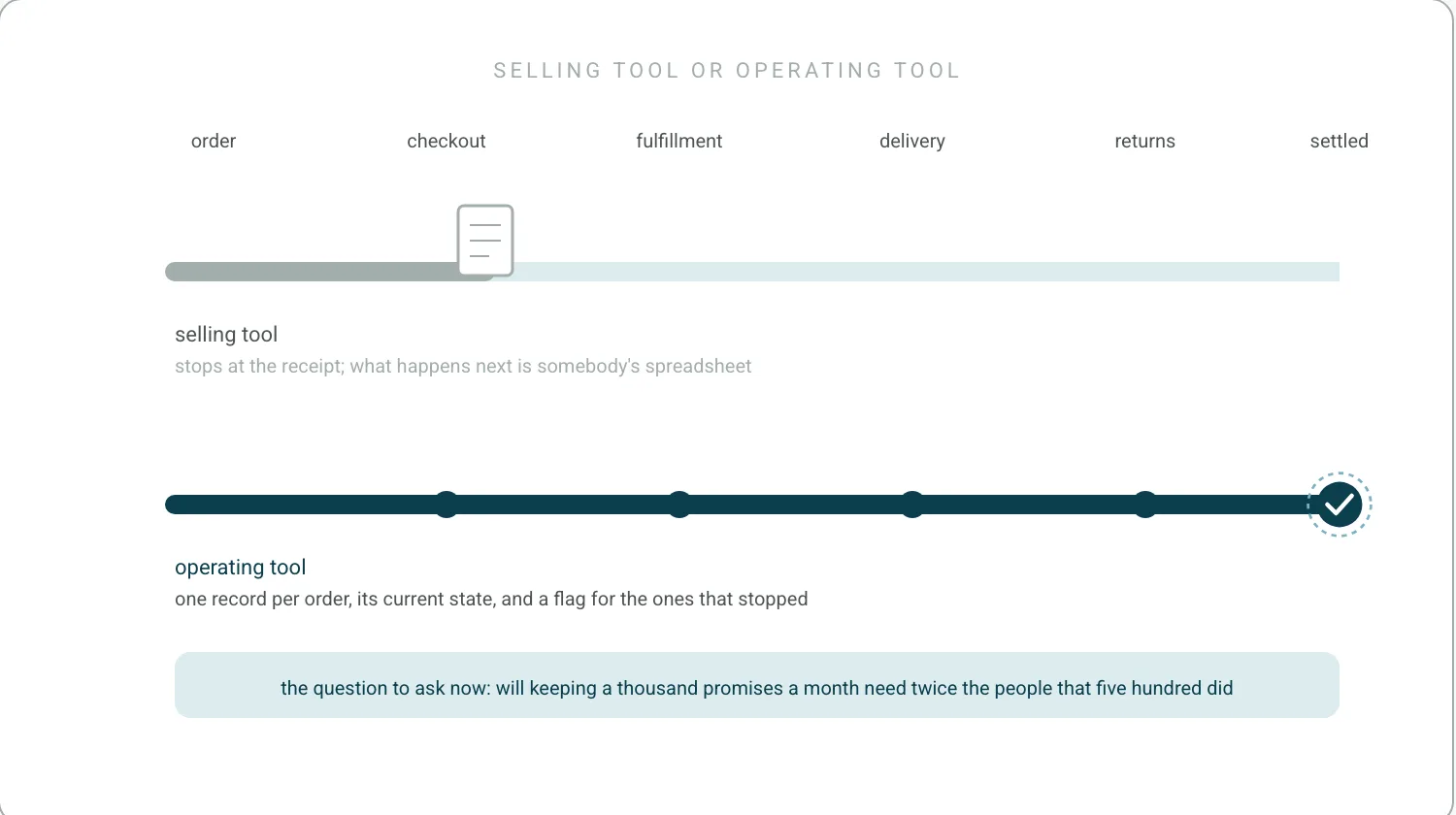
An online ordering system lets customers place orders through a digital channel and gives the business one place to receive, process, and track them. For a small business the practical scope is usually a storefront or ordering page, payment capture, an order record, and enough visibility to fulfill reliably. The distinction that matters when choosing one is whether it is a selling tool that stops at checkout, or an operating tool that also carries the order through fulfillment, delivery, and returns. What a storefront's own order record contains is public, in the Shopify Order resource for one platform, and it is a good way to see where the selling tool's job ends. The tier above it is an order management system for small business.
Order synchronization and inventory visibility
Synchronization keeps stock accurate wherever orders can arrive. For a business selling in one place this is trivial. It becomes the central problem the moment a second channel exists, whether a marketplace, a social channel, or a physical counter. The failure is overselling, and its cost is disproportionate for a small business because each disappointed customer is a larger share of the base. The properties worth checking are how often stock syncs, what happens when two channels sell the last unit at once, and whether the system reserves stock at order or at dispatch. Selling the same pool in more than one place is multichannel retailing, capturing orders from all of it consistently is order entry software, and the customer-facing failure is a cancellation or a split shipment.
The failure this prevents is not dramatic and it is the one that costs most. The biggest problem for small ecommerce teams is not that systems break, it is that nobody can see the fulfillment journey, so problems are discovered when a customer reaches out. Sync is worth getting right first for that reason rather than for tidiness: it is the only thing that makes an order's true state knowable without somebody checking. The daily method for doing that at small scale is how to keep track of orders for small business.
That is not a small-business quirk. In the 786 pain points we mined from 270 customer call transcripts between May 2025 and May 2026, every brand, whatever its size, described the period after the parcel leaves the warehouse as a black hole, and every one of them found out about a problem from the customer first.
Automated post-purchase workflows
The workflows that repay automation earliest are order confirmation, dispatch notification with tracking, and delivery confirmation, because they remove the highest-volume repetitive contact, most of which is WISMO. The tooling tiers for it are on free apps to keep track of customer orders. Beyond those, the next tier is the delay notice, which requires knowing an order is late against a stated date, and the returns acknowledgement. In the US that stated date is also a commitment under the FTC's Mail, Internet, or Telephone Order Merchandise Rule, which is worth knowing before promising two days. A small business can run these from its storefront's built-in notifications initially. The point at which that stops working is when orders begin failing in ways the notifications do not describe, since a confirmation that says an order shipped when it has not is worse than silence.
Streamlined returns and exchanges (RMA)
A return merchandise authorization process gives each return an identifier and a defined path: request, approval against policy, label, transit, receipt, inspection, and resolution. For a small business the value is less about labor saving than about consistency, since ad-hoc returns handled by email produce inconsistent decisions and lost items. The minimum workable version is a request form that captures the order and reason, a policy that resolves most cases without judgement, and a record of where each return is. Refund promptness matters more than process sophistication, and it has a legal floor as well as a service one in 16 CFR Part 435. The process in full is the RMA process.
Shipping and fulfillment integration
Integration means the order becomes a labeled parcel without re-keying, and the resulting tracking number returns to the order and the customer automatically. For small operations this is often a direct connection to one or two carriers or a shipping aggregator. The capabilities worth having early are address validation, which prevents failed deliveries, and tracking write-back, which prevents contact, and both depend on a carrier connection rather than on the storefront. Rate shopping matters more as volume grows, but promise accuracy matters immediately, since committing to a delivery date the chosen service cannot meet is the most common self-inflicted failure. Carriers publish what they will actually commit to, as USPS does with its service standards.
Customer support and ticketing alignment
Alignment means whoever answers customers can see the order without opening another system. In a small business this is frequently one person and a shared inbox, which works until volume or channel count grows. The transition point is usually marked by the same question being answered inconsistently or by contacts being missed across channels. The practical requirement at any size is that the person answering can see order status, fulfillment state, and tracking in one view, because the alternative is answering from memory or from the customer's account. At larger scale that view is a helpdesk connected to the order, and the self-serve version is customer order tracking.
Scalability and reliability
Scalability here is less about traffic than about the number of things that can go wrong at once. A system that works at twenty orders a day can fail at two hundred, not because it cannot process them but because exceptions that were individually noticeable become a queue nobody is watching. The signals that a business has reached that point are spreadsheets used to track problem orders, recurring manual checks each morning, and customers reporting problems the business had not detected, which is reactive rather than proactive customer service. Those are operational thresholds rather than volume thresholds, and they arrive at different order counts for different businesses.
Scalability in this category is usually sold as uptime and it should be read as headcount. What happens to most growing operations is that more volume, more channels and longer fulfillment paths demand more manual coordination, so the business scales by adding people to hold the systems together. That works until it does not, and it is the most expensive way to grow. Every order is a promise, and the question to ask of any system you are choosing now is whether keeping a thousand promises a month will need twice the people that keeping five hundred did. I have argued that scaling test on Add To Cart. What the answer looks like at the next size up is ecommerce application and post-purchase operations.
Frequently Asked Questions
What is the best online ordering system for small businesses?
There is no single answer, and the distinction that matters when choosing is whether the system is a selling tool that stops at checkout or an operating tool that also carries the order through fulfillment, delivery and returns. The second costs more and is the one that stops you scaling by adding people.
Is there a free online ordering system available?
Free tiers exist and are usually capped on order or shipment volume, which is the product decision rather than the feature list. What free rarely covers is detecting an order that has stopped progressing, since that is continuous work rather than a webhook. Where free stops for order tracking specifically is on free apps to keep track of customer orders.
What is a good app for small businesses to manage orders?
Judge it on synchronization first. If a business sells in one place this is trivial, and it becomes the central problem the moment a second channel exists, because the failure is overselling and its cost is disproportionate when each disappointed customer is a larger share of the base.
References
- Shopify. Shopify Order resource. Where a selling tool's order record stops.
- US Federal Trade Commission. FTC's Mail, Internet, or Telephone Order Merchandise Rule. The stated delivery date as a commitment.
- US Electronic Code of Federal Regulations. 16 CFR Part 435. The refund floor under a small operation's returns policy.
- United States Postal Service. USPS does with its service standards. What a carrier will actually commit to, before promising two days.
Ready to Stop Reacting?
The fastest way to see how Keeyu prevents complaints is to see it in action.
In one call, we’ll map your current operations, show how our AI Agent fits in, and walk through real examples of issues fixed before customers notice.
Most teams go live within 48 hours. We never share your data.

