
Free apps to keep track of customer orders
 Verified & Reviewed


 Copy Link
A free order-tracking app aggregates order and shipment status from a storefront and one or more carriers into a single view, and usually adds a customer-facing lookup page. Free tiers in this category are almost always capped on shipment volume per month, and the cap is the product decision rather than the feature list. What separates the tiers is rarely visibility, which is cheap to provide, but action: the ability to write back to the order, to reach systems past the storefront, and to detect a shipment that has stopped moving. The distinction between reading state and changing it is the safe-versus-unsafe method split in RFC 9110, and it is worth asking a vendor in those terms. The paid category is order tracking software and the method for a small team is how to keep track of orders for small business.
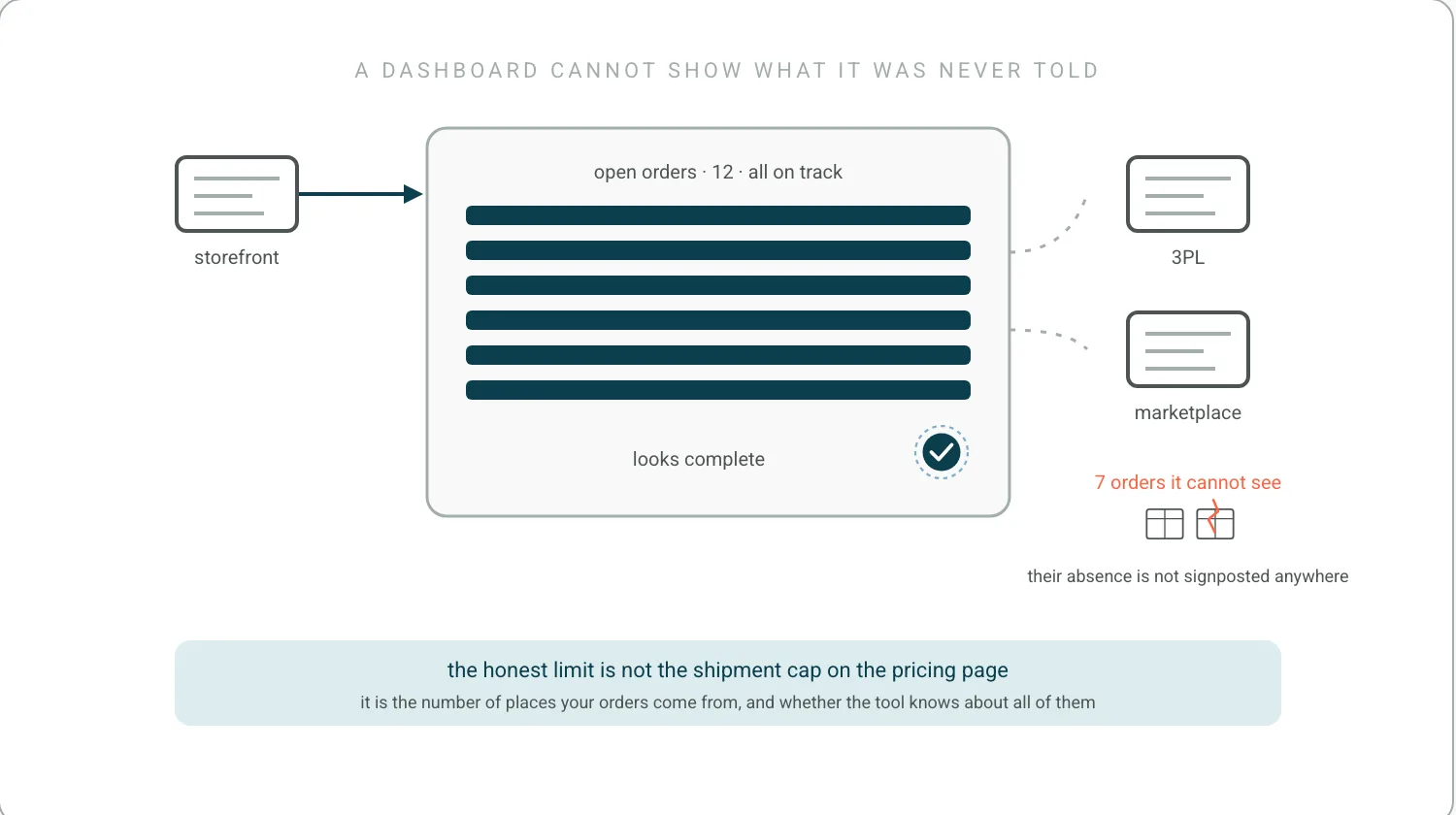
A dashboard cannot show the orders it was never told about
Operational visibility means one screen that shows the current state of every open order, sourced from the storefront and from the carriers rather than from a person checking tabs. The useful version sorts by exception rather than by date, so that the orders needing attention surface without a search. Free tools generally deliver this well for a single sales channel and a small carrier set, because both are read-only integrations that any vendor can support cheaply. What a storefront connector actually exposes is public, in the Shopify Order resource for one platform, which is a useful way to see where a free tier's data ends. The coverage gap appears with a second channel, a marketplace, or a warehouse that reports separately, since orders from an unconnected source are invisible on the dashboard and their absence is not signposted anywhere.
The coverage gap in that last sentence is the one that ends up costing money, and it is invisible by design. A dashboard fed by one channel looks complete, because a dashboard cannot show you the orders it was never told about. That is the reason a free tool's honest limit is not the shipment cap on the pricing page. It is the number of places your orders come from, and whether the tool knows about all of them. Running more than one is an online ordering system for small business once the volume justifies it, and multichannel retailing once it really does.
The unconnected source is usually the fulfillment provider. In the 786 pain points we mined from 270 customer call transcripts between May 2025 and May 2026, a lack of direct 3PL data access was a recurring entry, and its effect was the same every time: the merchant was left in a reactive posture, waiting for a customer to report the issue, because the one system that knew the order had not shipped was the one the dashboard could not see.
A lookup page answers where the order is and cannot change it
A customer-facing lookup page lets a buyer check their own order using an order number and an email address, which removes a class of contact entirely. Hosting the page on the merchant's own domain matters more than it appears, because a link out to a carrier site hands the customer to a third party at the moment they are most anxious and offers them no next action. Free tiers usually include a lookup page with the vendor's branding, and charge for removing it. The functional limit is the same on every tier: a lookup page answers where the order is and cannot do anything about where it is. The customer-facing version done properly is customer order tracking, and the wider deflection layer is customer self-service.
Noticing that nothing arrived is where free stops
Exception alerting is the feature that most reliably separates free from paid in this category. A carrier-reported exception, such as a failed delivery attempt or a customs hold, arrives as an event and is cheap to relay, since it is already in the feed, as the USPS Track and Confirm API shows. The costlier case is a shipment that has stopped scanning, which produces no event at all and has to be inferred by comparing elapsed time against the expected transit time for that lane. Inference requires the vendor to hold lane-level transit baselines and to run a scheduled check against every open shipment, which is ongoing compute rather than a webhook. The baselines themselves are published by some carriers, including the USPS service standards, and reconciling several carriers' versions is carrier integration work. That is why stalled-shipment detection is usually the first thing behind a paywall.
This is the line where free stops, and it is worth understanding why rather than assuming it is a paywall decision. Relaying a carrier's exception is cheap: the event arrives, the tool forwards it. Noticing that nothing has arrived is not, because there is no event to react to and something has to keep checking every open shipment against what should have happened by now. That is continuous work rather than a webhook, and it is why the orders that generate the most support contact are the ones a free tier is least likely to catch. Every order is a promise, and a tool that only reports what the carrier tells it can only report on promises that are still on track. That is the argument I made on Add To Cart, and the operating model behind it is proactive customer service.
Three kinds of free, and the honest comparison is against manual hours
Free in this category takes three forms and they behave differently. A permanently free tier capped on monthly shipments works until the cap, then either stops or converts. A free trial gives full capability for a fixed window, which is useful for proving the case and useless as a steady state. An open-source or spreadsheet-based approach has no license cost and real maintenance cost, which is a budget line in hours rather than dollars. The honest comparison is against the cost of the manual work being replaced, since a tool that saves a few hours a week justifies a small paid tier on the first month, while a tool that saves twenty minutes does not justify the setup either way. The same threshold rule, applied to automation generally, is on automation examples in real life.
Minutes for read-only, longer for anything that writes
Setup time in this category is short for the read-only case and long for anything else. Connecting a storefront and a carrier through an app store install is typically a few minutes and requires no developer, because both sides publish standard connectors. Time extends when the deployment needs a second channel, a warehouse or third-party logistics feed, or a custom event, since those usually involve credentials someone else holds and a data format that is specific to that provider. A practical test before committing is to install, connect one channel, and run a deliberately broken order through it, which reveals the coverage and latency limits faster than the documentation does. The same test, applied to a whole stack, is on third-party integrations, and what the orders it uncovers are costing is post-purchase operations.
Frequently Asked Questions
What is the best free app for keeping track of orders?
This page does not rank apps, and the honest guidance is about where free stops rather than which logo to pick. Free tiers deliver read-only visibility well for a single channel and a small carrier set. What sits behind the paywall is usually stalled-shipment detection, because inferring that nothing has arrived is continuous work rather than a webhook.
What is a good free program to keep track of clients?
A spreadsheet, honestly, at low volume. It holds the customer, the order, the channel, the ship date and the state, and it fails when two people edit it or when the channel count rises. The tier above it connects the storefront and the carriers automatically, and the method for running either is on how to keep track of orders for small business.
What is the best app to record customer orders?
The useful question is not which app but how many places your orders come from, because a dashboard fed by one channel looks complete and cannot show you the orders it was never told about. Check the source coverage before the feature list, and run a deliberately broken order through whatever you install.
References
- IETF. RFC 9110. Reading state against changing it, which is what the tiers actually split on.
- Shopify. Shopify Order resource. Where a free tier's storefront data ends.
- United States Postal Service. USPS Track and Confirm API. A carrier exception arriving as an event, and so being cheap to relay.
- United States Postal Service. USPS service standards. The lane baselines stalled-shipment inference needs.
Ready to Stop Reacting?
The fastest way to see how Keeyu prevents complaints is to see it in action.
In one call, we’ll map your current operations, show how our AI Agent fits in, and walk through real examples of issues fixed before customers notice.
Most teams go live within 48 hours. We never share your data.

