
Order fulfillment software: what to buy, and what it won't catch
 Verified & Reviewed


 Copy Link
Order fulfillment software automates the steps between "order placed" and "order shipped": syncing inventory across sales channels, routing each order to the right warehouse or 3PL, generating pick lists and labels, and pushing tracking back to the storefront. It is how a growing brand escapes spreadsheet fulfillment. My advice is to buy it, and know exactly where it stops. It was at P.E. Nation that I saw clearly how brands rely on the shopper to tell them there is a problem with everything after the buy button, and good fulfillment software does not change that. Every order is a promise. Keeyu keeps it. The best service is finding the reason something went wrong and fixing it before the shopper even knows, and that is the part fulfillment software was never built to do. That gap is what proactive e-commerce operations, the system of action for e-commerce, exists to close.
The feature checklist that actually matters
- Inventory synchronization across every channel. Shopify, marketplaces, retail. One stock truth, or you will oversell. This is the feature to test hardest in a trial, with your messiest SKUs, bundles included.
- Automated order routing. The right order to the right warehouse, 3PL, or dropshipper without a human touching it.
- Carrier and system integrations. It must speak to your ERP, your warehouse, and your carriers, or your team becomes the integration.
- Real-time status back to the store. Fulfillment data that reaches the customer-facing side, covered on the order tracking software page.
- Split-order logic. How the tool decides to ship an order in pieces, and what that costs you: see split shipments.
- Exception handling. The forgotten line item, and the reason this page has a second half.
Add a commercial item to the checklist: who will put their own money behind the result? For our first hundred customers we present an ROI as part of the business case and if we have not delivered it inside twelve months, months thirteen and fourteen are free, which I described on Marketing for SMEs. This industry promises the world routinely. A guarantee is the cheapest test of who means it.
What silent failure looks like
Keeyu exists because of a warehouse sale at P.E. Nation in 2020, a night I told the long version of on Founders in Motion. Volumes went through the roof, the storefront stopped syncing orders with the warehouse, and it kept taking orders for stock that had already sold out. We were high-fiving over the revenue. When the dust settled two or three days later, about a thousand shoppers had paid for something we could not give them, and nothing in the stack had told us. Years later the pattern repeated at EHP Labs, one of the sharpest operations teams we know: the breaking point came after a major sale, when the team spent days digging out of a backlog that customers had flagged before they did. Both brands had systems moving orders to the warehouse. Neither had anything watching the orders the tooling quietly dropped. The failure class is consistent: the order that never syncs from the storefront, the bundle that allocates two components out of three, the batch that sits behind a stockout while its ship-by promise expires. Fulfillment software processes what flows through it. It does not notice what stopped flowing. The mechanism is almost always the same: the chain of integrations between storefront, ERP, WMS, and downstream tools fails silently and intermittently, and orders get stuck in the gaps. For the definitional ground this page builds on, start at the fulfillment page.
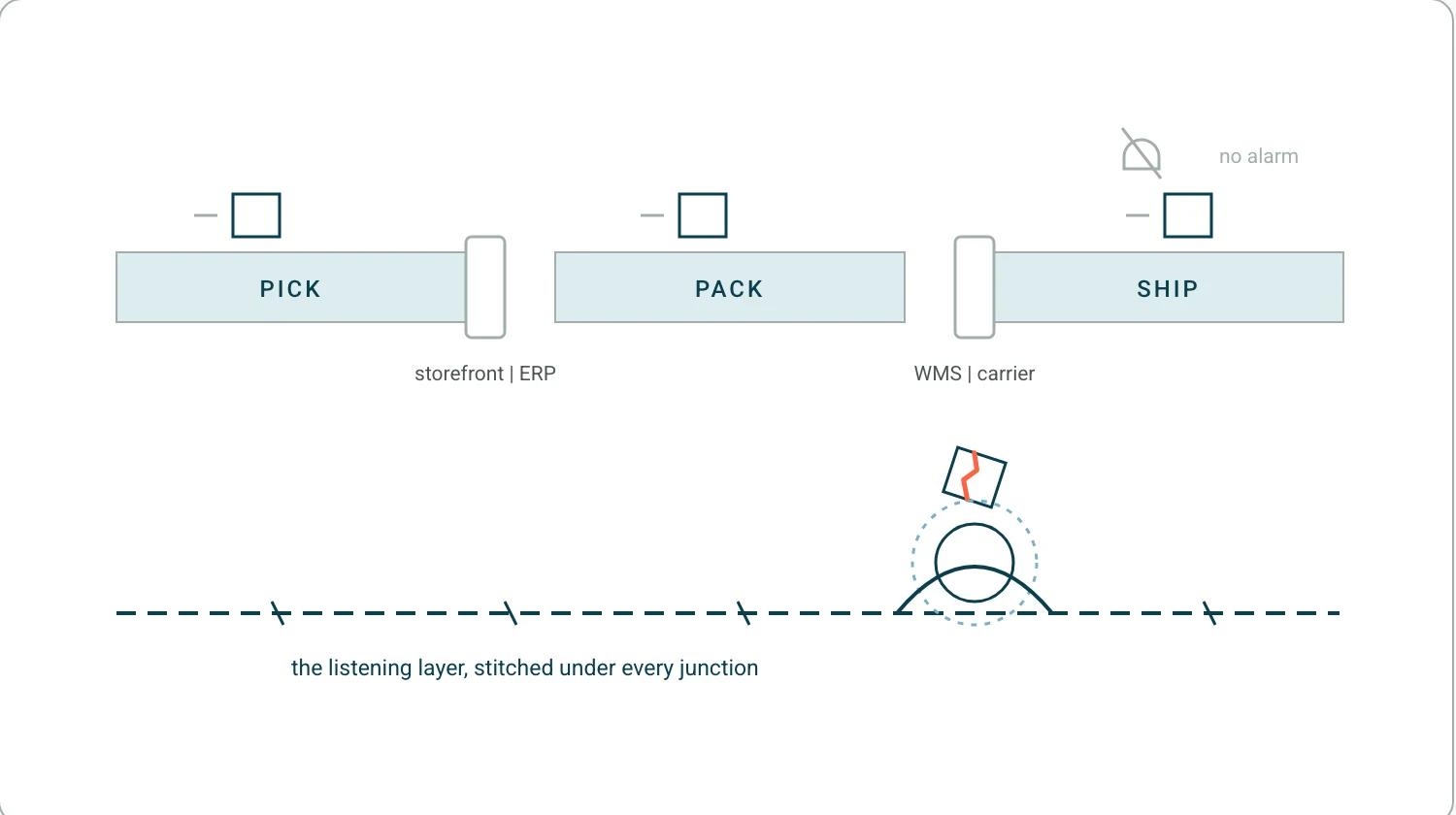
Silent is the operative word. Each point solution performs its function and none of them is built to detect that an order will miss its promise, so nothing raises a hand and the first notification you get is a shopper asking where their order is. I put it that way on Marketing for SMEs. By then your team is looking for the break in five systems while the customer waits.
Where the break usually is, from the 786 pain points we mined from 270 customer call transcripts between May 2025 and May 2026: orders stuck in middleware such as Boomi or Cin7, partial fulfillments that disagreed from one system to the next, and integrations that broke during an ERP migration. In every one of those entries the fulfillment software had done its job on the orders it could see.
Before you blame the carrier for a late order, work upstream, which is the misconception I picked apart on The Breakout CEO. Is your Shopify syncing correctly? Is your inventory allocated correctly? Are your styles loaded correctly? Is the payment system working? Is the warehouse shipping on time? Fulfillment software answers the last question at best. The other four are system, process and people failures that happen before a carrier ever touches the parcel.
Comparing providers: fit by volume and mess
The honest comparison question is not "which tool is best" but "which tool matches your volume and your mess." A low-SKU Shopify brand needs little more than the platform's native fulfillment plus a decent 3PL. Multi-channel brands with bundles, pre-orders, and dropshippers need real routing logic. At EHP Labs the hard cases were exactly the messy ones: bundle errors, partial shipments, and stockouts, which is why the fix there was not another fulfillment tool but a system that breaks bundles down, maps line items, flags the problem, and suggests the fix. Evaluate any candidate against your ugliest recurring order, not the demo's clean one, and check it against the wider order management software landscape rather than in isolation. And weigh pricing against the labor it genuinely removes: per-order fees look small until you multiply them by the manual exception-handling they still leave on your team's desk.
Ask each provider what happens when your stack is not on their list. On Add To Cart I said we had built 50 plus integrations, each one systemized so we can bring a brand on fast, finding the data through APIs, webhooks and even FTP. The comparison that matters is not the logo wall. It is what the timeline looks like when your ERP is the one they have never connected. We scored the fulfillment tools side by side, Keeyu included, in our ranking of order fulfillment software.
The layer fulfillment software is missing
Whatever you buy, the stack ends up as storefront, payments, fulfillment software, warehouse or 3PL, carriers, and the returns management layer behind them. Each system knows its own slice. Nobody is accountable for the promise that spans all of them. Keeyu connects every system from order placement through processing, picking, packing, shipping, delivery, and returns, and proactively identifies the operational issues upstream that become tickets, before the customer notices. Detect. Decide. Act. Keeyu gets shoppers what they want, on time, as promised. That is not a replacement for your fulfillment software. It is the layer that hears what your fulfillment software cannot: the silence of an order that stopped moving. We prove it on your own orders, with a paid proof of concept and a double money-back guarantee in the first 30 days. See it against your stack in a demo, or read how the whole discipline fits together on the post-purchase operations hub. Every order is a promise. Keeyu keeps it.
Frequently Asked Questions
What is order fulfillment software?
Software that automates the steps between an order being placed and shipped - syncing inventory across channels, routing orders to the right warehouse or 3PL, printing labels, and pushing tracking back to the store and the customer.
What features matter most in order fulfillment software?
Inventory synchronization across every sales channel, automated order routing, carrier and 3PL integrations, real-time status visibility, and exception handling. The last one is the most overlooked and the most expensive to live without.
How is order fulfillment software different from an OMS or WMS?
A WMS runs the warehouse floor, an OMS orchestrates orders across channels and locations, and fulfillment software is often a slice of both focused on pick, pack, and ship. Mid-size brands frequently run all three plus a 3PL, which is exactly where the gaps open.
Does fulfillment software prevent shipping delays?
It prevents the delays caused by manual processing. It does not catch the silent failures - the order that never syncs, the bundle that half-allocates, the batch stuck behind a stockout. Those need something watching every order against its promise.
References
- Keeyu customer results (EHP Labs): keeyu.com/customer-stories
- Marketing for SMEs, Jevon Le Roux on the E-Commerce Mistake Costing Millions - the orchestration layer, and the 55% ticket cut at EHP Labs.
- Add To Cart #578, Stop Customer Problems Before They Start: Inside Keeyu's AI Ops - stuck returns, failed payments and orders caught mid-flight.
- The Breakout CEO #86, The Pivot This Founder Made After an Investor Called It Impossible - one in five US shoppers not getting orders on time, and the ticket ratios behind it.
Keep the promise.
See how Keeyu catches and fixes post-purchase issues before customers notice.
In one call, we’ll map your operations and show how Keeyu detects issues, decides what needs to happen, and takes action across your existing systems.
We’ll confirm your integration requirements and rollout plan during the demo.
