
What does order fulfilled mean, and when is it lying to you
 Verified & Reviewed


 Copy Link
"Order fulfilled" means the merchant's side of the job is done: the items were allocated, picked, packed, and handed to the delivery process, usually with tracking assigned. In Shopify and most platforms it is the status that fires the shipping confirmation email, and the platform is explicit about the grain: its API models fulfillment status per fulfillment, not per delivery. In some businesses I talk to, order fulfillment runs on its own and customer service sits downstream, so nobody sees what is coming and they only find out when there is a complaint. That is the reason this page exists: fulfilled is a system's claim about a handoff, not a kept promise. Every order is a promise. Keeyu keeps it, and the word "fulfilled" has a way of ending a team's attention exactly when the promise is still in flight. Treating statuses as outcomes is the reactive habit that proactive e-commerce operations, the system of action for e-commerce, was built to break.
Fulfilled, shipped, delivered: three parties, three claims
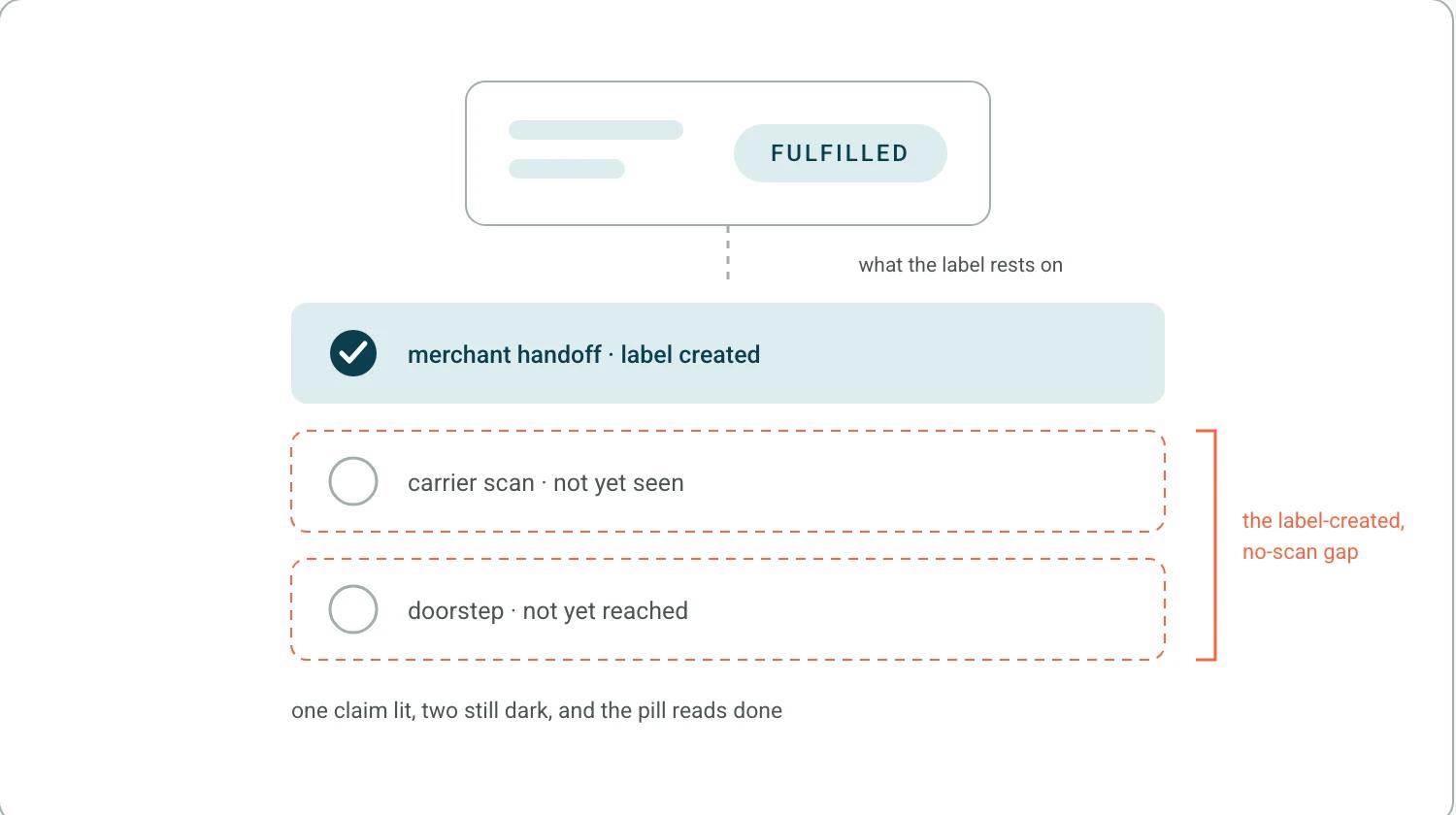
Standardize the vocabulary for your team, because these words carry decisions. Fulfilled is the merchant's claim: we processed it and handed it off. Shipped is the carrier's claim: we scanned it and it is in our network. Delivered is the carrier's claim about the doorstep. They are sequential in the happy case and contradictory in the interesting ones: a label created with no scan is fulfilled-but-not-shipped, and that gap is where orders quietly die. Write your customer-facing emails against the customer's meaning, not the system's: your shopper reads "fulfilled" as "on its way," so only say it when a carrier scan backs it up. On a call with a large marketplace retailer, I pointed to the gap between a seller saying an item has shipped and the first carrier scan as one of the two big visibility gaps where SLAs break unseen. The stage-by-stage mechanics live on the fulfillment page.
The three claims drift furthest apart under load. During Black Friday an order that normally leaves the warehouse inside twenty-four hours can stretch to seven days, or the stock is not where the system believed it was. Nothing about the fulfilled flag changes in that week. Everything about what it means does. As I said on Add To Cart, the storefront, the WMS and the carrier tool each do their own job well, but none of them is designed to detect an order that has not pushed through or is held up. So we take the checkout promise and work backwards along every touch point to see whether the order is where it should be by now.
The edge cases where the status lies
The definition is easy. Operations run on the exceptions.
- Partial fulfillment. Two of three items ship, the third waits on stock. Some brands refuse to part-ship at all: I picked up this complexity with an Australian online pharmacy, which holds orders rather than partially fulfilling, sometimes waiting on same-day supplier stock, which turns one order into multiple deliveries a day to manage. Neither policy is wrong. Both create statuses that need watching per line item, not per order.
- Marketplace and dropship fulfillment. A New Zealand omnichannel retailer we work with runs a marketplace managed entirely by drop shippers, so "fulfilled" is a claim made by independent suppliers. Your platform shows one status. The truth is federated across parties you do not operate.
- Returned but not resolved. The mirror case on the reverse leg, where a parcel is back with you and the refund has not moved. The RMA process page covers that grain.
- Fulfilled, never scanned. The classic silent failure. The label exists, the confirmation email went out, and the parcel is sitting on a bench. Nothing in the stack alarms, because every system did its job.
There are more ways for the status to be wrong than most teams count. We monitor around eighty points of failure across the post-purchase journey, a number I gave on eCommerce Australia, and a fulfilled flag can be sitting on top of any of them: an unsynced warehouse, a partial pick, a label printed but never manifested, a parcel sitting on a dock. The status is a claim by one system. The truth is the agreement of several.
Troubleshooting "fulfilled but not received"
Work the handoffs in order, against the wider status vocabulary on the order management process page. Was there ever a carrier scan after the label? No scan means the failure is between packing bench and carrier pickup, so check the manifest and the pickup, not the tracking page. This is what order-level truth should look like: live in production you double-click the order and it tells you, unfulfilled because of the stockout, or unfulfilled because processing is running behind a backlog. Scan but no movement past a threshold? Treat it as lost and act, rather than watching it. Partial fulfillment? Find which line item is holding, because the customer's complaint is about the whole order. The deeper answer is to stop running this checklist by hand per ticket. An order passes through a chain of systems on its way to the shopper: order placement, payment, processing, pick, pack, ship, deliver, and return. Any one of them can be where "fulfilled" lies, and a team that has to manually check each system per inquiry is a team that finds out from the customer. It is the gap I described on Add To Cart: every tool in that chain can be doing its own job while the order itself is held up between them. Our founding team lived this from the operator's chair, running ops at SurfStitch, P.E. Nation, and Sportscraft, which is why Keeyu tracks every order against its checkout promise across all of those systems and flags the fulfilled-but-stalled order before the shopper writes in. Keeyu gets shoppers what they want, on time, as promised. The tooling for the visibility layer is on the order tracking software page, the wider discipline on the post-purchase operations hub, and the live version on a demo. Every order is a promise. Keeyu keeps it, including the ones marked fulfilled.
The trigger we use is time between stages rather than a status. When an order has not moved for longer than that leg normally takes, we treat it as lost and start the recovery instead of waiting for proof, which is the rule I walked through on Add To Cart. Fulfilled but not received is that condition wearing a green label.
Two shapes of it recur in the 786 pain points we mined from 270 customer call transcripts between May 2025 and May 2026. A carrier picks up a batch and the parcels vanish with no tracking at all, so the fulfilled flag is the last thing any system ever records about them. And a 3PL quietly prioritizes new orders over the backlog, so a fulfilled order sits unshipped while newer ones leave, and nobody notices until the customer does.
Frequently Asked Questions
What does "order fulfilled" mean in Shopify?
The order's items have been marked as processed and handed to the delivery process, usually with tracking assigned. It means the merchant's side is done. It does not mean the parcel has moved, arrived, or will arrive on time.
What is the difference between fulfilled, shipped, and delivered?
Fulfilled means the merchant processed the order and handed it off. Shipped means the carrier has taken it and scanned it. Delivered means the carrier says it reached the customer. Each is a different party's claim, and they disagree more often than teams expect.
Why does my order say fulfilled but the customer has not received it?
Because fulfilled describes the merchant's handoff, not the delivery. Common causes: a label was created but the parcel never got a carrier scan, the shipment stalled in transit, or one item of a partial fulfillment is still waiting on stock.
What is partial fulfillment?
Some items in an order have been processed and shipped while others are still waiting, usually on stock or a second supplier. The order shows part-fulfilled, and each unshipped line is a separate promise still at risk.
References
- Keeyu customer results: keeyu.com/customer-stories
- The Breakout CEO #86, The Pivot This Founder Made After an Investor Called It Impossible - one in five US shoppers not getting orders on time, and the ticket ratios behind it.
- Add To Cart #599, How to Prevent "Where is my Order?" Complaints Before Customers Ask - preventing "where is my order" before the customer asks.
- Marketing for SMEs, Jevon Le Roux on the E-Commerce Mistake Costing Millions - the orchestration layer, and the 55% ticket cut at EHP Labs.
Keep the promise.
See how Keeyu catches and fixes post-purchase issues before customers notice.
In one call, we’ll map your operations and show how Keeyu detects issues, decides what needs to happen, and takes action across your existing systems.
We’ll confirm your integration requirements and rollout plan during the demo.
